

ANDA: What It Means for Generic Drugs and Your Prescription Savings
When you pick up a generic pill at the pharmacy, chances are it was approved through an ANDA, Abbreviated New Drug Application, the FDA’s official process for approving generic versions of brand-name medications. Also known as Abbreviated New Drug Application, it’s the reason your $50 brand-name drug now costs $6—and still works just as well. This isn’t a loophole. It’s a science-backed system designed to cut costs without cutting safety.
ANDA doesn’t require repeating expensive clinical trials. Instead, it proves the generic matches the brand in bioequivalence—meaning it releases the same amount of active ingredient at the same rate in your body. The FDA checks this using dissolution profiles, pH testing, and statistical models like the f2 similarity factor. If the generic passes, it’s approved. No guesswork. No compromises. That’s why a generic metformin tablet from 2020 works the same as one from 2024. The system is built to be consistent.
But ANDA doesn’t just affect price. It connects to bigger issues like NTI drugs, narrow therapeutic index medications like warfarin and levothyroxine, where even tiny differences in absorption can cause harm. That’s why 27 states restrict automatic generic swaps for these drugs—even though the FDA says they’re equivalent. It’s also why dissolution profile comparison, the method used to prove generics behave like brand drugs in the lab matters so much. If the dissolution doesn’t match, the drug won’t work the same in your body.
And it’s not just about pills. ANDA drives savings across Medicaid, Medicare, and out-of-pocket costs. In 2023 alone, FDA-approved generics saved the U.S. healthcare system $445 billion. That’s billions in copays avoided, especially for seniors and low-income patients who rely on these drugs daily. But that savings only works if the system stays trusted. When people worry that generics are "inferior," they’re often missing how tightly ANDA controls quality.
Behind every cheap generic is a stack of data—dissolution curves, bioavailability studies, manufacturing audits—all reviewed by the FDA. You don’t see it, but it’s there. That’s the power of ANDA. It turns complex science into simple savings. And it’s why you can trust a generic for high blood pressure, diabetes, or thyroid medication without second-guessing.
Below, you’ll find real-world guides on how generic drugs are tested, why some states block substitutions, how pricing is controlled, and what to watch for when switching brands. Whether you’re saving money, managing a chronic condition, or just trying to understand your prescription label, these posts break it down without the jargon.
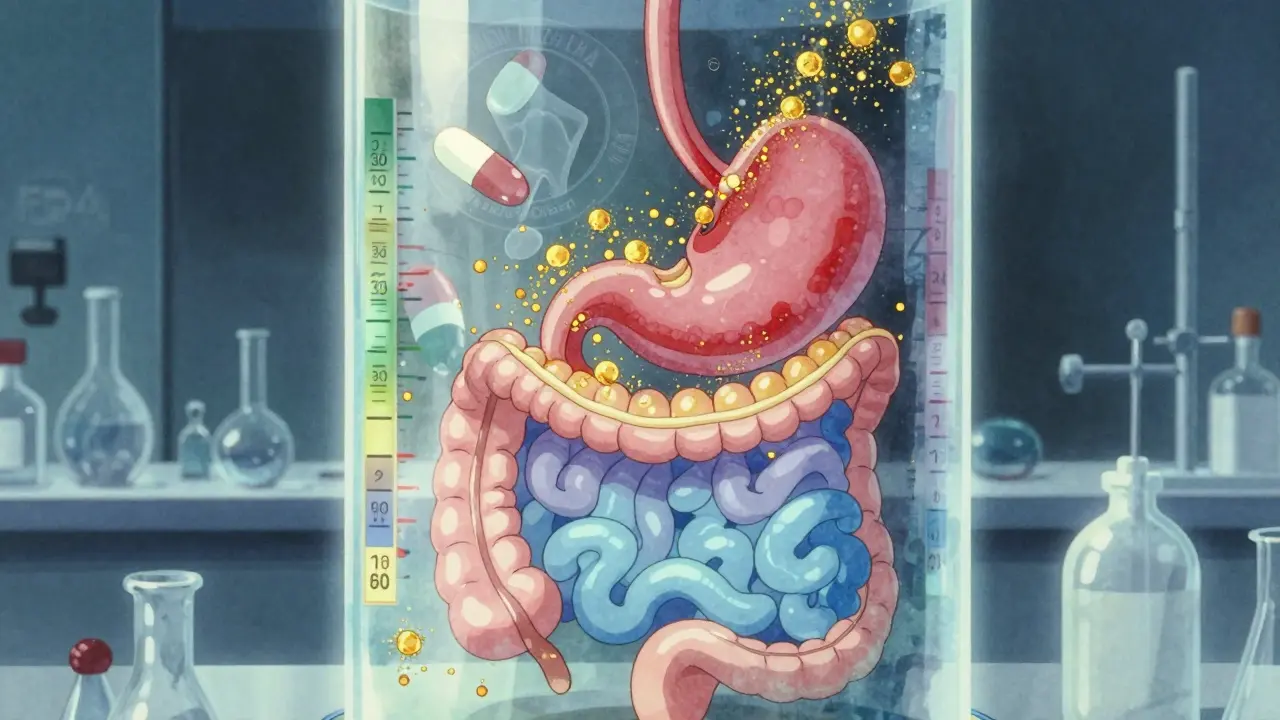
Dissolution Testing: How FDA Ensures Generic Drug Quality
The FDA uses dissolution testing to ensure generic drugs release active ingredients at the same rate as brand-name versions, avoiding costly human trials while guaranteeing therapeutic equivalence. This science-based method is key to safe, affordable generics.
Hatch-Waxman Amendments: How Landmark Law Made Generic Drugs Possible
The Hatch-Waxman Act of 1984 created the legal framework that made generic drugs possible in the U.S., balancing innovation incentives with affordable access. Today, 90% of prescriptions are filled with generics thanks to this landmark law.
Generic Drug Approval Standards: Safety, Quality, and Strength Requirements
Generic drugs must meet the same safety, strength, quality, and bioequivalence standards as brand-name drugs under FDA oversight. Learn how the ANDA process ensures generics are just as effective-and why complex formulations take longer to approve.