

The 80-125% Rule: Understanding Bioequivalence Confidence Intervals in Generic Drugs
 Jan, 27 2026
When you pick up a generic pill at the pharmacy, you expect it to work just like the brand-name version. But how do regulators know it’s truly the same? The answer lies in the 80-125% rule-a quiet but powerful standard that keeps millions of generic drugs safe and effective without requiring endless clinical trials.
What the 80-125% Rule Actually Means
The 80-125% rule isn’t about how much active ingredient is in the pill. It’s not saying your generic drug contains only 80% of the medicine found in the brand name. That’s a common misunderstanding. Instead, it’s about how your body absorbs and uses the drug.
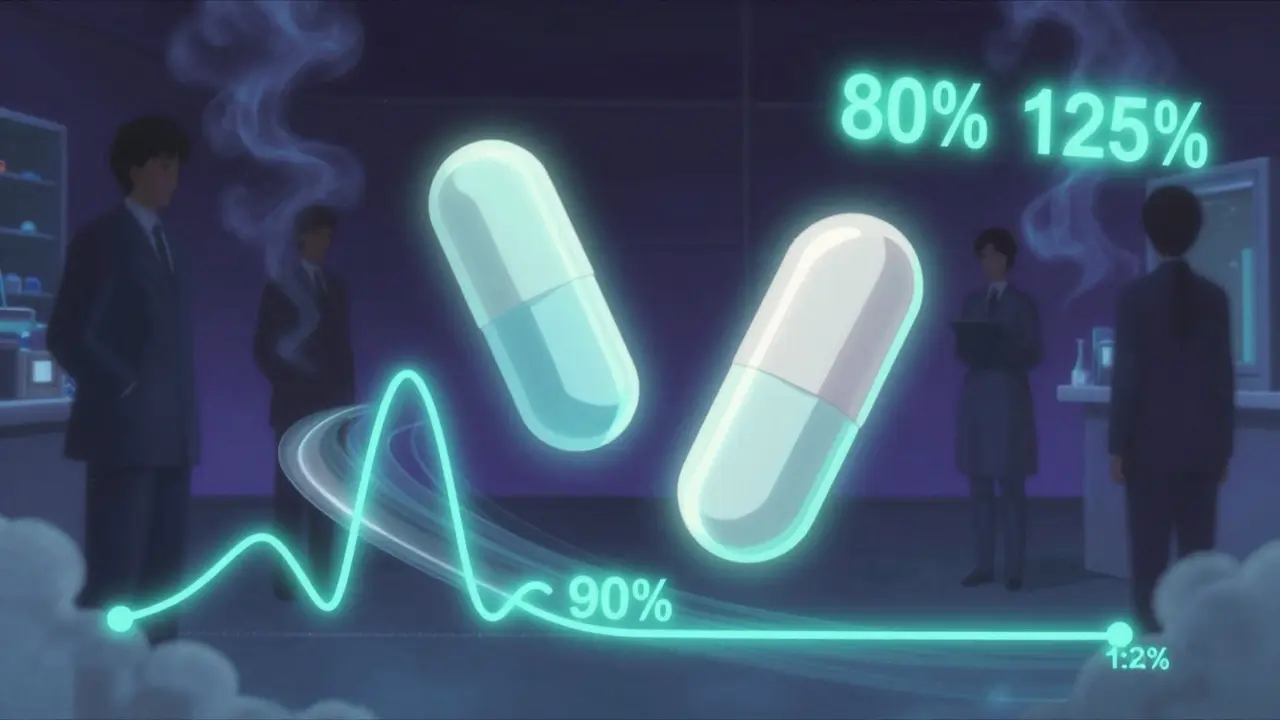
Regulators look at two key measurements: AUC (Area Under the Curve), which tells you how much of the drug enters your bloodstream over time, and Cmax (maximum concentration), which shows how fast it gets there. These numbers come from clinical studies where healthy volunteers take both the brand and generic versions. The data is then log-transformed because drug levels in the blood don’t follow a normal bell curve-they follow a log-normal pattern.
The rule requires that the 90% confidence interval of the ratio between the generic and brand drug’s geometric mean values for AUC and Cmax must fall entirely between 80% and 125%. If even one point of that interval dips below 80% or goes above 125%, the drugs aren’t considered bioequivalent. That’s it. No guesswork. No arbitrary thresholds. Just hard statistical evidence.
Why 90% Confidence Interval? Why Not 95%?
You might wonder why regulators use a 90% confidence interval instead of the more familiar 95%. It’s a deliberate choice. A 90% CI allows for a 5% error margin on each end-5% chance the true value is below 80%, and 5% chance it’s above 125%. That adds up to a 10% total risk of being wrong. That’s considered acceptable because the goal isn’t to prove absolute sameness-it’s to prove that any difference is too small to matter clinically.
Traditional hypothesis testing would fail here. Imagine two identical drugs. With a large enough sample size, even a 1% difference in AUC could be labeled "statistically significant"-even though it means nothing in real life. The confidence interval approach avoids that trap. It asks: "Is the difference big enough to worry about?" not "Is it different?"
Global Standard, Same Rules
The 80-125% rule isn’t just an American rule. It’s used by the FDA, the European Medicines Agency, the World Health Organization, Health Canada, and China’s National Medical Products Administration. That’s rare in global health regulation. This alignment means a generic drug approved in the U.S. can often be submitted for approval in Europe with minimal changes. It saves time, money, and speeds up access for patients worldwide.
This harmonization didn’t happen overnight. It came after years of debate in the 1980s, when experts realized the old ±20% additive rule didn’t work well with pharmacokinetic data. Switching to a multiplicative, log-transformed scale made the math fit the biology. The result? A standard that’s been in place for nearly 40 years-and still works.
When the Rule Doesn’t Fit
Not every drug plays nice with the 80-125% rule. Some drugs have a narrow therapeutic index-meaning even small changes in blood levels can cause serious side effects or treatment failure. Warfarin, levothyroxine, and certain anti-seizure drugs fall into this category. For these, regulators tighten the range to 90-111%. That’s a much stricter bar.
Then there are highly variable drugs. Some people’s bodies absorb them wildly differently than others. For drugs like cyclosporine or certain statins, the within-subject variability can exceed 30%. Applying the standard 80-125% range here would make it nearly impossible to prove bioequivalence-even if the drugs are clinically identical.
That’s where scaled average bioequivalence (SABE) comes in. The EMA and FDA allow regulators to expand the acceptance range-sometimes up to 69.84-143.19%-based on how much the reference drug varies from person to person. It’s not a loophole. It’s a smarter way to handle drugs that don’t behave predictably.
What the Rule Doesn’t Cover
Many people think the 80-125% rule guarantees that every generic is identical to the brand. But it doesn’t. It only confirms that the drug is absorbed at similar rates and levels. It says nothing about inactive ingredients-fillers, dyes, coatings, or release mechanisms.
That’s why some patients report differences when switching generics. A change in coating might make a pill dissolve slower in the stomach. A different filler might affect how well the drug dissolves in the gut. These aren’t bioequivalence failures-they’re formulation differences. The 80-125% rule doesn’t test for those. That’s why the FDA tracks post-market reports and sometimes updates labeling if problems arise.
According to FDA data from 2020, out of over 2,000 generic drugs approved between 2003 and 2016, only 0.34% required label changes due to bioequivalence concerns after they hit the market. Most issues reported by patients or doctors stem from non-bioequivalence factors-like inconsistent tablet hardness or poor dissolution in acidic environments.

Real-World Impact: Generics Save Billions
The 80-125% rule is the engine behind the $227 billion global generic drug market. In the U.S., generics make up 90% of all prescriptions filled-but only 23% of total drug spending. That’s billions saved every year for patients, insurers, and taxpayers.
Since the Hatch-Waxman Act of 1984, over 14,000 generic drugs have been approved in the U.S. alone. Without the 80-125% rule, each one would need expensive, large-scale clinical trials to prove effectiveness. That would delay access, raise prices, and block competition. The rule lets regulators rely on pharmacokinetic data from small, controlled studies instead.
It’s not perfect. Drug companies spend $2-5 million and 18-24 months on bioequivalence studies for each generic. But compared to the $1 billion and 10+ years it takes to bring a new brand drug to market, it’s a bargain.
Common Misconceptions
A 2022 survey by the American Pharmacists Association found that 63% of community pharmacists believed the 80-125% rule meant generic drugs contain 80-125% of the active ingredient. That’s wrong. The active ingredient in generics is tightly controlled-usually within 95-105% of the label claim, same as brand drugs.
Patients often worry when they hear "80%" and assume their medicine is weaker. Online forums are full of posts like, "My generic isn’t working like the brand." But post-marketing data tells a different story. In a 2022 survey of 412 neurologists, only 4% believed issues with generic anti-seizure drugs were due to bioequivalence failures. Most problems were linked to patient adherence, packaging confusion, or psychological factors-not the drug itself.
The Institute for Safe Medication Practices tracked over 1,200 reports of "therapeutic equivalence concerns" from 2015 to 2022. Only 17% were linked to bioequivalence issues. The rest? Packaging that looked too similar to another drug, confusing dosing instructions, or changes in tablet size that made patients think they were getting less medicine.
What’s Next?
The FDA is investing $15 million through 2027 to modernize bioequivalence standards. One big push is "model-informed bioequivalence," where computer simulations predict how a drug behaves in the body instead of relying solely on blood tests. This could cut study costs and time, especially for complex drugs like inhalers, injectables, or topical creams.
Another area of focus is narrow therapeutic index drugs. In 2022, the FDA proposed tighter limits (90-111%) for drugs like levothyroxine. That’s a direct response to real-world concerns-even if the 80-125% rule has worked well for decades.
Looking ahead, pharmacogenomics might change the game. If your genes make you a fast or slow metabolizer of a drug, should bioequivalence standards be personalized? That’s still theoretical-but research is moving in that direction.
For now, the 80-125% rule remains the gold standard. It’s not based on perfect science. It was chosen because it works. After 40 years, millions of patients, and thousands of approved generics, it’s still the most reliable way to ensure that a $5 generic pill does the same job as a $50 brand-name one.
Is the 80-125% rule about how much active ingredient is in a generic drug?
No. The 80-125% rule does not refer to the amount of active pharmaceutical ingredient (API) in the tablet. Generic drugs must contain the same amount of active ingredient as the brand name-typically within 95-105% of the labeled amount. The rule applies to the 90% confidence interval of the ratio of geometric means for pharmacokinetic parameters (AUC and Cmax) measured in clinical studies, not the content of the pill.
Why is a 90% confidence interval used instead of a 95% one?
A 90% confidence interval is used because it allows a 5% error margin on each side (total 10% risk), which regulators have determined is acceptable for bioequivalence. Using a 95% CI would make it harder to demonstrate equivalence, even when differences are clinically insignificant. The 90% CI balances statistical rigor with practical relevance.
Do all generic drugs need to meet the 80-125% rule?
Most do-but not all. Immediate-release solid oral dosage forms are the most common. For highly variable drugs, regulators may use scaled average bioequivalence (SABE), which allows a wider range. For narrow therapeutic index drugs like warfarin or levothyroxine, the range is tightened to 90-111%. Some complex products, like inhalers or topical creams, may require different approaches entirely.
Can a generic drug fail bioequivalence even if it’s made by the same company as the brand?
Yes. Even if the same manufacturer produces both the brand and generic versions, differences in manufacturing processes, excipients, or tablet formulation can affect absorption. Bioequivalence is tested head-to-head, regardless of who makes it. A brand-name company’s generic version must still meet the 80-125% rule to be approved.
Why do some patients say their generic doesn’t work as well?
Most reports of reduced effectiveness aren’t due to bioequivalence failures. They’re often caused by differences in inactive ingredients, tablet size, taste, or patient expectations. Psychological factors, inconsistent dosing schedules, or confusion between similar-looking generics can also play a role. Post-market surveillance shows that fewer than 2% of reported issues are linked to actual pharmacokinetic differences.
Is the 80-125% rule based on solid scientific evidence?
The 80-125% range was originally chosen based on expert judgment in the 1980s, not clinical trials. But decades of real-world data have since validated it. Studies show that generic drugs approved under this rule have no meaningful differences in therapeutic outcomes across hundreds of drug classes. It’s a practical standard that’s stood the test of time.
Ambrose Curtis
January 29, 2026 AT 09:42man i used to think generics were just cheap knockoffs until i read this. the 80-125% thing is wild-it’s not about how much drug is in the pill, it’s about how your body handles it. i’ve been on generic levothyroxine for years and never had an issue, but now i get why some people freak out when the pill looks different.
Katie Mccreary
January 30, 2026 AT 16:10lol so the FDA just picked 80-125% out of thin air? sounds like a corporate compromise to let pharma off the hook.
doug b
January 31, 2026 AT 08:56the fact that this rule is used globally is insane. most countries can’t even agree on which side of the road to drive on, but they all use the same math to make sure your blood pressure med works. that’s actually kinda beautiful.
matthew martin
January 31, 2026 AT 12:18the SABE thing for highly variable drugs is genius. imagine if we applied that to coffee-some people need 3 shots to feel awake, others get jittery from a sniff. why should drug math be any different? the system’s smart enough to know not all bodies are built the same.
Mel MJPS
February 2, 2026 AT 08:30i’ve had patients cry because their generic antidepressant ‘didn’t feel right.’ it’s never the drug-it’s the color, the shape, the little ‘A’ on it instead of ‘B.’ our brains are weird. we need the same pill to feel safe. the science doesn’t care, but people do.
Rhiannon Bosse
February 3, 2026 AT 09:24oh so the 80-125% rule is just a fancy way to let big pharma sell generics made in China while pretending they’re ‘safe’? 🤡
Rose Palmer
February 4, 2026 AT 18:40the 90% confidence interval is statistically sound and pragmatically aligned with clinical relevance. the 95% threshold would introduce unnecessary conservatism, potentially delaying access to affordable therapeutics without meaningful safety benefit.
Howard Esakov
February 5, 2026 AT 05:48so let me get this straight… the FDA lets a drug with 125% bioavailability into the market? that’s basically a 25% overdose! 🤯
Jeffrey Carroll
February 5, 2026 AT 13:18the fact that this rule has held up for 40 years speaks volumes. it’s not sexy science, but it’s reliable. i’ve reviewed bioequivalence data for 12 different drugs over my career-this method consistently predicts clinical outcomes better than any alternative we’ve tried.
Kevin Kennett
February 5, 2026 AT 17:11people say ‘my generic doesn’t work’ but they’re not taking it at the same time every day, or they switched from a white pill to a blue one and now they think it’s fake. it’s psychology, not pharmacology. i’ve seen it a hundred times.
Linda O'neil
February 7, 2026 AT 08:11if you’ve ever had a generic that felt ‘off,’ you’re not crazy. it’s not the active ingredient-it’s the coating. some generics dissolve slower, and if you’ve got acid reflux or a slow gut, that tiny delay can throw off your whole day. the rule doesn’t test that. but the FDA does track complaints. they’re not ignoring it.
jonathan soba
February 7, 2026 AT 17:43the 80-125% rule is a lie. it’s designed to make generics look safe so we don’t ask too many questions about where the ingredients come from.