

Temperature and Humidity Control for Safe Medication Storage: What You Need to Know
 Dec, 5 2025
Storing medications wrong isn’t just a mistake-it can be dangerous. A pill that’s been exposed to too much heat or moisture might not work at all. In some cases, it could even harm you. The temperature and humidity control for safe medication storage isn’t optional. It’s a science backed by federal rules, global health agencies, and real-world data showing what happens when things go wrong.
Why Temperature and Humidity Matter
Medications aren’t like canned food. They’re complex chemical formulas, often built around proteins or delicate compounds that break down easily. Heat, moisture, and even light can change their structure. When that happens, the drug loses its strength. For some medications-like insulin, birth control pills, or chemotherapy drugs-that drop in potency isn’t just inconvenient. It’s life-threatening. According to the FDA, 78% of pharmaceutical recalls in 2022 were tied to temperature problems during storage or transport. That means nearly four out of five recalls weren’t about manufacturing defects or contamination. They were about storage conditions being off by just a few degrees. Humidity plays a big role too. If the air is too damp, pills can swell, tablets can crumble, and liquid medications can grow mold. The World Health Organization estimates that 15-20% of all medications worldwide are wasted because of poor storage. That’s about $35 billion lost every year-money that could’ve gone to treating patients instead of throwing away ineffective drugs.What Are the Right Conditions?
The U.S. Pharmacopeia (USP Chapter 1079) breaks down storage into four clear categories:- Room Temperature: 68°F to 77°F (20°C to 25°C). This is the sweet spot for most pills, capsules, and creams. Brief excursions between 59°F and 86°F are allowed, but not for long.
- Controlled Cold: 36°F to 46°F (2°C to 8°C). Used for insulin, some vaccines, and injectables. Never freeze unless the label says so.
- Frozen: -13°F to 14°F (-25°C to -10°C). For certain biologics and specialty drugs.
- Deep Frozen: Below -4°F (-20°C). Reserved for very sensitive products like some gene therapies.
Where NOT to Store Medications
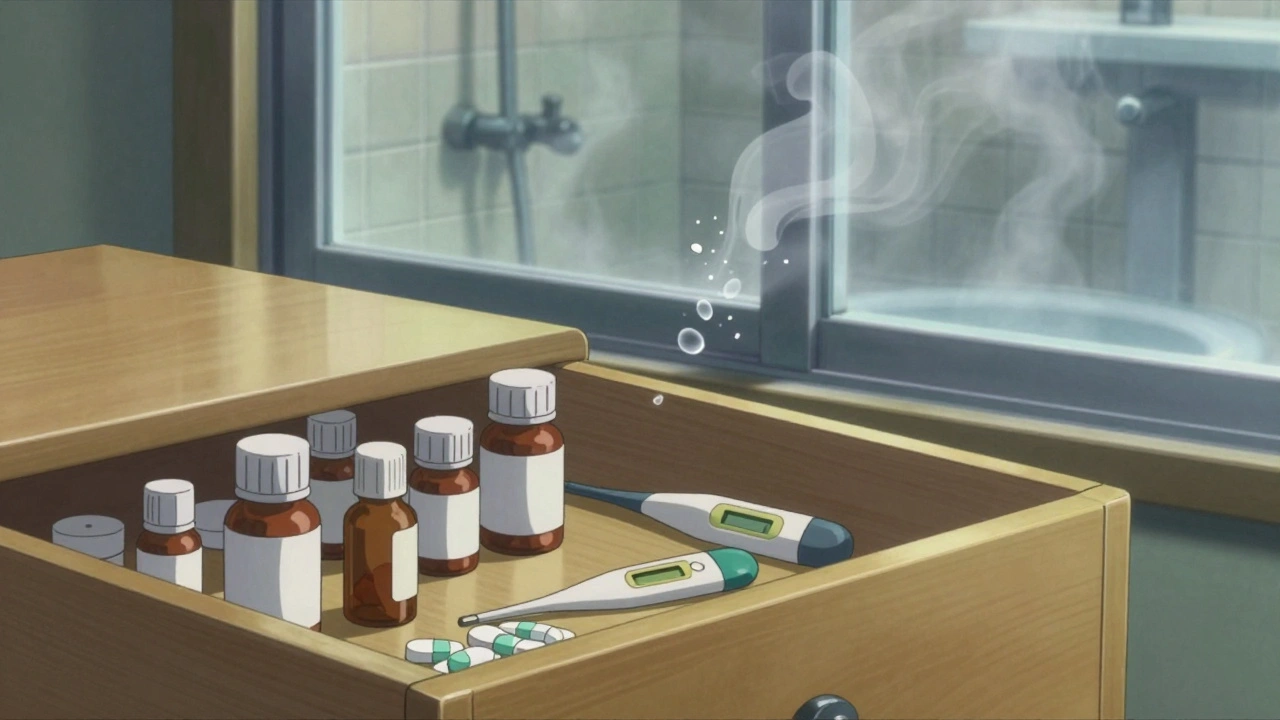
Bathrooms are the worst place. The steam from showers raises humidity. The heat from the dryer or hot water tank can spike the temperature. Even if your medicine cabinet looks clean and dry, the air around it isn’t stable. Kitchens are almost as bad. Ovens, stoves, and dishwashers create heat waves. A bottle of antibiotics on the counter near the stove might be fine in the morning, but by afternoon, it’s been exposed to 90°F. Windowsills? Don’t even think about it. Sunlight doesn’t just warm things up-it triggers chemical reactions that break down drugs. Even clear bottles let in enough UV light to damage sensitive compounds. And never, ever freeze a medication unless the label says you can. Insulin freezes and becomes useless. Once thawed, it doesn’t go back to normal. The proteins denature. It’s not just weaker-it’s unsafe.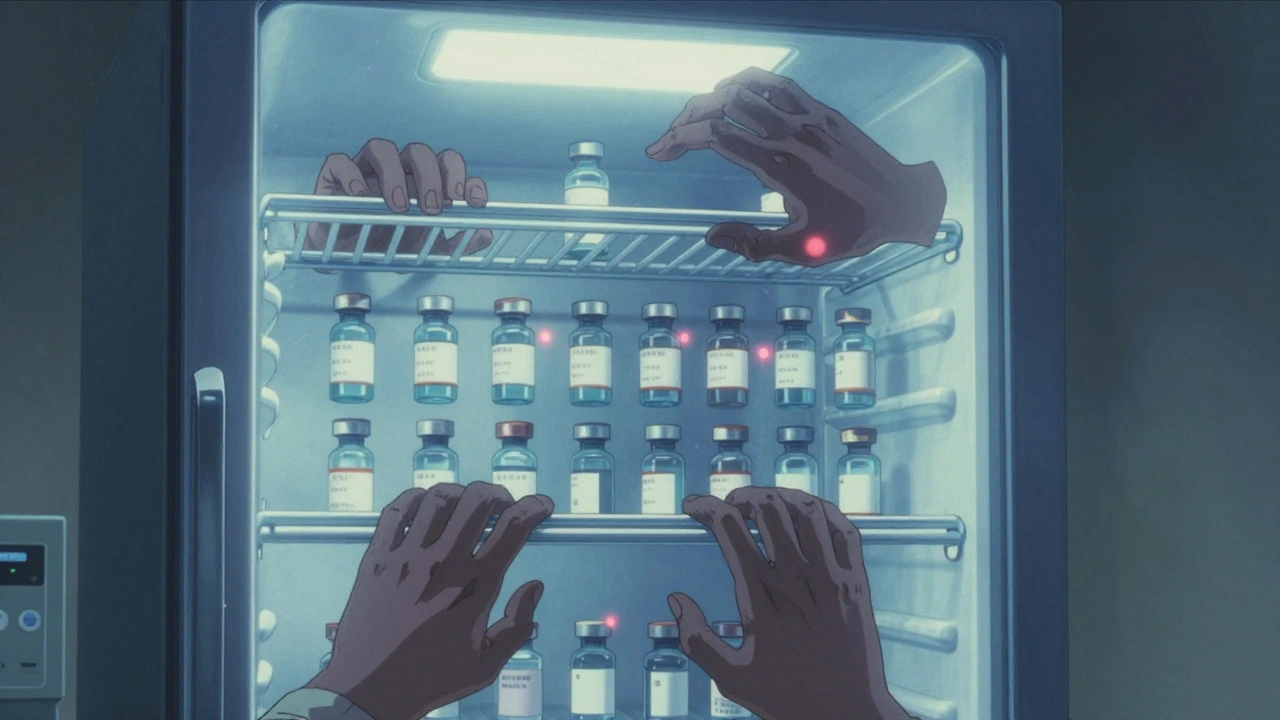
Storage Units and Equipment
Not all refrigerators are created equal. A standard kitchen fridge might look cool enough, but it’s not designed for medicine. Temperature swings happen every time the door opens. Studies show the top shelf can be 6°F warmer than the bottom. The door area? Up to 5°F hotter than the center. The CDC recommends storing vaccines and temperature-sensitive meds in the center of the fridge, away from walls and the door. Use a dedicated medical-grade refrigerator if possible. These units maintain stable temps even during power fluctuations and have alarms that alert you if the temperature drifts. Monitoring is non-negotiable. You need a data logger-not just a thermometer stuck to the wall. The device must:- Use a buffered probe (not a bare sensor)
- Log readings every 30 minutes or less
- Have an alarm for out-of-range temps
- Display min/max temperatures
- Be calibrated annually with a valid certificate
Real-World Consequences
Dr. Michael Chen’s 2022 study at Baystate Health showed that when medications were exposed to temperatures above 77°F, their effectiveness dropped by 23% to 37%. Hormone-based drugs like birth control and thyroid meds were the most affected. One woman took her pills for months, stored them in a hot bathroom. Her birth control failed. She didn’t know why-until the lab tested the pills. They had lost 32% potency. In healthcare settings, the Joint Commission found that 17% of medication errors trace back to improper storage. Facilities using continuous monitoring systems saw a 44% drop in adverse events. That’s not just numbers-it’s lives saved. And it’s not just hospitals. In homes, especially with elderly patients or those managing multiple prescriptions, poor storage is common. A 2023 analysis of 15,000 pharmacy logs showed 18.7% of pharmacies had at least one temperature excursion above 77°F during summer months. Each incident lasted an average of 4.2 hours. That’s long enough to damage a lot of drugs.
What’s Changing in 2025?
The FDA just updated its rules. By December 2025, all healthcare facilities must have real-time remote monitoring for temperature-sensitive medications. No more manual logs. No more guessing. Systems must send alerts to staff if temps go out of range-even when no one’s in the room. New technologies are making compliance easier. Blockchain systems, piloted by Pfizer and Moderna, track every temperature reading from warehouse to bedside with 99.98% accuracy. AI tools predict when a fridge is about to fail-before it happens. Phase-change materials in shipping containers can keep vaccines cold for five days without electricity. But the biggest change isn’t tech-it’s awareness. The International Pharmaceutical Federation says 85% of storage facilities will use IoT monitoring by 2027. That’s up from 42% in 2023. Why? Because the cost of failure is too high. A single rejected vaccine shipment can cost $127,000. A missed dose of insulin? That’s not a financial loss-it’s a medical emergency.What You Can Do Today
If you’re managing medications at home:- Keep them in a cool, dry place-like a bedroom drawer, not the bathroom.
- Use a small digital thermometer to check the temp. If it’s above 80°F, move them.
- Never leave pills in a car, even for 10 minutes. Summer temps inside a parked car can hit 140°F.
- Check expiration dates. If a pill looks cracked, sticky, or smells weird, throw it out.
- Ask your pharmacist: "Is this medication sensitive to heat or moisture?" Most will tell you.
- Invest in a medical-grade refrigerator with alarms.
- Install a certified data logger with remote alerts.
- Train staff every six months on proper storage and how to respond to alarms.
- Map your storage space. Use temperature sensors in the top, middle, and bottom to find hot or cold spots.
- Keep a log. Even if regulations don’t require it, you need proof you’re doing right.
Frequently Asked Questions
Can I store medications in the fridge if they’re not labeled for it?
No. Refrigeration isn’t safer for all drugs-it can damage some. Medications like tablets and capsules can absorb moisture from the fridge, causing them to break down. Only refrigerate if the label says "store in refrigerator" or "keep refrigerated." If in doubt, ask your pharmacist.
How often should I check the temperature of my medication storage?
If you’re using a data logger, it records automatically. But you should visually check the device daily and review the logs weekly. In healthcare settings, daily checks are required by most accreditation standards. At home, check once a week unless you’ve had a power outage or extreme weather.
What happens if my insulin freezes?
Frozen insulin loses its effectiveness permanently. The protein structure breaks down. Even if it thaws and looks normal, it won’t work right. Never use insulin that’s been frozen. Always store it in the fridge door (not the back) and never in the freezer compartment.
Are generic drugs more sensitive to temperature than brand names?
No. Both brand-name and generic drugs must meet the same FDA standards for stability. The active ingredient is identical. But fillers and coatings can vary slightly. If a generic looks different-crumbly, discolored, or smells odd-don’t use it. That’s a sign of degradation, not a brand issue.
How do I dispose of expired or damaged medications safely?
Don’t flush them or throw them in the trash. Take them to a drug take-back program at a pharmacy or hospital. If none are available, mix pills with coffee grounds or cat litter in a sealed bag before tossing. This prevents accidental ingestion and reduces environmental harm.
Nikhil Pattni
December 5, 2025 AT 13:36Okay so let me break this down for you folks who think their bathroom cabinet is fine-your insulin is probably dead by now. I’ve seen people store it next to the showerhead like it’s a bar of soap. Heat and humidity? Yeah, that’s not just ‘not ideal,’ that’s a biohazard. The FDA stats are real-78% of recalls? That’s not some corporate scare tactic. That’s your grandma’s blood pressure med turning into sugar pills. And don’t even get me started on the ‘I left it in the car for 10 minutes’ crowd. 140°F? That’s not storage, that’s a science experiment gone wrong. 🤦♂️
Arun Kumar Raut
December 7, 2025 AT 02:47Hey everyone, I just want to say-this is super important. I work with elderly folks and so many don’t even know where to keep their meds. I started putting little sticky notes on their pill bottles: ‘Not the bathroom!’ and ‘Keep in bedroom.’ Simple stuff. One lady told me she used to keep her heart meds in the kitchen window because it was ‘bright and clean.’ I showed her the sun damage on the bottle-yellowed, cracked. She cried. We moved it. She’s doing better now. Small changes matter.
precious amzy
December 7, 2025 AT 03:15While the empirical data presented here is statistically compelling, one must interrogate the underlying epistemological framework of pharmaceutical stability. Is potency loss truly the only metric of therapeutic efficacy? Or are we, as a society, conflating chemical integrity with ontological validity? The human body, after all, is not a lab. Bioavailability, placebo response, and individual metabolic variance are systematically excluded from these regulatory frameworks. One wonders-is the $35 billion waste a failure of storage… or a failure of our reductionist paradigm?
William Umstattd
December 7, 2025 AT 23:17Let me be crystal clear: storing medication in a bathroom is not just negligent-it’s criminal. I’ve seen patients end up in the ER because their insulin degraded. No excuses. No ‘but I didn’t know.’ If you’re an adult, you’re responsible for your own health. The FDA, WHO, and USP didn’t make these rules for fun. They made them because people died. If you’re too lazy to read the label, don’t blame the system when your pills stop working. You had one job.
Andrea Beilstein
December 9, 2025 AT 12:47I’ve been thinking about this a lot lately. We treat our phones like sacred objects-protecting them from heat, water, drops-but we toss our life-saving meds into a steamy bathroom like they’re old receipts. Why? Is it because we don’t see them as alive? As something that can die? There’s a philosophical disconnect here. We fear death but ignore the quiet, slow death of a pill in a drawer. Maybe the real problem isn’t the temperature-it’s how little we value our own bodies.
Sabrina Thurn
December 10, 2025 AT 22:24Just to clarify a common misconception: medical-grade refrigerators aren’t just ‘better fridges.’ They’re engineered with forced-air circulation, redundant cooling systems, and ±0.5°C precision. Standard fridges? They cycle on/off, have hot spots, and the door seal degrades over time. I’ve seen clinics use a $200 appliance to store $50,000 vaccines. That’s not cost-saving-it’s malpractice. Data loggers aren’t optional-they’re your legal shield. And yes, calibration matters. A probe that’s off by 2°F can make the difference between a viable dose and a toxic one.
Brianna Black
December 11, 2025 AT 14:12Wow. This is actually really well written. I’m not usually into this kind of stuff but I had no idea about the humidity part. I always thought it was just about heat. Now I’m checking my meds-turns out my thyroid pills were in the kitchen above the stove. I moved them. Thank you for the clarity. Also-why is nobody talking about how expensive these medical fridges are? Like, most people can’t afford one. So what’s the solution? Just hope you don’t get a heatwave?
Shubham Mathur
December 13, 2025 AT 10:34People need to stop being lazy. I live in India. We have power cuts. We have 45°C summers. We don’t have fancy fridges. So what? We use insulated boxes with ice packs. We wrap meds in foil. We store them under the bed. We don’t have money for IoT sensors but we still keep our meds alive. Stop acting like this is a rich-country problem. The real issue? No education. No outreach. No one telling grandmas in villages that their pills are garbage because they left them on the windowsill. Fix that first.
Stacy Tolbert
December 13, 2025 AT 12:09I just lost my mom to a stroke and she was on blood thinners. The pharmacy told us to store them in the fridge. We did. But we didn’t know about the door being warmer. One day the power went out. We didn’t notice. When she had the stroke… they tested the meds. They were degraded. I just want to scream. Why didn’t anyone tell us? Why is this not common knowledge? I feel so guilty. Like I killed her. I didn’t know. I swear I didn’t know.
Ryan Brady
December 14, 2025 AT 22:00USA is overreacting again. We got laws for everything now. Next they’ll make us wear gloves to open pill bottles. My grandpa stored his meds in the glovebox for 30 years. Lived to 94. You’re telling me he died of bad storage? Nah. He died of old age. Chill out. Not everything needs a sensor. 🤷♂️
Raja Herbal
December 16, 2025 AT 15:28So let me get this straight-we’re spending billions on IoT sensors and blockchain to track pills… but the same people who built this system won’t fix the $200/month insulin price? Funny. We can track a pill from factory to bedside but not make sure it’s affordable. The real crisis isn’t temperature-it’s capitalism. But hey, keep logging your fridge temps. Maybe that’ll distract us from the real problem.
Iris Carmen
December 18, 2025 AT 05:59lol i just realized i’ve been keeping my anxiety med in my purse for like 2 years. it’s been in my car, in the sun, in my gym bag… i thought it was fine since it still looked normal. guess i’m due for a refill. oops.
Rich Paul
December 18, 2025 AT 19:26Look, I work in pharma logistics. We use phase-change materials in shipping, real-time GPS temp tracking, and AI predictive failure models. But here’s the truth: 90% of the time, the problem isn’t the tech-it’s the person. The nurse who forgets to log. The pharmacist who says ‘it was fine yesterday.’ The patient who says ‘I didn’t think it mattered.’ Tech helps. But if the human doesn’t care? Nothing changes. Just saying.
Ruth Witte
December 19, 2025 AT 20:57OMG I just moved my meds to my bedroom drawer!!! 🙌 Thank you for this post!! I used to keep my birth control next to the sink-now I have a tiny box with a little thermometer. I even named it ‘Pillie’ 😍 We’re all doing better now! 💊💖
Noah Raines
December 20, 2025 AT 16:44Yeah but honestly-how many people even check their fridge temp? I mean, I’ve got a $5 digital one I stick on the shelf. I check it once a month. If it’s not melting ice, I’m good. I don’t need a $2000 medical fridge. That’s just corporate greed in disguise. Keep it simple. If the pills look fine, they’re fine. 😎
Katherine Rodgers
December 20, 2025 AT 16:46Oh great. Another article telling me I’m a bad person for not owning a data logger. Let me guess-next they’ll require us to wear a biometric patch that monitors our pill ingestion and sends an alert to the FDA if we miss a dose? At this point, I’m just waiting for the AI to decide if I’m worthy of taking my meds. I’m tired of being policed by pharmaceuticals. 🙄
Lauren Dare
December 21, 2025 AT 16:46Interesting that the USP is tightening humidity to 45% ±5%-but no one’s addressing the fact that most homes in the U.S. have RH levels of 60-70% in summer. The guidelines are technically sound, but practically unattainable for 80% of the population without dehumidifiers. This reads like a policy written by someone who’s never lived in a real house. The gap between regulation and reality is widening. And no one’s talking about it.
Gilbert Lacasandile
December 23, 2025 AT 09:39I just wanted to say I appreciate the depth of this post. I’ve been working in a small clinic and we’ve been using a standard fridge with a basic thermometer. After reading this, I ordered a medical-grade logger and a backup battery. We’re going to train the staff next week. It’s a small step, but it’s something. Thanks for the push.
Lola Bchoudi
December 24, 2025 AT 03:50As a pharmacy consultant, I’ve seen the damage firsthand. One clinic had a 37% drop in efficacy on hormone meds due to a broken fridge they didn’t notice for 11 days. The worst part? They didn’t even have a log. No one knew. That’s not negligence-it’s systemic failure. But here’s the good news: once you implement monitoring, compliance jumps to 98%. It’s not about punishment. It’s about systems that make doing the right thing easy. Start small. Start today. You’ve got this.