

Steroids and NSAIDs Together: Why Your GI Bleeding Risk Skyrockets and How to Stop It
 Feb, 7 2026
Steroid-NSAID Risk Calculator
Calculate Your Risk
This tool estimates your risk of gastrointestinal bleeding when taking both corticosteroids and NSAIDs together based on the latest research.
Risk Assessment
Risk Level
Key Risk Factors
Recommendations
Important: This calculator provides an estimate based on clinical data. Always consult your doctor for personalized medical advice.
When you take a steroid like prednisone for a flare-up and reach for ibuprofen to ease the pain, you might think you're just managing two common problems. But what you're doing could be quietly putting your stomach at serious risk. The combination of systemic corticosteroids and nonsteroidal anti-inflammatory drugs (NSAIDs) doesn't just add risks-it multiplies them. And the consequences? Life-threatening gastrointestinal bleeding that could have been prevented.
Why This Combo Is So Dangerous
NSAIDs like ibuprofen, naproxen, and diclofenac hurt your stomach in two ways. First, they irritate the lining directly. Second-and more importantly-they block an enzyme called COX-1. That enzyme helps make prostaglandins, which protect your stomach by boosting mucus, blood flow, and healing. Without them, your stomach lining becomes vulnerable. Corticosteroids like prednisone or methylprednisolone make things worse. They don’t just add to the damage-they sabotage your body’s ability to fix it. Steroids slow down tissue repair, reduce mucus production, and, dangerously, mask symptoms. You might have a bleeding ulcer and feel no pain because the steroid is suppressing inflammation. By the time you notice black stools or dizziness, it’s often too late. Research shows this isn't theoretical. A landmark 2001 study found that using both together raised the odds of upper GI bleeding or perforation by nearly 9 times compared to not using either. That’s not a small increase-it’s a catastrophic jump. And it gets worse with higher NSAID doses. At high doses (like ibuprofen over 1200 mg/day), the risk skyrockets to more than 12 times higher.It’s Not Just Your Stomach
Most people assume NSAID-related bleeding happens only in the upper GI tract-stomach and duodenum. But that’s not true. About one-third of serious NSAID-related bleeds come from the lower GI tract: the small intestine or colon. And when steroids are added? The risk doesn’t just move-it expands. Studies show 86% of patients with lower GI bleeds had taken NSAIDs. Steroids make the damage harder to detect and harder to heal, no matter where it occurs.Not All NSAIDs Are Created Equal
If you need an NSAID, not all choices are the same. Traditional NSAIDs (tNSAIDs) like naproxen and ibuprofen are the biggest offenders. They block both COX-1 and COX-2 enzymes. COX-2 helps with pain and inflammation, but COX-1 protects your gut. Block both? You’re asking for trouble. COX-2 selective inhibitors like celecoxib (Celebrex) were developed to avoid this. They target only COX-2, sparing COX-1. Clinical trials show they cut upper GI bleeding risk by 50-60% compared to traditional NSAIDs. The CONCERN trial found that for patients on aspirin and NSAIDs, celecoxib plus a PPI reduced recurrent bleeding by 54% compared to naproxen plus a PPI. But here’s the catch: even celecoxib isn’t safe with steroids. The risk drops, but it doesn’t disappear. The combination still elevates bleeding risk-just not as dramatically. So if you’re on a steroid, switching to celecoxib helps, but it’s not enough on its own.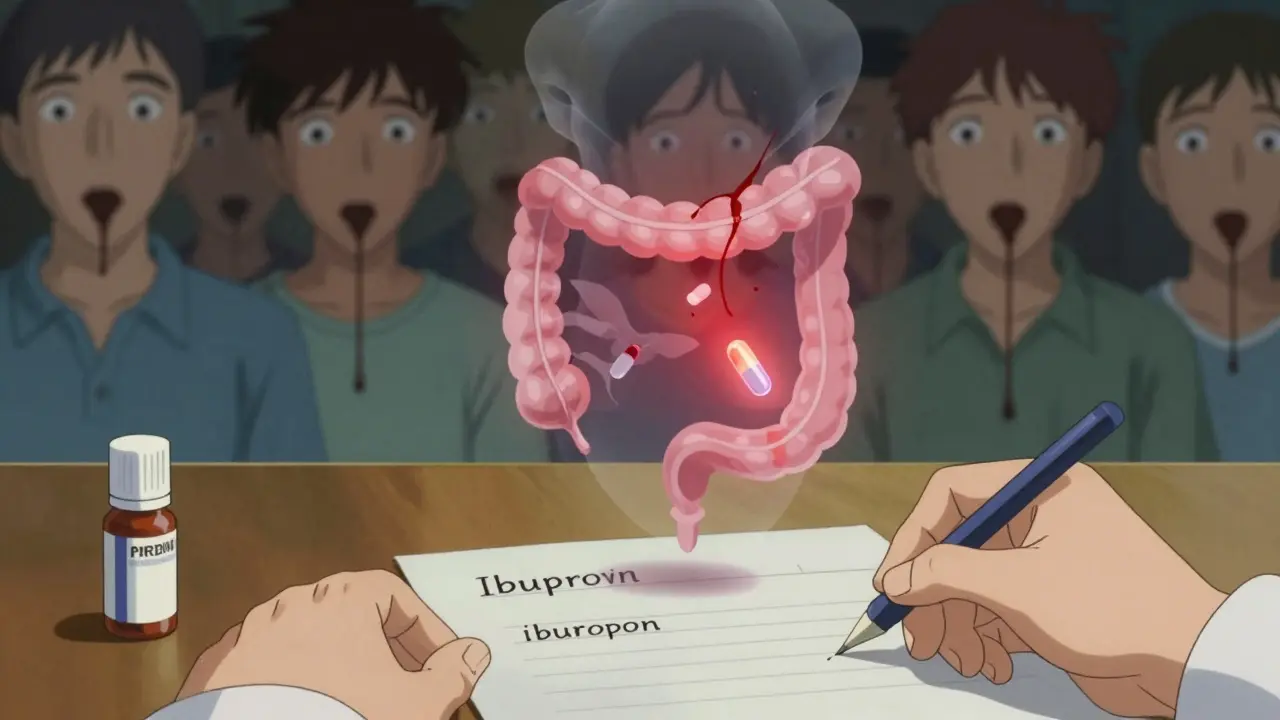
Who’s Most at Risk?
This isn’t a one-size-fits-all danger. Certain factors turn a risky combo into a ticking time bomb:- Age over 65
- History of peptic ulcer or GI bleeding
- High-dose NSAID use (e.g., ibuprofen ≥1200 mg/day, diclofenac ≥100 mg/day)
- Taking blood thinners like warfarin or apixaban
- Multiple NSAIDs (e.g., taking both ibuprofen and naproxen)
- Chronic conditions like kidney disease or heart failure
The Only Proven Solution: PPIs
The only thing that reliably prevents this kind of bleeding is a proton pump inhibitor (PPI). Drugs like omeprazole, esomeprazole, pantoprazole, or lansoprazole shut down stomach acid production. That gives your stomach lining a chance to heal-even when NSAIDs and steroids are tearing it down. PPIs aren’t just helpful-they’re essential. Studies show they reduce NSAID-induced ulcers by 73%. H2 blockers like famotidine? They help a little, but they’re 48% less effective. If you’re on steroids and NSAIDs, an H2 blocker is not good enough. Guidelines from the American Gastroenterological Association and the European Society of Gastrointestinal Endoscopy say this clearly: Any patient on both steroids and NSAIDs needs a PPI. No exceptions. Not for short-term bursts. Not for low-dose NSAIDs. Not even if you’ve never had a stomach problem before. For most people, a standard dose like omeprazole 20 mg once daily is enough. But if you’re high-risk-over 65, with past ulcers, or on blood thinners-you need double the dose: 40 mg daily.Why So Many People Still Get Hurt
You’d think this would be simple. But reality is messy. A 2022 study of over 12,000 hospital admissions found that only 38.7% of patients on both steroids and NSAIDs got a PPI. In non-rheumatology clinics? Just 22.3%. That means more than 6 out of 10 people were left unprotected. Why? Because doctors don’t always connect the dots. A patient comes in with a sinus infection, gets a 5-day prednisone burst, and says, “I’ve been taking Advil for my headache.” The doctor prescribes the steroid, never asks about the NSAID, and walks away. Or worse-the patient self-medicates. OTC ibuprofen is everywhere. No one warns them. A 2023 survey by the NSAID Injury Foundation found that 63% of patients who suffered bleeding had never been told about this risk by their prescriber. Even when PPIs are prescribed, they’re often stopped too soon. If you’re on a 10-day steroid course and a 14-day NSAID course, you need PPI protection for the full 14 days-not just while you’re on the steroid. Many patients stop the PPI after the steroid ends, thinking the danger is gone. It’s not.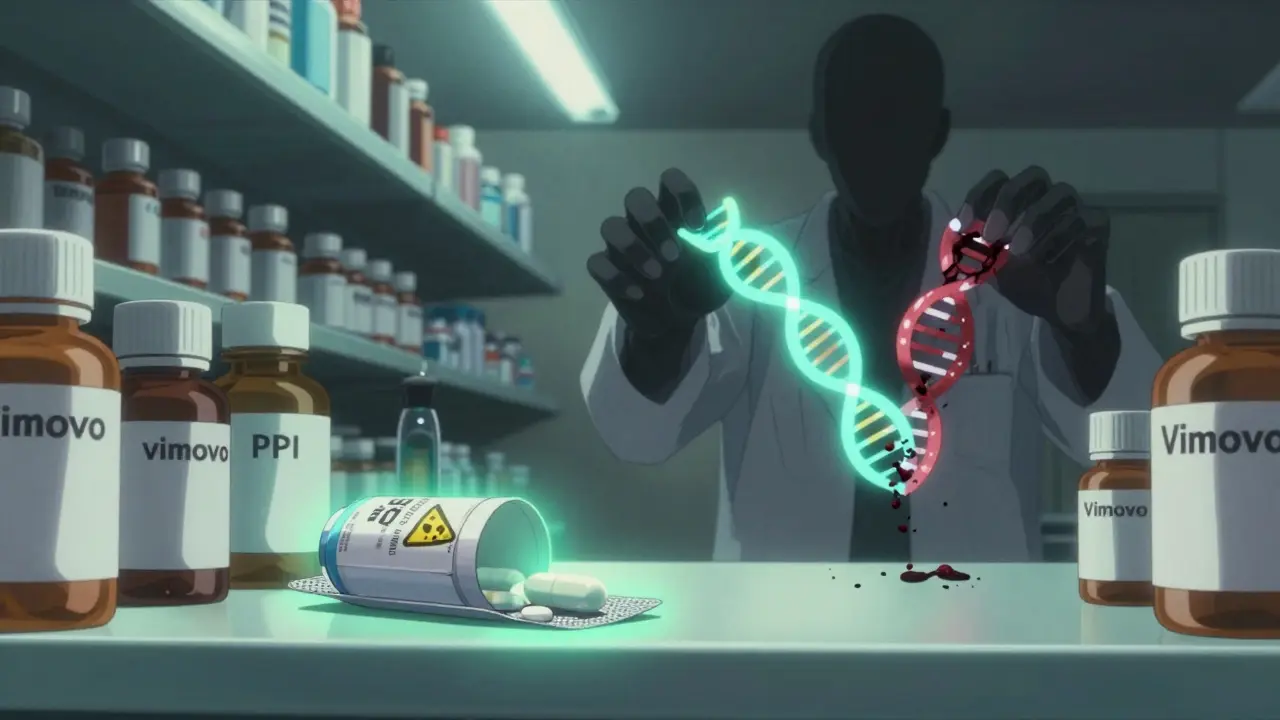
What’s New in Prevention
There’s progress. In 2023, the FDA approved Vimovo-a single pill combining naproxen and esomeprazole. The PRECISION-2 trial showed it reduced visible ulcers by 54% compared to naproxen alone. It’s a step forward, especially for patients who need NSAIDs long-term. Some health systems are taking automation seriously. Mayo Clinic, Kaiser Permanente, and others now have clinical decision support tools built into their electronic health records. If a doctor orders prednisone and ibuprofen together, the system auto-populates a PPI prescription. At Mayo, this cut bleeding events by nearly 70%. Researchers are also looking at genetics. Variants in genes like CYP2C9 and PTGS1 can make some people far more vulnerable to NSAID damage. Early data suggests risk can vary more than twofold based on DNA. This isn’t ready for clinics yet-but it’s coming.What You Should Do
If you’re on steroids and NSAIDs together:- Ask your doctor if you need a PPI. Don’t wait for them to bring it up.
- Don’t assume OTC NSAIDs are safe. Even 200 mg of ibuprofen daily can be dangerous with steroids.
- If you’re on blood thinners, the risk is even higher. PPIs are non-negotiable.
- Take the PPI for the entire time you’re on the NSAID-not just while on steroids.
- If your doctor says you can use an H2 blocker instead, ask for the evidence. It’s not strong enough.
- Watch for warning signs: black or tarry stools, vomiting blood, dizziness, or sudden abdominal pain. Call your doctor immediately.
Camille Hall
February 8, 2026 AT 23:30Just had my doc prescribe prednisone for my flare-up and I was already taking ibuprofen for my knee. I never knew this combo was so dangerous. Thanks for laying it out so clearly - I’m getting a PPI script today. No more guessing with my gut.
Also, to anyone else reading: if your doctor doesn’t bring it up, ASK. Seriously. It’s that simple.
Ashlyn Ellison
February 10, 2026 AT 00:13Yikes. I’ve been doing this for years. Took naproxen for my back pain and prednisone for allergies. Thought I was fine. Now I’m scared. Gonna call my doctor tomorrow.
Scott Conner
February 11, 2026 AT 19:18so like… if u take celebrex instead of ibuprofen, is it safer? or still bad? i read somethin bout cox-2 but idk if it’s legit or just pharma bs
Tatiana Barbosa
February 12, 2026 AT 10:13THIS. IS. CRUCIAL. I work in primary care and I’ve seen too many patients show up with melena and no idea why. We’re not talking about rare side effects - we’re talking about a predictable, preventable, BILLION-DOLLAR problem that’s ignored because ‘it’s just OTC.’
Stop treating this like a ‘maybe’ and start treating it like a protocol. PPIs aren’t optional. They’re the standard of care. Period.
And if you’re on warfarin or apixaban? You’re not ‘at risk’ - you’re already in the danger zone. No PPI? You’re gambling with your life. Don’t be that guy.
Ken Cooper
February 13, 2026 AT 02:06Wait - so even if I only take ibuprofen for 3 days? And the steroid is 5 days? I still need the PPI for the whole 14 days? That seems crazy…
Also, why do they even sell NSAIDs over the counter if this is so dangerous? Someone’s gotta be making money off this…
And I’ve been taking famotidine for years - is that just a scam? Like, what’s the point? I feel lied to.
MANI V
February 13, 2026 AT 11:05This is why Western medicine is broken. You take a pill to fix a symptom, then you need another pill to fix the side effect of the first pill, then another pill to fix the side effect of the second pill…
Instead of asking why your body is inflamed in the first place, you just blanket suppress it with chemicals. Then you wonder why everyone’s sick.
Try fasting. Try turmeric. Try acupuncture. Try not poisoning yourself with steroids and NSAIDs. It’s not rocket science - it’s basic biology.
Chima Ifeanyi
February 14, 2026 AT 17:17Let’s be real - the entire pharmaceutical-industrial complex profits from this cycle. PPIs are a $10B+ market. Celecoxib? Patent-protected. Vimovo? A single-pill profit machine.
The real solution? Stop prescribing steroids for minor inflammation. Stop selling NSAIDs like candy. But no - we need to keep the revenue streams flowing. The ‘prevention’ narrative is just a clever way to sell more drugs.
And don’t get me started on how they’re pushing genetic testing next. Next thing you know, your DNA will be used to upsell you a $500/month ‘personalized’ PPI regimen.
Tori Thenazi
February 15, 2026 AT 21:26Okay, but what if I’m on prednisone and ibuprofen and I’ve been taking omeprazole for years? Is that why I’ve had weird bloating and anxiety? Did the PPI cause my mental health issues? I read online that PPIs can mess with your gut microbiome and cause depression…
And what if I’m allergic to PPIs? What then? Are we just supposed to bleed out? I’m not kidding - my cousin died from this. No one warned her. No one. I’m crying right now.
Elan Ricarte
February 16, 2026 AT 08:15Look - I’m not a doctor, but I’ve been on steroids and NSAIDs since I was 24 for autoimmune crap. I’ve had two ER trips because of this exact combo. I’m alive because I caught the black stools in time.
So here’s the raw truth: your doctor doesn’t care. They’re rushed. They’re distracted. They think you’re ‘fine’ because you’re not screaming.
But your gut doesn’t scream - it just… stops. One day you’re fine. The next, you’re in ICU with a perforated ulcer. No warning. No second chance.
I stopped taking NSAIDs cold turkey. Switched to gabapentin. Took PPIs religiously. No more hospital visits. No more fear.
If you’re reading this and you’re on both - STOP. Just stop. Find another way. Your stomach isn’t a suggestion. It’s your lifeline.