

Rifampin and Birth Control: What You Need to Know About Contraceptive Failure Risks
 Dec, 26 2025
Rifampin Contraceptive Risk Calculator
Contraceptive Risk Period Calculator
This tool calculates your contraceptive risk window when taking rifampin. Remember: rifampin requires backup contraception for 28 days after your last dose.
When you're prescribed rifampin for tuberculosis or a stubborn staph infection, the last thing you might think about is your birth control. But if you're taking hormonal contraceptives - pills, patches, or rings - rifampin can make them stop working. This isn't a myth. It's not rare. It's been documented for over 50 years, and women have gotten pregnant while taking both.
Why Rifampin Breaks Birth Control
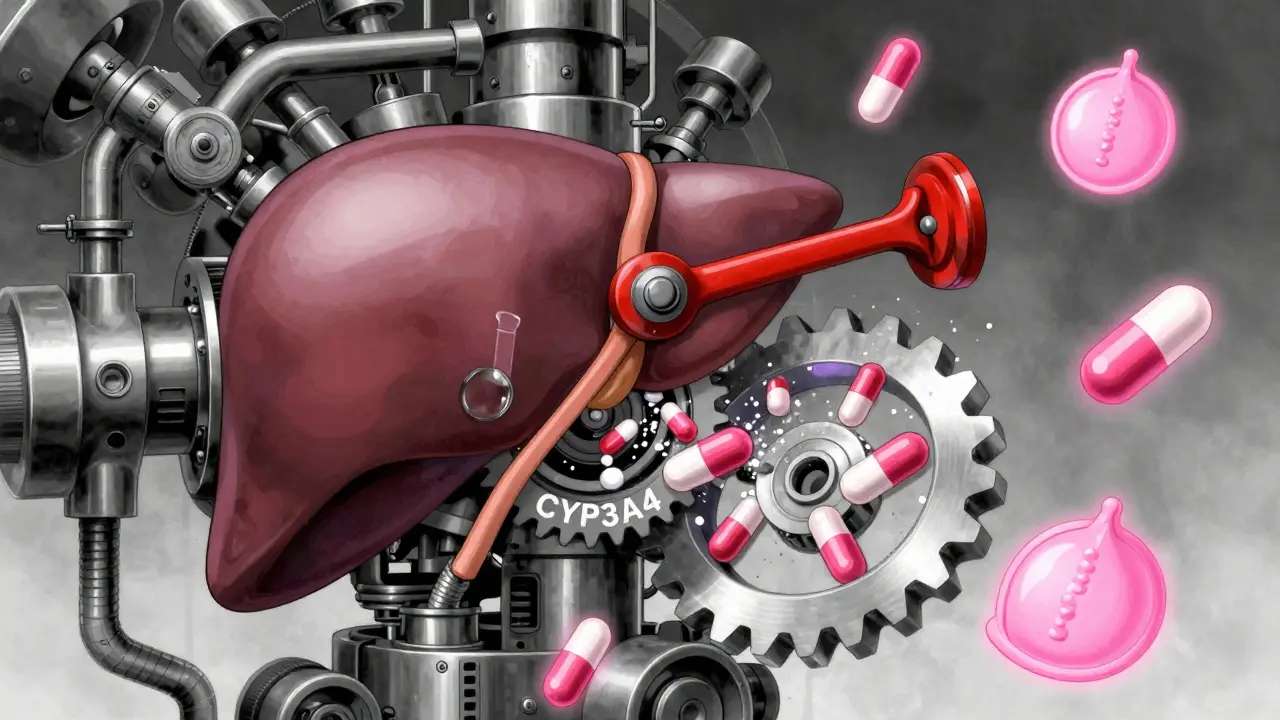
Rifampin doesn't directly interfere with hormones like estrogen or progestin. Instead, it turns on a powerful enzyme system in your liver called CYP3A4. Think of it like flipping a switch that speeds up your body's ability to break down certain drugs. Once this switch is on, your body starts metabolizing the hormones in your birth control much faster than normal.Studies show that rifampin can slash estrogen levels by up to 67% and progestin levels by more than half. That’s not a small drop. It’s enough to drop hormone concentrations below the threshold needed to prevent ovulation. In one study, half the women taking rifampin while on birth control showed signs of ovulation - meaning their bodies were releasing eggs again, even though they were taking pills daily.
This isn’t just theory. Real cases have been reported since the 1970s. Women on consistent birth control, no missed pills, no vomiting, no diarrhea - still got pregnant while on rifampin. And it’s not just one or two cases. It’s a pattern confirmed by multiple reviews from the American Academy of Family Physicians, the CDC, and the British Journal of Obstetrics and Gynaecology.
Not All Antibiotics Are the Same
You’ve probably heard warnings about antibiotics and birth control from your doctor or pharmacist. But here’s the truth: rifampin is the only antibiotic with solid proof of causing contraceptive failure.Penicillin? Tetracycline? Azithromycin? Erythromycin? None of these have been shown in controlled studies to reduce hormone levels or increase ovulation. The UK reported 117 cases of contraceptive failure linked to these antibiotics between 1970 and 1999 - but those were all anecdotal. No follow-up studies found a real pharmacological link. The same goes for common cold antibiotics. Your body doesn’t treat them the same way it treats rifampin.
There’s one exception: rifabutin. It’s a cousin of rifampin, used sometimes for HIV patients with MAC infections. It also induces liver enzymes, but less powerfully. Studies show it lowers hormone levels by about 20-30%. It’s not as risky as rifampin, but it’s still risky enough that doctors recommend backup contraception.
And then there’s ketoconazole - an antifungal. It does the opposite. It slows down hormone breakdown. That can cause side effects like nausea or breast tenderness, but it doesn’t cause failure. It’s a reminder that not all drug interactions go the same way.
How Long Does the Risk Last?
This is where people get it wrong. Rifampin doesn’t just affect you while you’re taking it. The enzyme induction lasts long after the drug is gone.Rifampin’s half-life is only 3-4 hours. That means it clears your bloodstream quickly. But the enzymes it turns on? They stick around. Your liver keeps producing them for weeks. That’s why you need backup contraception for a full 28 days after your last rifampin pill.
Stop rifampin on day 60? You’re still at risk until day 88. That’s not a suggestion. That’s the CDC’s official guidance. Combined hormonal contraceptives are classified as Category 4 - meaning the risk of using them with rifampin is unacceptable. You can’t just wait a few days. You can’t assume your body ‘caught up.’ The enzyme activity doesn’t reset overnight.
What Backup Contraception Actually Works
Not all backup methods are created equal. You need something that doesn’t rely on hormones.- Copper IUD: This is the gold standard. It works by creating a hostile environment for sperm and eggs. It’s over 99% effective, lasts up to 10 years, and isn’t affected by any drug. It’s also reversible. Many OB-GYNs recommend it for women on rifampin.
- Condoms: Not ideal alone, but when used consistently and correctly, they’re about 98% effective. They’re easy to get, don’t require a prescription, and protect against STIs too - which matters if you’re being treated for TB.
- Implants like Nexplanon: Early data is promising. A 2023 study of 47 women using etonogestrel implants during rifampin treatment showed zero pregnancies. That’s encouraging, but the sample size is small. Experts still recommend adding a barrier method just in case.
Don’t rely on withdrawal, rhythm methods, or emergency contraception as backup. They’re not reliable enough when the stakes are this high.
What Doctors Get Wrong
A 2017 survey found that only 42% of primary care doctors consistently warn patients about rifampin’s effect on birth control. And 28% of them tell patients to use backup contraception for all antibiotics - which is unnecessary and confusing.Some doctors think, “It’s just a few weeks. She’ll be fine.” Others assume the patient knows. Some don’t even ask if the patient is on birth control. That’s dangerous.
And here’s another mistake: switching a woman off her pill to a non-hormonal method for the whole course of rifampin, then forgetting to help her switch back. That’s a recipe for unintended pregnancy later on. The solution isn’t always to stop the pill - it’s to add a barrier method on top of it.

Why This Matters Beyond Birth Control
This isn’t just about avoiding pregnancy. It’s about reproductive justice. In places like sub-Saharan Africa, where tuberculosis is common and access to contraception is limited, this interaction can lead to unplanned pregnancies in women who already face barriers to healthcare.Manufacturers now test every new hormonal contraceptive against rifampin before approval. The FDA and EMA require it. If a new pill can’t prove it won’t fail with rifampin, it doesn’t get approved. That’s how seriously this is taken.
But even with all the science, a 2022 study in the Journal of Women’s Health found that 63% of women prescribed rifampin still didn’t get proper counseling. That’s not a failure of science. That’s a failure of communication.
What You Should Do Right Now
If you’re taking rifampin and using hormonal birth control:- Stop assuming your pill is working.
- Use a copper IUD or condoms every time you have sex - for the entire time you’re on rifampin and for 28 days after.
- Talk to your doctor or pharmacist. Ask: “Is this antibiotic known to interfere with birth control?” If they say yes, ask: “Is it rifampin or rifabutin?” If they say no, ask: “Can you show me the evidence?”
- If you’re considering long-term contraception, ask about the copper IUD. It’s one of the most effective methods available, and it’s not affected by any antibiotic.
If you’re not on rifampin? You don’t need backup contraception for penicillin, amoxicillin, doxycycline, or azithromycin. Those warnings are outdated. Don’t waste time or money on unnecessary methods.
What’s Changing in the Future
Researchers are looking for alternatives to rifampin in TB treatment. One promising 4-month regimen uses rifapentine and moxifloxacin instead. Early results suggest it might be just as effective without the contraceptive risk. If it gets approved, it could change how TB is treated globally.For now, the safest path is clear: if you’re on rifampin, treat your birth control like it’s broken. Use a backup. Stay protected. And make sure your provider knows exactly what you’re taking - because this interaction can have life-changing consequences.
josue robert figueroa salazar
December 26, 2025 AT 18:15Alex Ragen
December 27, 2025 AT 16:42Bryan Woods
December 28, 2025 AT 09:45Ryan Cheng
December 30, 2025 AT 04:04wendy parrales fong
December 30, 2025 AT 13:11Jeanette Jeffrey
December 30, 2025 AT 14:36Shreyash Gupta
December 31, 2025 AT 17:35Ellie Stretshberry
January 1, 2026 AT 06:01Zina Constantin
January 2, 2026 AT 04:57Dan Alatepe
January 2, 2026 AT 19:55Sarah Holmes
January 4, 2026 AT 03:48Jay Ara
January 5, 2026 AT 18:33