

Priority vs Standard Review: How FDA Prioritizes Generic Drug Applications
 Mar, 10 2026
The U.S. Food and Drug Administration (FDA) doesn't treat every generic drug application the same. Two paths exist: priority review and standard review. The difference isn't just paperwork-it's months of time, millions in revenue, and sometimes, whether a life-saving medicine reaches patients faster. If you're a manufacturer, a pharmacist, or even a patient wondering why some generics hit shelves sooner than others, understanding these two tracks explains a lot.
What's the Real Difference in Timeline?
The clock starts ticking the moment the FDA accepts your application. For a standard review, the target action date is 10 months. That’s the deadline the FDA aims to meet before making a decision-approve, reject, or ask for more info. Priority review? It’s 8 months. Two months might not sound like much, but in the world of generics, that’s a massive advantage. This timeline comes from the Generic Drug User Fee Amendments (GDUFA) III, which took effect in October 2022 and runs through 2027. It replaced older standards and tightened accountability. In 2022, the FDA approved 822 original generic applications. Of those, 83.1% of priority review applications met the 8-month goal. Standard review applications hit their 10-month target 72.3% of the time. The gap isn’t random-it reflects how much harder it is to get a standard application right the first time.Who Gets Priority Review?
Not every generic gets the faster track. The FDA only gives priority review to specific cases:- First generics: The very first generic version of a brand-name drug after its patents and exclusivity expire. This is the big one. Being first means you get 180 days of market exclusivity-no competition. That’s why companies fight hard to be first.
- Drugs in shortage: If the FDA declares a shortage of a drug-like an antibiotic, insulin, or heart medication-any generic application for that drug gets priority. In 2022, over 100 drugs were on the FDA’s shortage list.
- Medically important advances: A generic that’s significantly better than existing ones-like a more stable formulation, fewer side effects, or easier administration-can qualify.
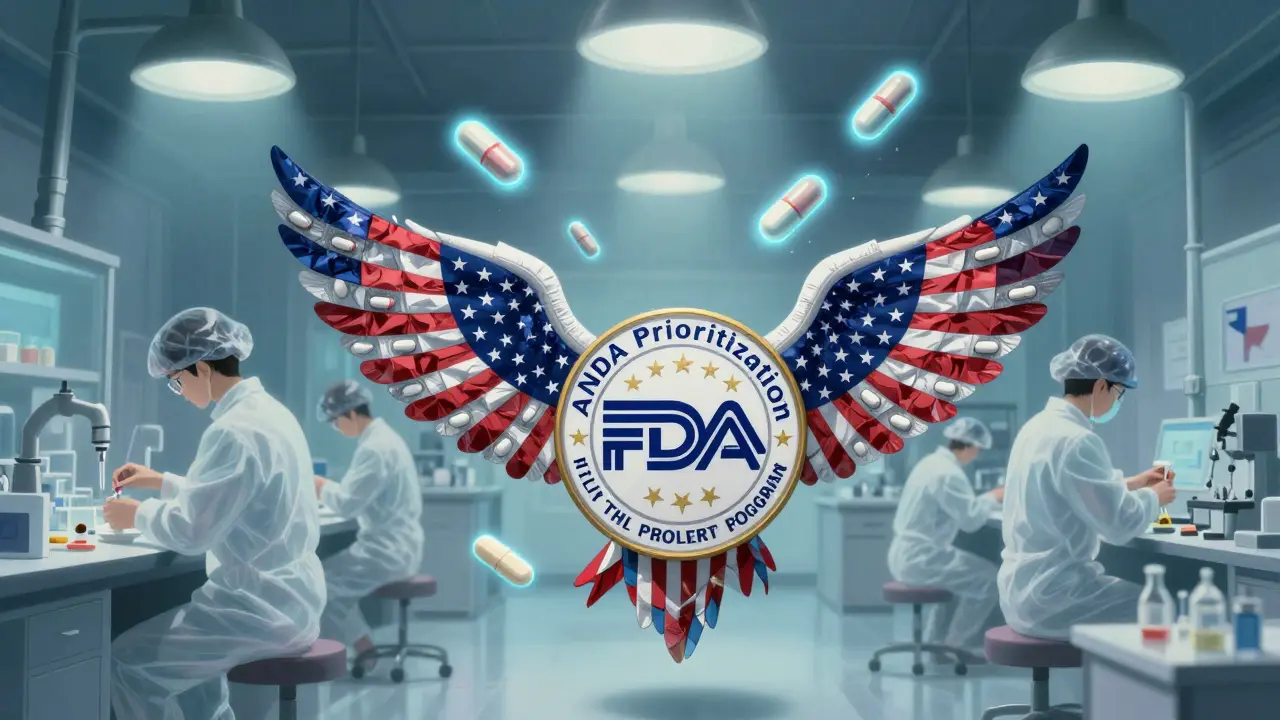
The New U.S. Manufacturing Pilot
In October 2023, the FDA launched a new twist: the ANDA Prioritization Pilot Program. This isn’t just about speed-it’s about where the drug is made. To qualify for priority review under this pilot, an application must prove three things:- The bioequivalence studies were done in the U.S.
- The finished dosage form (the pill, injection, etc.) is manufactured in the U.S.
- All active pharmaceutical ingredients (APIs) come from U.S. suppliers.
Why Do So Many Applications Get Rejected?
Even with priority review, many applications fail. In 2022, 31.7% of original ANDAs received at least one Complete Response Letter (CRL)-a formal request for more data or corrections. The biggest reason? Chemistry, manufacturing, and controls (CMC) issues. That’s 47.2% of all delays. Generic drugs aren’t simple copies. They have to match the brand-name drug in strength, purity, and how they’re absorbed by the body. If the particle size of the active ingredient is off by a few microns, or if the coating on a tablet doesn’t dissolve the same way, the FDA will reject it. The average application needs 1.7 review cycles to get approved. Each cycle adds about 4.2 months to the timeline. To fix this, the FDA started the Complex Generic Drug Product Pilot Program in January 2023. It offers early scientific advice to companies making hard-to-copy products like inhalers, topical creams, or extended-release pills. These make up 18.3% of pending applications but only 9.7% of approvals. Companies using this program now have a 38.7% first-cycle approval rate-up from 24.1% before.
What’s Changing in 2024 and Beyond?
The FDA isn’t stopping. In 2024, they’re rolling out AI-assisted review tools. In internal tests, these tools cut review times for straightforward applications by 18.7%. By late 2024, they’ll be used on real applications. That means fewer delays for simple generics. Meanwhile, the number of ANDA applications is rising. The FDA expects 1,275 submissions in FY 2024-a 12.5% jump from 2023. Priority reviews are expected to make up 32.8% of those, up from 28.4% in 2022. Analysts predict these changes could shorten the average time to market by 4.3 months by 2026. That could save the U.S. healthcare system over $18 billion a year.What This Means for Patients and Providers
You might not see the paperwork, but you feel the impact. When a generic drug hits the market faster, prices drop. In 2022, generics made up 88.6% of all prescriptions in the U.S. but only 15.3% of total drug spending. That’s how much money patients and insurers save. When a drug is in shortage, priority review can mean the difference between having insulin on the shelf or rationing it. When a first generic arrives, it often cuts the price of a brand-name drug by 80% or more within a year. But the system isn’t perfect. The average time from patent expiration to first generic approval is still 2.7 years-too long. Patent litigation, complex manufacturing, and regulatory delays all play a role. The new U.S. manufacturing incentives help, but they’re not a magic fix. The bottom line? The FDA’s review system is designed to balance speed with safety. Priority review isn’t a shortcut-it’s a targeted boost for drugs that need to get to patients faster. And as more manufacturing moves back to the U.S., that boost might become even more powerful.What’s the difference between priority review and standard review for generic drugs?
Priority review gives generic drug applications a target action date of 8 months from submission, while standard review has a 10-month timeline. Priority review is only given to applications that meet specific criteria, such as being the first generic for a drug, addressing a drug shortage, or representing a medically important advance. Standard review applies to all other applications.
How does the FDA decide if a generic drug qualifies for priority review?
The FDA grants priority review based on three main criteria: (1) the application is for the first generic version of a brand-name drug after patent expiration, (2) the drug addresses a documented shortage, or (3) the generic drug is a medically important advance over existing therapies. The agency uses data from the Orange Book, shortage reports, and clinical evidence to make this determination.
What is the ANDA Prioritization Pilot Program?
Launched in October 2023, this pilot gives priority review status to generic drug applications that conduct bioequivalence testing in the U.S., manufacture finished dosage forms domestically, and use U.S.-sourced active pharmaceutical ingredients (APIs). It’s designed to strengthen domestic supply chains and reduce reliance on foreign manufacturing.
Why do so many generic drug applications get rejected?
The most common reason for rejection is issues with Chemistry, Manufacturing, and Controls (CMC)-like inconsistent drug particle size, improper tablet coating, or unstable formulations. In 2022, 47.2% of delays were due to CMC problems. Many applications require multiple review cycles, adding months to the timeline.
How has the FDA improved approval success rates?
The FDA introduced the Complex Generic Drug Product Pilot Program in 2023, which provides early scientific feedback to manufacturers of hard-to-copy products like inhalers and topical creams. Companies using this program now have a 38.7% first-cycle approval rate, up from 24.1% before. They’re also testing AI tools that reduced review times by 18.7% in pilot testing.
Will the U.S. manufacturing requirement make generics more expensive?
Initially, yes-shifting manufacturing to the U.S. raises production costs. But the FDA’s priority review incentive (2-month faster approval) helps offset this by letting companies capture more market share before competitors enter. Long-term, reducing supply chain risks could lower costs by preventing shortages and price spikes caused by global disruptions.
Chris Bird
March 11, 2026 AT 16:46Priority review = 8 months. Standard = 10. That’s it. No magic. No wizardry. Just two months. But those two months? That’s where the money is. First generic gets 180 days alone. That’s like printing money while everyone else waits. Simple.
Bridgette Pulliam
March 12, 2026 AT 22:47It’s fascinating how the FDA’s structure quietly shapes public health outcomes. The priority system isn’t just bureaucratic-it’s a lifeline for patients relying on insulin or antibiotics during shortages. What’s often missed is how much human effort goes into meeting those CMC standards. Behind every approved generic is a team of chemists, engineers, and regulatory specialists pulling 80-hour weeks. This isn’t just policy. It’s labor.
Miranda Varn-Harper
March 14, 2026 AT 15:12Let’s be real. The "priority review" label is a marketing ploy dressed up as regulatory efficiency. The FDA doesn’t prioritize based on need-it prioritizes based on profit potential. First generics? Sure. But what about the 100+ drugs in shortage? Why aren’t ALL of them prioritized? The system rewards the rich, not the sick. And now they’re pushing U.S. manufacturing? That’s just another subsidy for big pharma under the guise of patriotism.
Tom Bolt
March 15, 2026 AT 04:37Actually, the timeline isn’t 8 vs. 10 months. That’s the target. The median time for standard review is 14.7 months. For priority? 11.2. And the FDA misses its own targets nearly a third of the time. The numbers you cited are aspirational, not actual. The system is not as clean as this article makes it seem. The data doesn’t lie. The narrative does.
Denise Jordan
March 15, 2026 AT 15:32So... we’re supposed to be excited that some pills get approved two months faster? Cool. I guess. Meanwhile, my co-pay for my blood pressure med went up 30% last year. Who’s really winning here?
Gene Forte
March 16, 2026 AT 02:15Every single day, someone’s life is saved because a generic drug was approved faster. That’s not bureaucracy-that’s compassion in action. The FDA’s system isn’t perfect, but it’s designed to protect lives while still allowing innovation. And now? We’re bringing manufacturing home. That’s not just smart policy-it’s moral. When we control our own supply chains, we control our own health. That’s worth fighting for.
Kenneth Zieden-Weber
March 16, 2026 AT 17:29So let me get this straight. The FDA gives priority to generics that are made entirely in the U.S.? And you’re surprised only 12.3% qualify? That’s like saying, "We’ll give you a gold star if you can run a marathon while carrying a fridge on your back." Meanwhile, the API supply chain is global because it’s efficient. Now we’re forcing companies to rebuild everything from scratch just to get a two-month head start? Brilliant. What’s next? Mandatory yoga sessions before submitting an ANDA?
David L. Thomas
March 18, 2026 AT 02:36The CMC failure rate is the elephant in the room. 47.2% of delays stem from chemistry, manufacturing, and controls? That’s not a regulatory bottleneck-it’s an industry-wide competency gap. Most generic manufacturers are still operating on 1990s tech. The FDA’s Complex Product Pilot is the only real innovation here. Early scientific engagement is the future. AI-assisted review? That’s just the next layer. The real transformation is in pre-submission dialogue. We’re moving from gatekeeping to coaching.
Mike Winter
March 19, 2026 AT 23:44I find it interesting how the narrative around U.S. manufacturing is framed as patriotic, yet the economic reality is far more complex. Many APIs are produced overseas not because of laziness, but because of decades of investment, specialized infrastructure, and skilled labor pools. Forcing domestic production without addressing workforce development or R&D subsidies may create more bottlenecks than solutions. We need nuance, not slogans.
Randall Walker
March 20, 2026 AT 21:06So... you’re telling me the FDA’s got AI now? And you’re not scared? I mean, what happens when the algorithm says "approve" but the pill dissolves in your stomach like a sugar cube? I’m not saying it’s bad... I’m just saying... I hope someone’s still holding a microscope.
Alexander Erb
March 21, 2026 AT 19:28Love this breakdown! 🙌 Seriously, the U.S. manufacturing pilot? Huge win. I work in supply chain, and seeing companies shift production stateside is wild. One client moved two lines to PA just to qualify. Took 18 months. But now? No more Chinese New Year delays. No port shutdowns. And they got approved 6 weeks faster. Win-win. 🇺🇸💊
Donnie DeMarco
March 23, 2026 AT 18:19Yo, priority review = free money. First generic? You’re basically getting a monopoly for half a year. That’s why big pharma corps fight tooth and nail to be first. It’s not about patients-it’s about cash. And now they’re pushing U.S. stuff? Bet they’re lobbying harder than ever. The FDA’s playing nice, but the game’s still rigged. Just sayin’.
Shourya Tanay
March 25, 2026 AT 13:02The ANDA Prioritization Pilot introduces a fascinating tension between regulatory efficiency and geopolitical strategy. While the intent to localize supply chains is laudable, the technical feasibility of sourcing 100% of APIs domestically remains questionable. The current infrastructure lacks scale, and the cost implications may inadvertently reduce access for low-income populations. A phased, incentivized transition-rather than a binary threshold-might better balance security and equity.
LiV Beau
March 26, 2026 AT 06:13Reading this made me so hopeful. 🥹 The fact that AI is cutting review times? The pilot programs helping manufacturers get it right the first time? This isn’t just policy-it’s progress. And for patients who wait months for life-saving meds? That’s hope made real. We’re not just approving pills-we’re restoring dignity. Keep going, FDA. You’re doing good work.