

Pregnancy and Generics: What You Need to Know About Safety and Effectiveness
 Feb, 17 2026
When you're pregnant, every pill you take matters-not just for you, but for your baby. That’s why so many expectant mothers wonder: Are generic medications safe during pregnancy? It’s a smart question. After all, generics make up about 90% of all prescriptions filled in the U.S., and over half of pregnant women take at least one medication. But if you’ve ever heard someone say, "I switched to the generic and felt worse," it’s easy to feel confused-or even scared.
The truth? FDA-approved generics are not cheaper because they’re less safe. They’re cheaper because they don’t need to repeat expensive clinical trials. The active ingredient-the part that actually works-is identical to the brand-name version. And when it comes to pregnancy, that’s what matters most.
How the FDA Ensures Generic Drugs Are the Same
The U.S. Food and Drug Administration (FDA) doesn’t just approve generics based on paperwork. Each one must prove it works the same way in your body as the brand-name drug. That’s called bioequivalence. To qualify, a generic must deliver between 80% and 125% of the same amount of active drug into your bloodstream as the original. For most medications, that’s plenty tight.
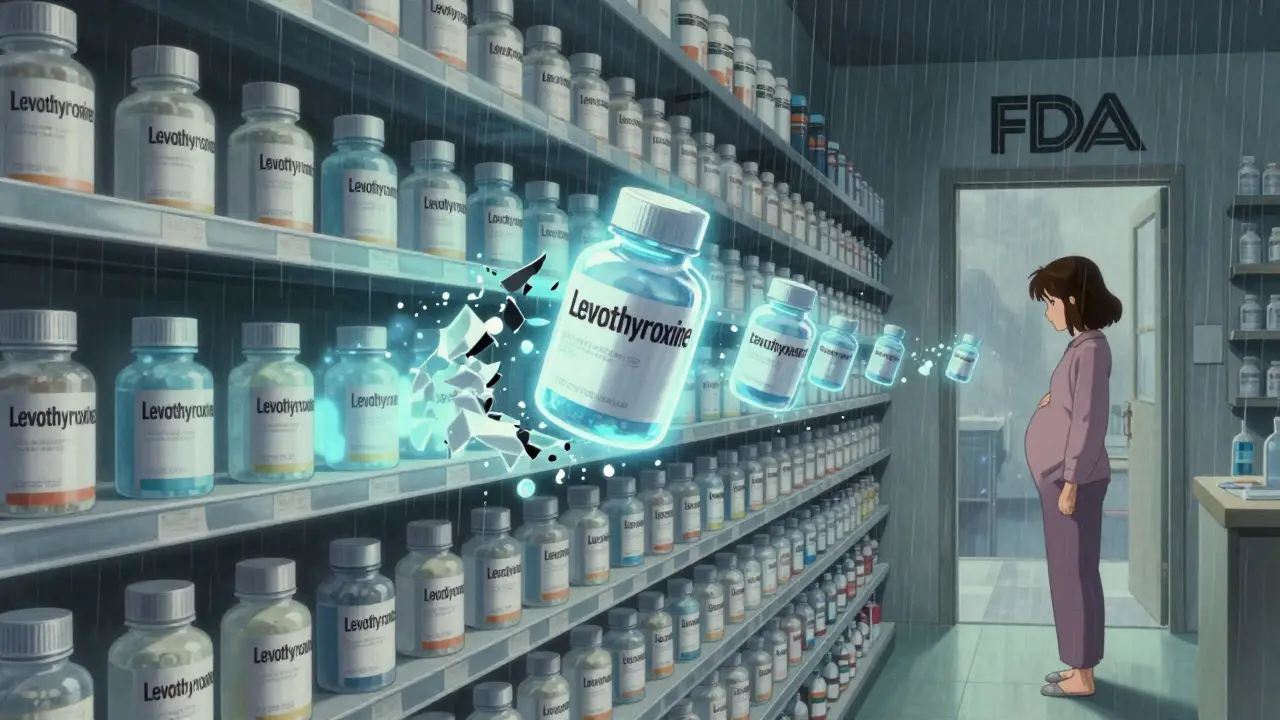
But some drugs need even stricter standards. Take levothyroxine, used to treat underactive thyroid during pregnancy. Untreated hypothyroidism raises your risk of miscarriage by 61% and preterm birth by 39%. Because even small changes in how this drug is absorbed can affect your baby, the FDA tightened the bioequivalence range for levothyroxine generics to 90-112% back in 2012. That’s not a loophole-it’s a safety upgrade.
And here’s something most people don’t realize: if the brand-name drug gets a new pregnancy warning, the generic must update its label within 30 days. The FDA makes sure both versions carry the same warnings, the same cautions, and the same information. There’s no "generic version" of a warning.
What About Inactive Ingredients?
Generics can differ in color, shape, flavor, or filler ingredients-things like cornstarch, dyes, or preservatives. These don’t affect how the drug works. But during pregnancy, your body changes. Your stomach empties slower. Your blood volume increases. Your kidneys filter faster. That’s why some women notice differences.
A 2020 study in the American Journal of Managed Care found that 32.7% of pharmacists had heard from pregnant patients who said they felt different on one generic versus another. For example, some women reported more nausea on one generic version of ondansetron than another. That doesn’t mean the drug failed. It means the fillers might have irritated a sensitive stomach.
That’s why if you’re switching generics and notice something off-more nausea, dizziness, or a change in how you feel-talk to your provider. It’s not about the active ingredient. It’s about your body’s reaction to the formulation. Sometimes, going back to a different generic brand helps.
Common Pregnancy Medications and Their Generics
Many of the drugs you take during pregnancy already have generic versions. And they’re backed by solid data:
- Acetaminophen (Tylenol): The go-to for headaches and fever. Generic versions are identical in safety and effectiveness. No increased risk of birth defects.
- Prenatal vitamins: The active ingredients-folic acid, iron, calcium-are the same. A Reddit thread with nearly 300 responses found 63% of users saw no difference between brand and generic. A few said generics caused more nausea, but others said the opposite.
- Methyldopa: Used for high blood pressure in pregnancy. Generic versions have been used for decades with no safety concerns.
- Metformin: For gestational diabetes. A 2021 study of 157 women using generic metformin showed the same outcomes as those using the brand name.
- Doxylamine-pyridoxine (Diclegis): For nausea. Approved as a generic in late 2022. No new safety signals since.
Even high-risk drugs like isotretinoin (formerly Accutane) have generics-and they’re just as tightly controlled. The iPLEDGE program, which requires monthly pregnancy tests and birth control for anyone taking this drug, applies equally to every version. FDA data from 2018-2022 showed no difference in pregnancy rates between brand and generic isotretinoin.
What Experts Say
Dr. Siobhan Dolan, a leading OB-GYN, puts it simply: "The molecular structure is the same. The safety data applies directly." The American College of Obstetricians and Gynecologists (ACOG) agrees. Their 2020 guidelines say providers should feel confident prescribing generics during pregnancy. No hesitation needed.
But not everyone is so sure. Dr. Kristin Palmsten points out that pregnancy changes how your body handles drugs. Slower digestion, more fluid in your blood-these could, in theory, make tiny differences in how a generic is absorbed. But after studying thousands of cases, she adds: "We haven’t seen evidence that this changes outcomes."
And here’s the kicker: the FDA’s own adverse event database shows no spike in problems with generics during pregnancy. The same goes for MotherToBaby, which tracks medication exposures during pregnancy. Their registry includes over 2,000 cases of generic use-with no pattern of increased risk.
What You Should Do
Here’s a practical guide:
- Don’t refuse a generic because it’s generic. If your doctor prescribes it, it’s because the benefits outweigh any theoretical risk.
- Ask about the manufacturer. Some pharmacies switch generic brands without telling you. If you notice a change in how you feel, ask if the pill you got is the same as before.
- Report changes. If you feel worse after switching-more nausea, dizziness, headaches-tell your provider. It might not be the drug. It might be the filler.
- Avoid compounded meds. These aren’t FDA-approved generics. They’re made in small labs and aren’t tested for safety in pregnancy.
- Keep using prenatal vitamins. Whether they’re brand or generic, they contain the same nutrients. Skipping them because of cost or fear is riskier than taking a generic.

Why This Matters
Cost matters. A brand-name prenatal vitamin can cost $50 a month. A generic? $10. That’s not a luxury-it’s a lifeline for families. If you’re choosing between taking a pill and not taking it, the generic is the answer.
And the system is getting better. The FDA’s Sentinel Initiative now tracks medication use in real time across millions of electronic health records. By 2027, 95% of pregnancy medications will have generic versions. Better monitoring means fewer surprises.
Still, 41% of OB-GYNs say patients are hesitant. That’s not because the science is unclear. It’s because the messaging hasn’t caught up. You deserve to know: the generic you’re taking is not a second-choice option. It’s the same medicine, tested the same way, held to the same standard.
Frequently Asked Questions
Are generic medications less effective during pregnancy?
No. Generic medications must prove they work the same way as brand-name drugs in your body. The FDA requires them to deliver the same amount of active ingredient within a strict range. For drugs like levothyroxine and metformin, which are critical in pregnancy, the standards are even tighter. There’s no evidence that generics are less effective.
Can switching from brand to generic harm my baby?
There’s no proof that switching causes harm. The active ingredient is identical. However, some women notice changes in side effects-like more nausea-due to different inactive ingredients. If you switch and feel different, talk to your provider. You might need to try a different generic brand, but that doesn’t mean generics are unsafe.
Why do some doctors still hesitate to prescribe generics?
Most don’t. But some patients express fear, and doctors may respond by sticking with brand names to avoid conflict. This isn’t based on science-it’s about patient anxiety. Studies show that after a quick explanation, over 80% of women feel comfortable using generics. Education matters.
Is it safe to take generic prenatal vitamins?
Yes. The active ingredients-folic acid, iron, calcium, DHA-are identical. A large Reddit survey found 63% of users saw no difference between brand and generic. A few reported more nausea, but others said the opposite. The nutrients are what matter, not the brand name.
What should I do if I’m worried about a generic I’m taking?
Don’t stop taking it. Call your provider or pharmacist. Ask: "Is this the same active ingredient?" and "Has this been used safely in pregnancy?" Most generics have been used for years. If you’re still unsure, ask if you can try a different generic brand. But don’t skip the medication-it’s often more dangerous to go without it.
Taylor Mead
February 18, 2026 AT 11:49Look, I get why people freak out about generics. I used to be one of them. But after my second pregnancy, I switched from brand-name prenatal to a $12 generic and didn’t even notice the difference. No nausea spike, no weird side effects. Just same folic acid, same iron, same peace of mind.
Turns out, my OB-GYN was right - the FDA doesn’t cut corners on pregnancy meds. If it’s approved, it’s safe. Stop overthinking it.
Irish Council
February 20, 2026 AT 09:09Laura B
February 21, 2026 AT 17:26I’m a pharmacist in rural Texas and I see this all the time. Women will refuse a generic because they think it’s "weaker" - but then they’ll switch back to the brand and say, "I feel better now."
Turns out, it’s often the filler - cornstarch, dye, whatever - that’s upsetting their stomach. Not the drug.
Pro tip: if you notice a change after switching, ask for a different manufacturer. Not all generics are made equal. The active ingredient? Always the same.
Robin bremer
February 22, 2026 AT 23:37Jayanta Boruah
February 24, 2026 AT 23:27It is imperative to recognize that the bioequivalence standards established by the FDA, while statistically robust, do not account for inter-individual pharmacokinetic variability, particularly in the context of pregnancy-induced physiological alterations such as increased glomerular filtration rate and altered hepatic metabolism.
Therefore, while population-level data may demonstrate equivalence, individual patient outcomes may diverge due to epigenetic, microbiome, or hormonal modulation of drug absorption - a phenomenon insufficiently addressed in current regulatory frameworks.
Hariom Sharma
February 26, 2026 AT 14:20Bro, you’re overcomplicating this. Generics saved my wife’s pregnancy. Brand prenatal was $60 a month. Generic? $10. She took it every day. Baby’s healthy. No issues.
Stop letting fear drive your choices. The science is clear. Your baby needs the nutrients - not the fancy packaging.
Nina Catherine
February 27, 2026 AT 04:36i just switched to a generic for nausea and now i feel like i’m gonna die every morning 😭 is this normal?? i thought they were the same??
also my pill is blue now?? i miss the pink one…
Benjamin Fox
February 28, 2026 AT 05:25Jonathan Rutter
March 1, 2026 AT 06:47Here’s the truth no one wants to admit: generics are fine until they’re not. I had a patient who switched to a generic levothyroxine and went into thyroid storm. Her TSH spiked from 2.1 to 18.7 in two weeks.
Turns out, the manufacturer used a different binding agent. The FDA says 80-125% is fine - but what if your body needs 98%? What if you’re one of the 3% who can’t tolerate the variation?
Don’t treat this like a commodity. Your baby’s brain development isn’t a cost-cutting exercise.
Jana Eiffel
March 2, 2026 AT 21:24The ontological equivalence of pharmaceutical agents cannot be reduced to molecular identity alone. The phenomenological experience of the pregnant subject - shaped by somatic transformation, cultural perception, and pharmacological expectation - introduces an epistemic gap between bioequivalence and therapeutic equivalence.
Thus, while regulatory frameworks may assert sameness, the lived reality of the patient demands a more nuanced, individualized approach to therapeutic substitution.
John Cena
March 3, 2026 AT 07:41Been a nurse for 15 years. Seen hundreds of pregnant women on generics. Never once saw a bad outcome tied to the generic version. The panic? It’s mostly fear of the unknown.
Same active ingredient. Same data. Same safety record.
Just take the damn pill.
aine power
March 3, 2026 AT 11:07Tommy Chapman
March 5, 2026 AT 03:35Freddy King
March 6, 2026 AT 01:54Here’s the meta-problem: we’re treating pregnancy as a pharmacokinetic variable rather than a biopsychosocial phenomenon. The real issue isn’t bioequivalence - it’s systemic distrust in healthcare infrastructure. The fact that we even have to debate this reveals deeper pathologies in how we commodify maternal health.
Generics aren’t the problem. The lack of patient-centered education is.
Taylor Mead
March 7, 2026 AT 15:09Went back and read your comment, @7754. I get your fear. But your patient’s TSH spike? That’s why we have pharmacist tracking systems now. Most pharmacies alert you if the generic manufacturer changes. And if you’re on levothyroxine? Your doctor checks your levels every 4 weeks anyway.
It’s not about trusting the system. It’s about trusting your care team. They’re not letting you down - they’re trying to keep you safe and affordable.