

Nausea from Opioids: How to Manage Antiemetics, Timing, and Diet Adjustments
 Feb, 14 2026
Opioid Nausea Timing Calculator
How to Use This Tool
Based on clinical evidence: Take antiemetics 30-60 minutes before your opioid dose to maximize effectiveness. Timing is critical for reducing nausea.
Haloperidol (0.5-2 mg)
Dopamine blocker - Works for 70-75% of patientsBest for severe nausea; avoid if you have Parkinson's or history of movement disorders.
Prochlorperazine (5-10 mg)
Dopamine blocker - Often better toleratedPreferred first-line option by palliative care teams.
Metoclopramide (5-10 mg)
Prokinetic - Speeds stomach emptyingBest if nausea is related to slow digestion or constipation.
Ondansetron (4-8 mg)
Serotonin blocker - Moderately effectiveOnly moderately effective for opioid nausea; better for short-term use.
Your Recommended Timing
When you start taking opioids for pain, nausea isn’t just an inconvenience-it can make you quit the medication altogether. About 30-40% of people new to opioids experience vomiting or severe nausea, especially in the first few days. This isn’t rare. It’s predictable. And it’s manageable-if you know how.
Why Opioids Make You Nauseous
Opioids don’t just block pain signals. They also bind to receptors in a part of your brain called the chemoreceptor trigger zone (CTZ). This area doesn’t care if you’re in pain-it only knows when toxins or chemicals show up. Opioids trick it into thinking you’ve swallowed something poisonous. The result? Your body tries to eject it. That’s nausea. That’s vomiting.It’s not your stomach. It’s your brain. That’s why antacids won’t help. You need to target the signal, not the symptom.
When Does It Happen? Timing Matters
Most people feel sick within 24 to 48 hours after starting an opioid. The nausea peaks when the drug hits its highest level in your blood-usually 60 to 90 minutes after you take it orally. If you’re on a 4-hour dosing schedule, that means nausea often hits right after meals, during work, or before bed. It’s no accident.Here’s the good news: tolerance kicks in. For most people, nausea fades within 3 to 7 days if the dose stays the same. But those first few days? They’re brutal. And they’re the reason many stop taking opioids-even when they’re working well for pain.
Which Antiemetics Actually Work?
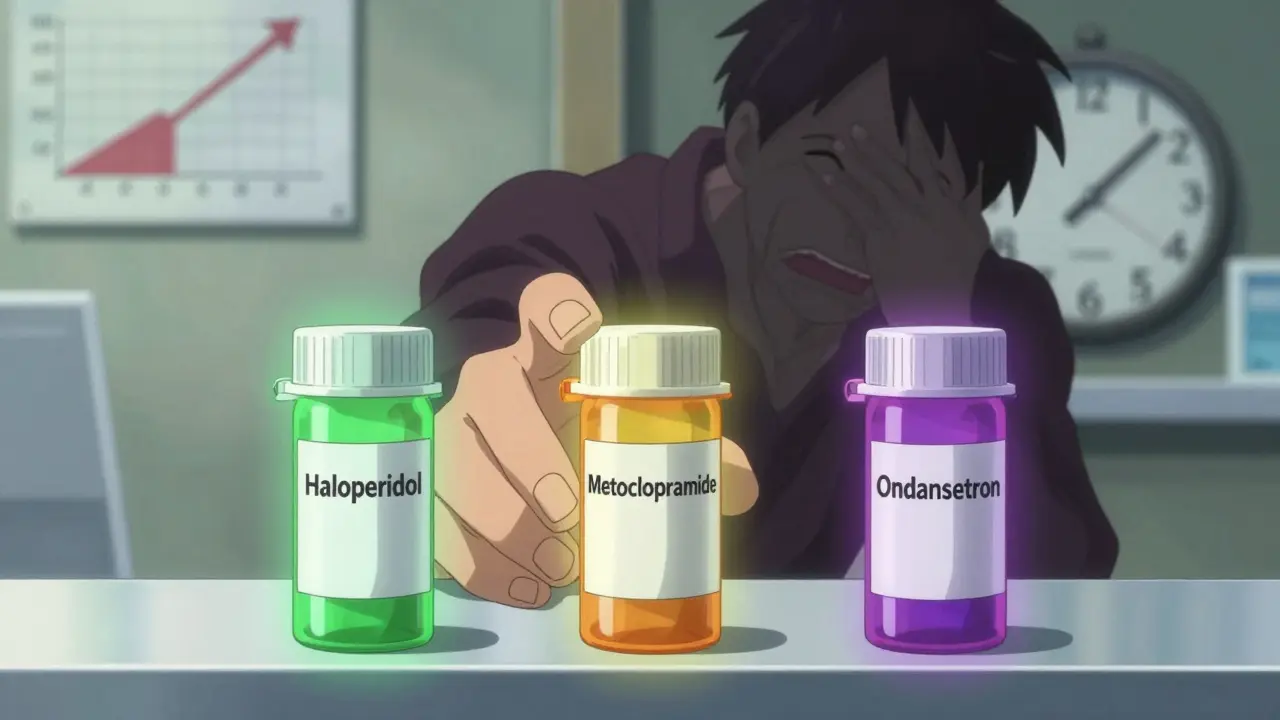
Not all anti-nausea drugs are created equal. Some are better for opioid-induced nausea than others. Here’s what the evidence says:- Haloperidol (0.5-2 mg): A dopamine blocker. Cheap-about $0.05 per tablet. Works well for 70-75% of patients. But it can cause stiffness, tremors, or slow movement, especially in older adults. Avoid if you have Parkinson’s.
- Prochlorperazine (5-10 mg): Also a dopamine blocker. Often better tolerated than haloperidol. Used as a first-line option by many palliative care teams.
- Metoclopramide (5-10 mg every 6-8 hours): The only prokinetic available in the U.S. It speeds up your stomach emptying. Great if your nausea is tied to slow digestion or constipation. But it can cause jitteriness or muscle spasms in 10-15% of users.
- Ondansetron (4-8 mg): Blocks serotonin. Popular because it’s well-known, but studies show it’s only moderately effective for opioid nausea. Best for short-term use or if you can’t tolerate dopamine blockers. Costs about $3.50 per tablet.
- Dexamethasone (4-8 mg IV or oral): Used in cancer care. Works for about half of patients. Mechanism isn’t fully understood, but it’s often added in combination therapy.
Here’s what you need to know: Prophylactic antiemetics (taking them before nausea starts) rarely prevent opioid nausea. A 2019 review of 35 medical centers found no significant benefit. So don’t rely on them as a shield. Use them as a tool-after symptoms appear.
When to Take Antiemetics
Timing is everything. Taking your antiemetic 30 to 60 minutes before your opioid dose gives it time to reach peak levels just as the opioid does. That’s when nausea hits hardest. If you take your opioid at 8 a.m., take your antiemetic at 7 a.m. If you take it at midnight, take the antiemetic at 11 p.m.This small window makes a big difference. Studies show patients who time their antiemetics this way report up to 40% less nausea than those who take them randomly.
Diet Adjustments That Help
You can’t eat your way out of opioid nausea-but you can make it worse or better.- Avoid heavy meals. Large, greasy, or high-fat meals slow stomach emptying. That’s a double hit when opioids are already slowing digestion.
- Eat small, dry snacks. Crackers, toast, or plain rice can help settle your stomach without triggering nausea.
- Stay upright after eating. Don’t lie down for at least 30 minutes after a meal. Gravity helps food move through your system.
- Try ginger. Though not studied specifically for opioid nausea, ginger is backed by evidence for other types of nausea (like motion sickness or chemo). A 250-500 mg capsule or 1 cup of ginger tea before your opioid dose may help.
- Hydrate slowly. Sip water or clear fluids throughout the day. Avoid gulping. Carbonated drinks can cause bloating and make nausea feel worse.
Constipation from opioids can also trigger nausea. If your bowels are backed up, your stomach doesn’t empty properly. That’s why metoclopramide works well for some-it clears the path. Don’t ignore bowel movements. Stool softeners and fiber help reduce this secondary cause of nausea.
What About Switching Opioids?
If one opioid makes you sick, maybe another won’t. This is called opioid rotation.- Morphine to oxycodone: May reduce nausea in some people. Evidence is weak.
- Morphine to methadone: Stronger evidence. Methadone has a different chemical profile. Studies show 50-60% of patients with persistent nausea improve after switching, but this requires careful dosing by a specialist.
- Morphine to hydromorphone: The National Comprehensive Cancer Network (NCCN) says this switch reduces nausea in 40-50% of cancer patients based on retrospective data.
Don’t switch blindly. You need a plan. A 3-day transition with dose adjustments is standard. Do this only under medical supervision.

The ‘Start Low, Go Slow’ Method
This isn’t just advice-it’s a strategy backed by data.Instead of starting with the usual 10 mg of morphine, begin with 2.5-5 mg every 4 hours. Increase by 25-50% every 24-48 hours, not daily. This approach cuts opioid-induced nausea by 35-40%. Why? Your brain gets used to the drug gradually. It doesn’t get shocked.
It takes longer to reach pain control-7 to 10 days instead of 2 or 3. But if you avoid nausea, you’re more likely to stick with it. And that’s the whole point.
What If Nothing Works?
About 42% of cancer patients stop opioids because of uncontrolled nausea-even with antiemetics. That’s alarming.If you’ve tried:
- Timing antiemetics correctly
- Switching antiemetic classes
- Adjusting diet
- Starting low and going slow
and you’re still vomiting or too nauseated to eat, talk to your provider about:
- Lowering the opioid dose by 25-33%. You might still get pain relief without nausea.
- Adding non-opioid pain options (like gabapentin, acetaminophen, or physical therapy).
- Exploring newer agents like 6β-naltrexol, still in trials but showing promise in early studies. In one trial, 1 out of 6 patients got nauseated when given morphine + 6β-naltrexol-compared to 4 out of 6 with morphine alone.
Final Thoughts
Nausea from opioids isn’t a sign you’re doing something wrong. It’s a biological response. And it’s not permanent. With the right combination of timing, medication, and diet, most people get through it.Don’t quit opioids because you feel sick. Work with your provider to adjust. Use antiemetics smartly. Eat light. Time your doses. And remember: the goal isn’t to eliminate nausea completely-it’s to make it manageable so you can live with your pain, not be ruled by it.
Can I take over-the-counter anti-nausea meds like Pepto-Bismol for opioid nausea?
No. Pepto-Bismol and similar products target stomach irritation or acid, not the brain’s chemoreceptor trigger zone. Opioid nausea comes from the brain, not the stomach. These OTC options won’t help. Stick to prescription antiemetics like haloperidol, prochlorperazine, or metoclopramide.
How long should I keep taking antiemetics?
Typically 3 to 7 days after starting the opioid, unless symptoms persist. Most people develop tolerance during this time. If nausea continues beyond 7 days, your provider may need to switch your opioid, adjust the dose, or try a different antiemetic. Don’t keep taking them indefinitely without review.
Can I take antiemetics with other medications?
Some antiemetics interact with other drugs. Metoclopramide and haloperidol can increase sedation when combined with benzodiazepines or sleep aids. Prochlorperazine can affect heart rhythm if you’re on certain antibiotics or antifungals. Always tell your provider about every medication you take-including supplements.
Is nausea a sign I’m taking too much opioid?
Not necessarily. Nausea is more about how your brain responds to the drug than the dose itself. Someone on a low dose can be very nauseated, while someone on a higher dose may feel fine. But if nausea is severe and persistent, your provider may lower your dose by 25-33%-you might still get pain relief without the side effect.
Do I need to avoid food entirely when I’m nauseated from opioids?
No. Avoiding food can make nausea worse. Instead, eat small, bland meals-crackers, toast, rice, applesauce. Stay upright after eating. Skipping meals can lead to low blood sugar and worsen dizziness. The goal is to keep your stomach moving, not empty.
Joe Grushkin
February 14, 2026 AT 19:07Virginia Kimball
February 15, 2026 AT 00:33Chiruvella Pardha Krishna
February 16, 2026 AT 09:02Sarah Barrett
February 16, 2026 AT 09:15Kaye Alcaraz
February 16, 2026 AT 15:18Erica Banatao Darilag
February 18, 2026 AT 08:54Charlotte Dacre
February 19, 2026 AT 17:57Esha Pathak
February 21, 2026 AT 04:33Not just for nausea-ancient Ayurveda knew this. Ginger + warm water + slow sipping = magic. I’ve seen patients on chemo and opioids both benefit. No prescription needed. Just truth from the East. Modern science finally catching up. Namaste.
Mike Hammer
February 21, 2026 AT 10:18Daniel Dover
February 23, 2026 AT 00:26Kapil Verma
February 24, 2026 AT 04:09Michael Page
February 25, 2026 AT 20:15Mandeep Singh
February 25, 2026 AT 23:23Betty Kirby
February 27, 2026 AT 20:20