

Metabolic Rate: How Adaptive Thermogenesis Sabotages Weight Loss and How Reverse Dieting Can Help
 Dec, 29 2025
After losing 50 pounds, Sarah thought she’d finally beat her metabolism. She’d eaten clean, lifted weights, tracked every calorie - and yet, after six months of maintenance, she started gaining back every pound she lost. She wasn’t lazy. She wasn’t eating more. Her scale just wouldn’t budge. What she didn’t know was that her body had started adaptive thermogenesis - a hidden biological switch that slows metabolism to protect against starvation. And it’s happening to millions of people who lose weight and then watch it creep back on.
What Is Adaptive Thermogenesis?
Adaptive thermogenesis isn’t just a fancy term for a slow metabolism. It’s your body’s survival mode kicking in after you lose weight. When you cut calories, your body doesn’t just burn less because you’re lighter - it actively lowers your energy expenditure beyond what your new weight should require. That drop? It’s extra. It’s not just from losing muscle or fat. It’s your body fighting to get you back to your old weight. Research from Columbia University shows this isn’t rare. It happens in almost everyone who loses significant weight, whether they were obese or just overweight. In one landmark study, participants from the TV show The Biggest Loser still had metabolisms running 500 kcal/day slower than expected, six years after losing over 100 pounds each. That’s like eating an extra slice of pizza every single day without gaining weight - and yet, most of them regained nearly all the weight. This isn’t your fault. It’s biology. Your body treats weight loss like famine. Leptin, insulin, thyroid hormones, and even your nervous system all dial down to conserve energy. Brown fat, once thought to be a major player, may contribute less than we thought - but the overall effect is real. One study found that after just one week of dieting, people burned an average of 178 fewer calories per day - not because they moved less, but because their bodies literally turned down the heat.Why Reverse Dieting Is the Only Real Way Forward
Most people think the answer is to eat even less. But that’s like trying to fix a leaky roof by drilling more holes. Reverse dieting flips the script. Instead of pushing harder to lose more, you slowly add calories back in - not to gain weight, but to retrain your metabolism to handle more food without storing it. The goal? Get your body used to eating at maintenance levels again. Not by jumping back to your old intake, but by creeping up: 50 to 100 extra calories per week. If your weight stays stable, you keep going. If you gain more than half a pound in a week, you pause for another week before adding more. This isn’t magic. It’s physics. Your body needs time to adjust its hormones, reset leptin levels, and rebuild muscle if you’ve lost any. The slower you go, the better your chances of avoiding regain. People who reverse diet over 3 to 6 months report better energy, fewer cravings, and more stable weight than those who just stop dieting and eat normally again.What Actually Works - and What Doesn’t
Not all reverse dieting advice is created equal. Here’s what science says matters:- Protein is non-negotiable. Eat 1.6 to 2.2 grams of protein per kilogram of body weight. That’s about 120-150g per day for a 150-pound person. Protein preserves muscle, and muscle burns more calories at rest.
- Strength training is your secret weapon. Two to three sessions a week of lifting weights can reduce the drop in metabolism by up to 15%. Muscle doesn’t just look good - it keeps your metabolism active.
- Don’t rush. Adding more than 150 calories per week is a recipe for fat gain. Your body needs weeks to adapt to each new calorie level.
- Track indirect signs. Your resting heart rate and morning body temperature can drop by 5-10% when your metabolism is suppressed. If those numbers start rising as you eat more, it’s a good sign your metabolism is waking up.

Who’s Most at Risk?
Some people are more vulnerable than others. If you’ve:- Lost 20+ pounds or more
- Been on a very low-calorie diet (under 1,200 kcal/day) for more than 8 weeks
- Done multiple weight loss cycles (yo-yo dieting)
- Had your weight drop rapidly (more than 2 pounds per week)
The Bigger Picture: Why Surgery Works Better
It’s no coincidence that people who get gastric bypass surgery often keep weight off longer than those who diet. Research shows that while both groups lose similar amounts of weight, the metabolic drop after surgery is smaller. Why? Because surgery changes gut hormones, insulin sensitivity, and appetite signals in ways diet alone can’t. It doesn’t just shrink your stomach - it resets your brain’s set point. That doesn’t mean surgery is the answer for everyone. But it does prove one thing: metabolic adaptation isn’t just about calories in and out. It’s about biology. And biology responds to more than willpower.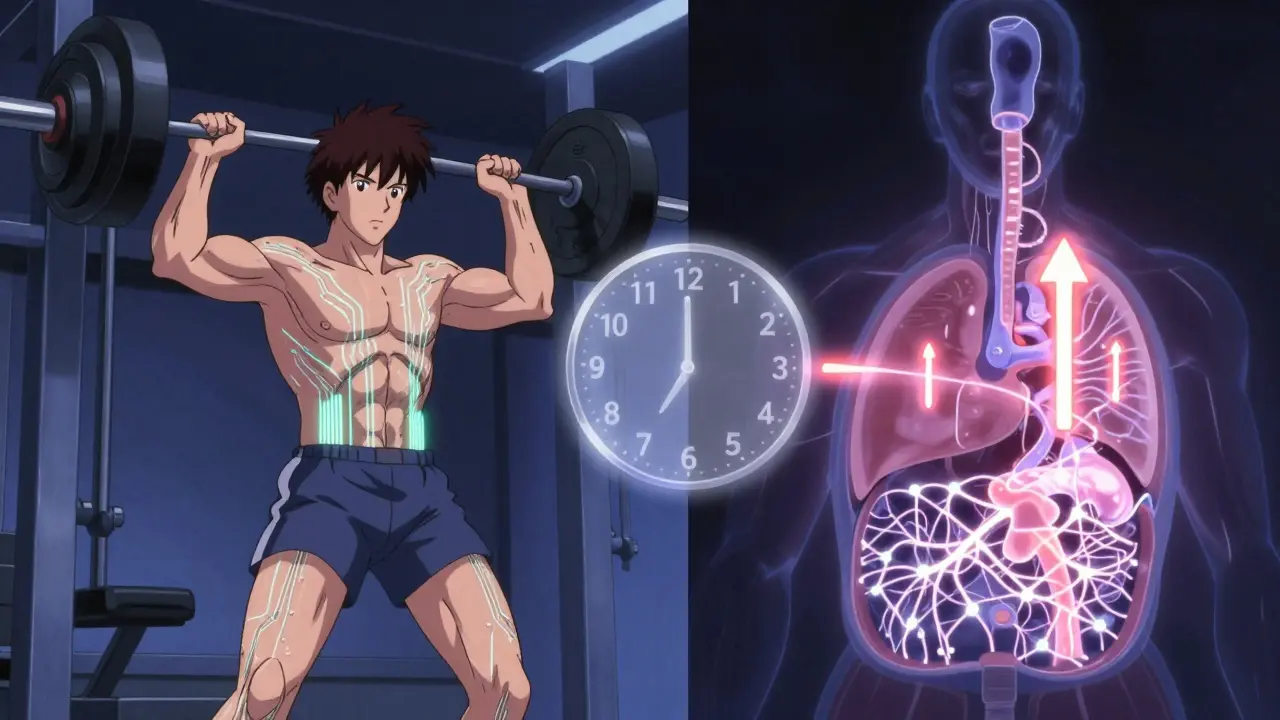
What’s Next? The Science Is Evolving
Scientists are now looking at ways to fight adaptive thermogenesis before it even starts. Clinical trials are testing drugs that activate brown fat. Others are studying how specific gut bacteria influence metabolism after weight loss. Early data shows certain probiotics might help prevent the metabolic slowdown. Meanwhile, companies like Levels and Zoe are using continuous glucose monitors to track how your body responds to food in real time. They’re building tools to predict who’s likely to regain weight - and how to stop it. But for now, the best tool you have is reverse dieting. It’s not glamorous. It doesn’t make headlines. But it’s the only method proven to help your metabolism recover after weight loss.Start Here: Your 4-Step Reverse Dieting Plan
1. Calculate your current maintenance calories. Use an online TDEE calculator, then subtract 200-300 kcal to account for adaptive thermogenesis. That’s your starting point. 2. Add 50-100 kcal per week. Focus on adding carbs and fats first - not protein. Keep protein high (1.6-2.2g/kg) throughout. 3. Monitor your weight and energy. If your weight stays stable for two weeks, add more. If you gain more than 0.5 lb, hold for another week. Don’t panic over small fluctuations. 4. Keep lifting weights. At least two full-body sessions per week. Muscle is your metabolic insurance policy. Do this for 3-6 months. You won’t see results overnight. But if you stick with it, your body will learn to trust food again - and stop hoarding fat.Can you reverse adaptive thermogenesis completely?
Most people can restore 80-90% of their original metabolic rate with consistent reverse dieting, resistance training, and adequate protein intake. Complete reversal isn’t guaranteed - especially after extreme weight loss or multiple diet cycles - but significant improvement is common. The goal isn’t to return to your pre-diet metabolism, but to reach a sustainable, healthy maintenance level.
How long does reverse dieting take?
It typically takes 3 to 6 months, depending on how much weight you lost and how low your calories were. Someone who lost 30 pounds over 6 months might take 4 months to reverse diet. Someone who lost 100 pounds over a year may need 8-12 months. Rushing it increases the risk of regain.
Do I need to keep reverse dieting forever?
No. Once you reach your maintenance calories and your weight stabilizes for 4-6 weeks, you’re done. You don’t need to keep adding calories. You just need to stick with that level - and keep lifting weights and eating enough protein. Reverse dieting is a bridge, not a lifestyle.
Can I reverse diet if I’m still losing weight?
Yes - and you should. If you’ve been losing weight slowly (0.25-0.5 lb per week) and feel exhausted, hungry, or irritable, your metabolism is likely adapting. Adding 50 kcal/week may slow your loss slightly, but it will help you sustain it long-term. The goal isn’t speed - it’s sustainability.
What if I gain weight during reverse dieting?
A small gain (up to 0.5 lb per week) is normal as your body re-learns how to handle more food. If you gain more than that for two weeks straight, pause the increases for 1-2 weeks and maintain your current intake. Don’t go back to your old diet. Just hold steady. Your metabolism will catch up.
Teresa Rodriguez leon
December 29, 2025 AT 15:33After 3 years of yo-yoing, I finally get it now. This isn't about willpower. It's biology. I thought I was broken. Turns out, my body was just trying to survive.
Nicole K.
December 30, 2025 AT 12:31You people are so lazy. If you just stopped eating junk and did more cardio, you wouldn't need all this fancy science. It's simple: eat less, move more. End of story.
Sharleen Luciano
December 31, 2025 AT 13:37Oh please. Another ‘reverse dieting’ guru selling snake oil disguised as biochemistry. The fact that you're citing The Biggest Loser as a valid model proves you haven't read the follow-up studies. That cohort had metabolic rates that never recovered because they were starved into organ failure. This isn't adaptation-it's trauma. And now you're telling people to *add calories* like it's some kind of spiritual reset? Please. If you want to fix your metabolism, stop pretending it's a dial you can turn with macros. It's a complex endocrine ecosystem. You don't reverse it-you manage it. And most people don’t have the patience, the access, or the mental bandwidth to do that properly. So yes, they gain it back. Not because they’re weak. Because the system is rigged.
Henriette Barrows
January 2, 2026 AT 13:29This made me cry. Not because I’m sad-but because I finally feel seen. I lost 40 pounds, felt amazing for a while, then everything collapsed. I thought I was failing. Turns out my body was just doing its job. I’m starting reverse dieting next week. No more guilt. Just patience.
Alex Ronald
January 2, 2026 AT 18:55Protein intake is everything. If you're not hitting 1.8g/kg, you're fighting an uphill battle. Muscle isn't just for looks-it's your metabolic engine. And yes, lifting heavy twice a week is non-negotiable. I've seen clients regain 15 lbs in 3 months because they stopped training. Not because they ate more. Because they lost lean mass. Your metabolism doesn't care about calories alone. It cares about tissue.
Manan Pandya
January 4, 2026 AT 18:38Excellent breakdown. I appreciate the emphasis on hormonal adaptation over simplistic calorie math. Many people misunderstand that adaptive thermogenesis isn't a flaw-it's an evolutionary feature. The body prioritizes survival over aesthetics. Reverse dieting is not indulgence; it's recalibration. Also, tracking resting heart rate and morning temperature is a brilliant, low-cost proxy for metabolic recovery. Most professionals overlook these markers.
Aliza Efraimov
January 6, 2026 AT 11:03OMG I’M NOT ALONE!!! I thought I was the only one who felt like a zombie after losing weight. I was eating 1,300 calories, doing HIIT 5x a week, and STILL gaining? I was ready to quit. But this? This makes sense. I’m starting reverse dieting tomorrow. I’m scared, but I’m also… hopeful? Like, maybe I don’t have to hate food forever?
Tamar Dunlop
January 7, 2026 AT 22:00While the concept of adaptive thermogenesis is well-documented, I find the notion of reverse dieting to be somewhat oversimplified in popular discourse. The physiological mechanisms involved are deeply intertwined with neuroendocrine feedback loops, and while gradual caloric increase may facilitate hormonal normalization, it is not universally effective. Moreover, the assumption that metabolic rate can be fully restored ignores individual variability in genetic predisposition and epigenetic memory. One must approach this with clinical nuance-not as a DIY protocol.
David Chase
January 9, 2026 AT 18:01LMAO at all these ‘reverse dieting’ posts. You people are pathetic. You lost weight, now you wanna eat pizza and call it ‘metabolism healing’? 🤡 You think your body’s gonna forgive you for starving it for a year? Nah. It remembers. And it’s gonna make you pay. I’ve seen 100+ people try this. 98% gained back double. The only thing that works? Bariatric surgery. Or just stay skinny and stop whining. 🍕💀
Emma Duquemin
January 10, 2026 AT 00:22I did reverse dieting for 8 months after losing 60 lbs. I started at 1,100 calories. Now I eat 2,300. I’m not ‘fat.’ I’m *recovered.* My energy? Like a damn dragon. My cravings? Gone. My period came back. My skin stopped breaking out. I used to cry in the shower because I felt like a failure. Now I dance in the kitchen while making oatmeal. This isn’t a diet. It’s a homecoming.
Kevin Lopez
January 11, 2026 AT 15:13Adaptive thermogenesis ≠ metabolic damage. TDEE recalibration post-deficit is expected. Protein >1.6g/kg, resistance training, caloric progression ≤100kcal/wk. No magic. Just math. Stop romanticizing it.
Duncan Careless
January 13, 2026 AT 10:23Interesting stuff. I lost 35lbs last year and felt like my body was shutting down. I didn’t know what was happening. Reverse dieting sounds like the right way to go-slow and steady. I’m gonna try it. Thanks for the clarity. Not sure if I’ll stick with it, but at least now I know it’s not just me being lazy.