

How to Set Achievable Adherence Goals and Track Progress for Medication Compliance
 Dec, 1 2025
Taking your medicine as prescribed sounds simple-until you’re juggling multiple pills, side effects, work schedules, or just plain forgetfulness. For people managing chronic conditions like diabetes, high blood pressure, or asthma, missing even a few doses can lead to serious health setbacks. The good news? You don’t have to rely on willpower alone. Setting achievable adherence goals and tracking progress changes everything.
Why Most Medication Plans Fail
It’s not laziness. It’s not lack of care. Nearly half of all people with chronic illnesses don’t take their meds as directed. Why? Because traditional advice-“Take this twice a day”-is too vague. No one tells you how to fit it into your life, what to do when you miss a dose, or how to know if you’re actually succeeding. Studies show that when patients are just told to “be compliant,” they overestimate their adherence by 30-40%. One person might think they’re taking their pills every day because they remember taking them on Monday, Wednesday, and Friday. But they missed Tuesday, Thursday, Saturday, and Sunday. That’s not compliance. That’s guesswork. The solution? Turn vague instructions into clear, trackable goals. That’s where SMART goals come in. Originally a business tool from the 1980s, SMART goals are now used by clinics, pharmacies, and digital health apps to help people stick to their treatment plans-with real results.What SMART Goals Really Mean for Medication Adherence
SMART isn’t just a buzzword. It’s a structure that turns confusion into clarity:- Specific: Not “take my blood pressure pill.” Instead: “I will take my lisinopril 10mg at 8 a.m. every morning with my breakfast.”
- Measurable: How will you know you did it? Count pills left in the bottle. Use a pill tracker app. Sync with a smart pill bottle that logs each opening.
- Achievable: If you work two jobs and get home at 11 p.m., setting a goal to take your pill at 7 a.m. might be unrealistic. Adjust it to when you’re most likely to remember-maybe right before bed.
- Relevant: Why does this matter to YOU? Not because your doctor said so. Because you want to avoid another hospital visit. Because you want to play with your grandkids without feeling tired all the time.
- Time-bound: Set check-in dates. “I’ll review my pill count every Sunday at 6 p.m.” Or “I’ll check my glucose readings every Friday and compare them to last week.”
Start by Identifying Your Biggest Barriers
Before you even set a goal, ask: What’s stopping me? Some common barriers:- Cost: The pill is too expensive, so I skip doses to make it last.
- Side effects: I feel dizzy after taking it, so I stop.
- Complexity: I have six different pills at different times. I get confused.
- Memory: I forget unless I’m reminded.
- Access: I don’t have reliable transportation to the pharmacy.
- Literacy: I don’t understand the instructions.
How to Track Progress Without Going Crazy
Tracking doesn’t mean logging every pill in a notebook for six months. There are easier, smarter ways.- Smart pill bottles: These cap devices beep if you don’t open them on time and send alerts to your phone or your care team. Accuracy: 98%.
- Pharmacy refill records: Your pharmacy tracks when you pick up refills. If you haven’t refilled in 45 days for a 30-day supply, that’s a red flag.
- App-based trackers: Apps like Medisafe or ThoroughCare let you tap a button when you take a pill. They send reminders, show weekly graphs, and even let you share progress with family or your doctor.
- Wearables and sensors: For diabetes, continuous glucose monitors show how your blood sugar responds to your meds. If your numbers improve after a week of consistent dosing, that’s proof it’s working.
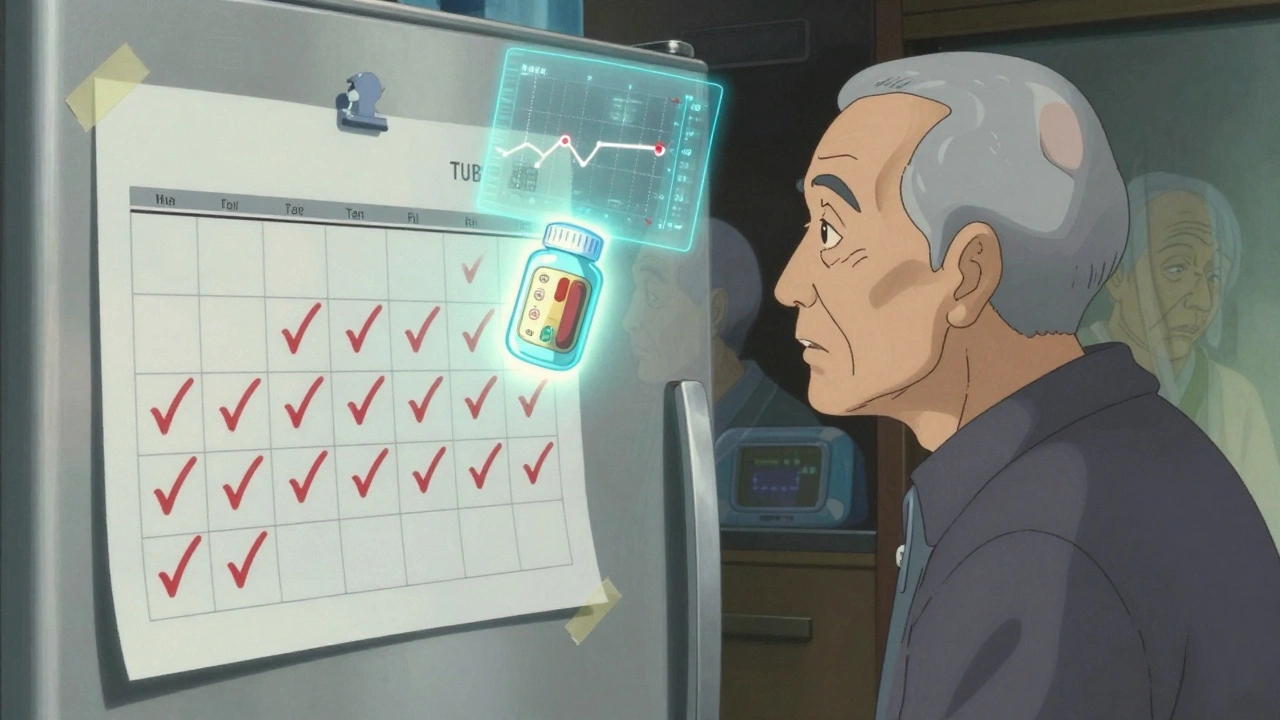
- Simple checklists: If tech isn’t your thing, print a calendar. Put a big green checkmark every day you take your meds. No fancy tech needed.
Real Examples That Worked
Here’s what real people did:- Maria, 68, with hypertension: She used to forget her amlodipine. She started keeping it next to her toothbrush. Every morning after brushing, she took it. She used a paper calendar. After three weeks, she had 21 checks in a row. Her BP dropped 12 points.
- James, 52, with asthma: He didn’t use his inhaler unless he felt wheezy. His doctor helped him set a goal: “Use my inhaler every morning and night, even when I feel fine.” He synced his inhaler with a sensor app. It showed him he was only using it 3 times a week. He started getting daily reminders. After a month, he was using it 14 times a week. His ER visits dropped from 3 to 0.
- Linda, 71, with type 2 diabetes: She felt overwhelmed by her 7 daily pills. She worked with her pharmacist to simplify: “Take metformin with breakfast and dinner, glimepiride with breakfast, and the rest with dinner.” She used a pill organizer with days of the week. She celebrated every Sunday when she got all her pills in. Her A1C dropped from 8.4 to 7.1 in four months.
What to Do When You Slip Up
You’re going to miss a dose. Maybe more than one. That’s normal. The mistake isn’t missing the pill. The mistake is giving up because you missed it. Instead:- Don’t double up unless your doctor says so.
- Ask yourself: What happened? Was it a busy day? Did you run out? Did you feel sick?
- Adjust your goal. If you keep forgetting at night, move it to morning.
- Use your tracker to see the pattern. Did you miss it every time you ate out? Then plan ahead-pack your pills when you leave the house.
How Providers Can Help (Even in Short Appointments)
If you’re a patient, ask your doctor or pharmacist: “Can we set one simple adherence goal this visit?” If you’re a provider, you don’t need 30 minutes. Use this 5-minute framework:- Ask: “What’s the hardest part about taking your meds?”
- Listen. Don’t interrupt.
- Help them pick ONE thing to improve this week.
- Define it using SMART: “So you’ll take your pill at 8 a.m. with coffee, and you’ll check your app every Sunday?”
- Give them a tool: a printed tracker, a free app, or a reminder sticker.

The Bigger Picture: Why This Matters
Medication non-adherence costs the U.S. healthcare system $300 billion a year. That’s billions in avoidable hospital stays, ER visits, and complications. But beyond the numbers-it’s about your life. Taking your meds consistently means:- More energy to play with your kids or grandkids
- Less pain, fewer headaches, better sleep
- Staying independent longer
- Not being the person who always has to cancel plans because they feel awful
What’s Next? AI and the Future of Adherence
The next wave of adherence tools uses AI. Apps now predict when you’re likely to miss a dose-14 days in advance-by analyzing your past behavior. Some smart pill bottles adjust reminders based on your schedule. Voice assistants like Amazon Halo can ask, “Did you take your pill today?” and remember your answers. By 2026, all major electronic health records will be required to include standardized fields for adherence goals. That means your doctor will see your progress-not just your lab results. But the core hasn’t changed. Technology helps. But the real breakthrough is still you-setting a goal that fits your life, tracking it simply, and not giving up when you stumble.What’s the easiest way to start tracking my medication adherence?
Start with one pill you take daily and use a free app like Medisafe or a simple paper calendar. Mark each day you take it. After a week, check your streak. If you missed a day, ask why. Adjust your time or place-maybe take it with your morning coffee instead of at night. Small wins build momentum.
I have too many pills. How do I not get overwhelmed?
Work with your pharmacist to simplify. Can some pills be taken together? Are there combination pills available? Use a pill organizer with compartments for morning, afternoon, evening, and night. Set one phone alarm for each time you need to take pills. Focus on getting one routine down before adding another.
My pills are expensive. I skip doses to make them last. What can I do?
Talk to your doctor or pharmacist about generic options, patient assistance programs, or mail-order pharmacies. Many drugmakers offer coupons or free samples. Never skip doses without talking to your provider first-alternatives exist. Your health isn’t worth the risk.
I’m older and don’t use smartphones. Can I still track my adherence?
Absolutely. Use a printed calendar taped to your fridge or medicine cabinet. Put a big checkmark or sticker on each day you take your pills. Ask a family member to check in once a week. Some pharmacies offer free pill organizers with your prescription. Simple works better than high-tech when it’s sustainable.
How do I know if my adherence goal is working?
Look for changes in how you feel and your health numbers. Are you sleeping better? Less dizzy? Lower blood pressure? Better blood sugar? Your doctor can also check refill records or use a smart device to see your usage patterns. If your numbers are improving and you’re hitting your weekly check-ins, you’re on track.
What if I miss a week? Should I start over?
No. Don’t restart. Just continue. Look at your tracker and ask: What changed? Were you sick? Traveling? Stressed? Adjust your goal to fit your new reality. Maybe you need a reminder at lunch instead of breakfast. Progress isn’t about perfection-it’s about persistence.
patrick sui
December 2, 2025 AT 23:21SMART goals are legit game-changers for med adherence - I’ve seen patients go from 30% to 85% compliance just by tying pills to existing habits (brushing teeth, coffee, etc.). Smart bottles + app syncs? Chef’s kiss 🤌. The real win is making it *personal*, not prescriptive.
Declan O Reilly
December 3, 2025 AT 23:06so many people think compliance is about willpower but its really about design. if your life doesnt support the habit, youll fail. its not you its the system. i used to miss my bp meds till i started keeping em in my sock drawer next to my slippers. now i take em before i even stand up. dumb? maybe. works? hell yes.
Nnaemeka Kingsley
December 4, 2025 AT 06:55bro this is so real. in my village, people skip meds cause they cost too much. but if you just put the pill in a matchbox and keep it with your phone, you remember. no app needed. just habit + reminder. small things, big change.
Kshitij Shah
December 4, 2025 AT 12:54oh wow another ‘SMART’ framework. next they’ll tell us to ‘synergize our wellness paradigms’ with blockchain-enabled pill dispensers. 🙄 i take my meds when i remember. if i forget, i guess my body’s telling me something. maybe the drug isn’t for me.
Matt Dean
December 6, 2025 AT 08:53if you can’t follow a simple pill schedule, you shouldn’t be trusted with your own health. this article reads like a kindergarten handbook for adults who can’t adult. stop making excuses and just do it. 2x a day. not hard.
Walker Alvey
December 6, 2025 AT 08:59you people treat medication like a to-do list. it’s not. it’s a covenant with your future self. if you need a sticker chart to remember your own survival, maybe you’re not ready to be alive. just saying.
Adrian Barnes
December 6, 2025 AT 09:39The empirical data presented in this article is statistically significant, yet the underlying epistemological assumption-that behavioral modification via external tracking mechanisms leads to sustained physiological outcomes-is fundamentally flawed. Compliance is not a function of algorithmic nudges, but of ontological commitment to self-preservation, which remains statistically underrepresented in the general populace.
Declan Flynn Fitness
December 6, 2025 AT 23:26My aunt used a paper calendar and a red marker. Every day she took her meds, she drew a big heart. After 30 days, she had 28 hearts. She cried because she felt proud. No app. No fancy tech. Just love and consistency. 🫶
Michelle Smyth
December 8, 2025 AT 11:00How quaint. A ‘paper calendar’? As if we’re living in 2007. The real innovation is AI-driven predictive adherence modeling, integrated with EHRs and real-time biometric feedback loops. If you’re still using stickers, you’re not managing your health-you’re performing it for a nostalgia podcast.