

How to Manage Mild Side Effects Without Stopping a Medication
 Jan, 30 2026
Starting a new medication can feel like stepping into the unknown. You’re hoping it helps, but you’re also bracing for side effects. The truth? Mild side effects are incredibly common-up to 70% of people experience them in the first week or two. Nausea. Dry mouth. A little fatigue. Loose stools. These aren’t signs the drug is failing. They’re often just your body getting used to it.
Yet, nearly half of all people who stop their meds early do so because they didn’t know how to handle these reactions. And that’s a problem. Stopping a medication you need can lead to worse health outcomes than the side effects themselves. The good news? You don’t have to quit. Most mild side effects can be managed without ditching your prescription.
What Counts as a Mild Side Effect?
Mild side effects are uncomfortable but not dangerous. They don’t require emergency care. Common ones include:
- Nausea or upset stomach
- Dry mouth
- Mild diarrhea or constipation
- Feeling tired or sluggish
- Headaches
- Mild dizziness
These usually show up within the first few days and fade within 1-2 weeks. If you’re on an antidepressant, blood pressure med, or cholesterol drug, your body needs time to adjust. Think of it like breaking in a new pair of shoes-it feels weird at first, but it gets better.
What’s not mild? Chest pain, trouble breathing, swelling, rash with fever, or sudden confusion. If you have any of these, call your doctor right away. But if it’s just a queasy stomach or a dry throat? You’ve got options.
How to Tackle Nausea and Upset Stomach
Nausea is the #1 reason people quit meds. But here’s the thing: taking your pill on an empty stomach is often the culprit, not the drug itself.
Try this: take your medication with a small meal or a glass of milk. For 78% of non-antibiotic prescriptions, food helps buffer the stomach without affecting how the drug works. Avoid greasy, spicy, or overly sweet foods. Stick to bland stuff-toast, rice, bananas. Drink 8-10 ounces of water with your dose. That alone helps 62% of people feel better within 72 hours.
Some people swear by ginger tea or peppermint candy. There’s decent evidence these help soothe nausea. Just avoid alcohol and caffeine-they make it worse.
Fixing Dry Mouth Without Switching Meds
Over 100 common medications cause dry mouth. It’s annoying. It makes speaking, eating, even sleeping harder. But it’s also one of the easiest side effects to fix.
Drink water regularly-not just when you’re thirsty. Sip 1-2 ounces every 15-20 minutes. Keep a water bottle nearby. Use sugar-free gum or lozenges with xylitol or citric acid. Sour candies work because they trigger saliva production. Studies show this boosts saliva flow by 79% within two days.
Avoid mouthwashes with alcohol. They dry you out more. Instead, try a humidifier at night. Your mouth will thank you.
Managing Diarrhea or Constipation
Some meds speed up your gut, others slow it down. Both are common.
If you’re having diarrhea: cut back on caffeine, citrus juice, and high-fiber foods like beans or bran cereal. Stick to low-residue foods-white rice, bananas, applesauce. Loperamide (Imodium) can help, but only use it if your pharmacist says it’s safe with your med. In trials, it worked in 73% of cases when used correctly.
If you’re constipated: drink 2.5-3 liters of water daily. That’s about 10-12 glasses. Eat 30-35 grams of fiber from fruits, veggies, and whole grains. Walk for 30 minutes a day. Even a slow stroll helps your gut move. One study of over 1,200 people found this combo resolved constipation in 68% of cases.

Beating Fatigue Without Caffeine Overload
Feeling drained on a new med? It’s not laziness. Many drugs affect energy levels temporarily.
Don’t reach for energy drinks. They spike your heart rate and make anxiety worse. Instead, focus on rhythm. Eat balanced meals with 45-65% carbs, 20-35% fats, and 10-35% protein. Don’t skip breakfast. Move your body-even a 15-minute walk helps. Aim for 150 minutes of moderate activity a week. And sleep 7-9 hours. A 2021 NIH trial showed this combo improved energy in 63% of people within two weeks.
Try taking your med in the morning if it’s causing drowsiness. Some blood pressure pills, for example, work better and cause less fatigue when taken at night. Talk to your pharmacist about timing.
The Mindset Shift That Changes Everything
Here’s something most doctors don’t tell you: how you think about side effects can change how bad they feel.
Harvard researchers ran three studies where patients were told, “These mild sensations mean your treatment is working.” Not “It’s just a side effect.” Not “It’ll pass.” But “This is your body responding to the medicine.”
Result? Patients reported 40% less symptom intensity. They were less anxious. They called their doctors less. And they stayed on their meds longer.
This works best for drugs that take weeks to kick in-like antidepressants, thyroid meds, or blood pressure pills. If you’re on an antibiotic or blood thinner, this trick doesn’t apply as much. But for chronic conditions? Reframing side effects as signs of progress can be powerful.
What to Do When It Doesn’t Get Better
Not every side effect vanishes on its own. If after 7-10 days you’re still struggling, don’t wait. Don’t just “tough it out.”
Write down exactly what you’re feeling, when, and how often. Note what you’ve tried. Then call your prescriber or pharmacist. Don’t say, “I feel weird.” Say, “I’ve had nausea after taking my pill at 8 a.m. I tried it with toast and milk, and it helped a little, but it’s still happening.” Specifics help them help you.
Many side effects can be fixed with small tweaks: changing the time you take it, switching brands, or adding a low-dose supplement. But you won’t get there unless you speak up.
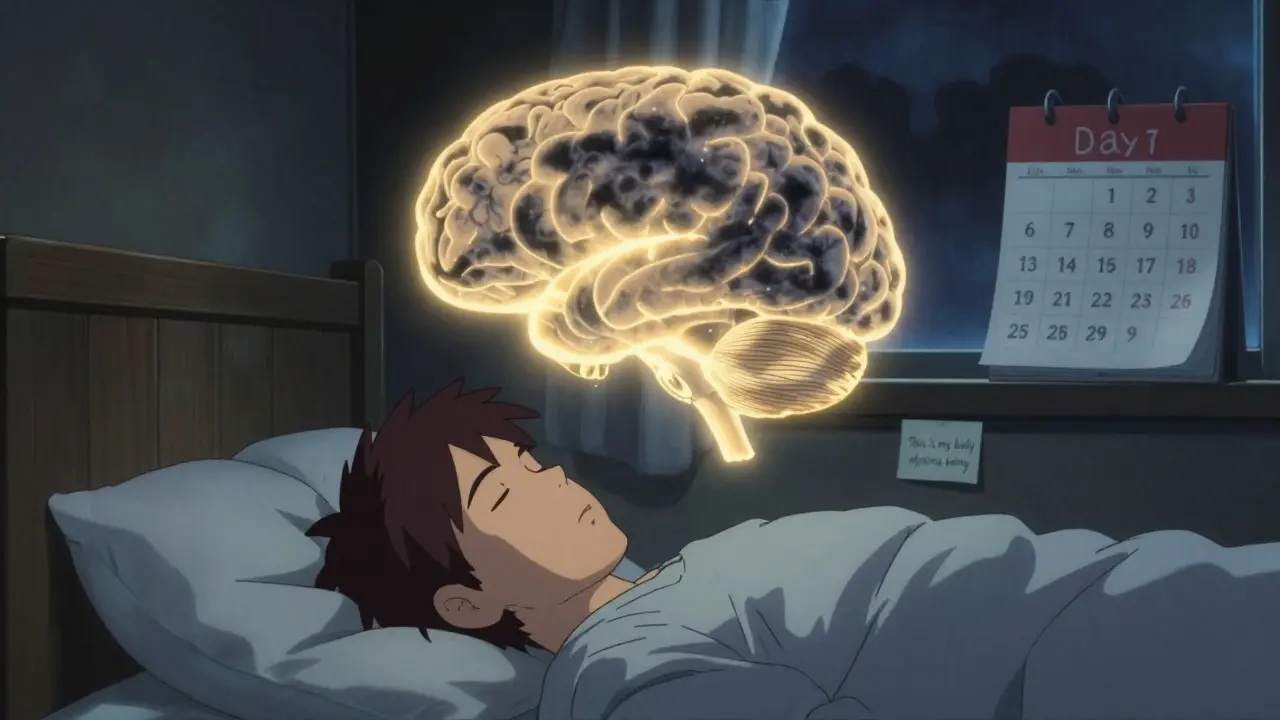
Why This Matters More Than You Think
Every time you quit a medication because of a mild side effect, you’re risking your health. A 2021 study found people who stuck with their meds despite side effects were 65-80% more likely to still be taking them six months later. That’s huge.
For people with high blood pressure, diabetes, or depression, staying on treatment isn’t optional. Stopping can lead to strokes, heart attacks, or relapses. The cost? Up to $1,800 per person per year in avoidable hospital visits, according to IQVIA.
Health systems are waking up to this. Pharmacy chains now offer side effect management programs. Insurance companies like UnitedHealthcare have seen 22% fewer medication stops after rolling out guided support. The FDA is now requiring drug makers to include clear, actionable side effect tips in their packaging.
You’re not alone. And you don’t have to suffer silently.
Quick Action Plan
Here’s what to do right now:
- Identify your side effect: Is it nausea? Dry mouth? Fatigue?
- Apply the right fix: Food for nausea, water and sour candy for dry mouth, fiber and movement for constipation.
- Track it for 72 hours before calling your provider.
- Reframe your thinking: “This is my body adjusting, not failing.”
- Call your pharmacist if it doesn’t improve in 7-10 days.
You’re not weak for feeling side effects. You’re strong for staying on track-and smart for knowing how to manage them.
Can I just stop my medication if the side effects are annoying?
No-not without talking to your doctor or pharmacist first. Stopping a medication abruptly can cause rebound symptoms, worsen your condition, or lead to dangerous complications. Most mild side effects improve within 1-2 weeks. There are usually safe ways to manage them without quitting.
Do all medications cause side effects?
Almost all do, especially when you first start taking them. About 50-70% of people experience at least one mild side effect in the first week. This doesn’t mean the drug isn’t right for you-it just means your body needs time to adapt. The goal isn’t to avoid side effects entirely, but to manage them so you can keep taking the medicine.
Should I take my medication with food or on an empty stomach?
It depends on the drug. For most non-antibiotic medications, taking them with food reduces stomach upset. About 78% of these drugs are safe to take with meals. But some need an empty stomach to work properly. Always check the label or ask your pharmacist. If you’re unsure, start with a small snack like crackers or toast.
Is it normal for side effects to get worse before they get better?
Sometimes, yes. Your body is adjusting to a new chemical. For example, antidepressants can cause increased anxiety or nausea in the first few days before improving. If symptoms are mild and gradually improving over 7-10 days, it’s likely part of the adjustment. If they spike suddenly or become severe, contact your provider immediately.
Can I use over-the-counter meds to treat side effects?
Sometimes, but not always. Loperamide for diarrhea or xylitol gum for dry mouth are usually safe. But some OTC drugs can interact with your prescription. For example, antacids can interfere with antibiotics or thyroid meds. Always check with your pharmacist before using anything new-even something you think is harmless.
How long should I wait before calling my doctor about side effects?
Wait 72 hours to try basic fixes like changing when or how you take the pill, drinking more water, or eating with your dose. If you’re still struggling after 7-10 days, call your provider. Don’t wait longer. Your doctor can adjust the dose, switch medications, or add something to help-without you having to quit the treatment entirely.
Final Thought
Mild side effects aren’t a reason to quit. They’re a signal to adapt. With the right tools-food, water, timing, mindset-you can ride them out and keep doing what matters: staying healthy. You didn’t start this medication to give up. You started it to feel better. Don’t let a few uncomfortable days take that away from you.
Donna Fleetwood
January 30, 2026 AT 23:35Just wanted to say this post saved my sanity. I was about to quit my antidepressant after two days of nausea-now I know it’s not me failing, it’s my body adjusting. Took it with a banana and some toast like you said, and within 48 hours, I felt like myself again. Thank you for the practical advice.
Also, the mindset shift about side effects = signs of progress? Game changer. I’m telling my whole support group.
Melissa Cogswell
January 31, 2026 AT 10:51As a pharmacist, I see this every day. People panic at the first twinge and stop cold turkey. The data here is solid-food buffers most GI side effects, hydration fixes dry mouth, and timing matters more than people realize.
One quick tip not mentioned: if you’re on a statin and get muscle fatigue, don’t assume it’s the drug. Low vitamin D is often the real culprit. Get tested before quitting.
Beth Cooper
January 31, 2026 AT 13:0670% experience side effects? That’s not normal-that’s Big Pharma conditioning us to tolerate poison. They don’t want you to know there are natural alternatives. Ginger tea? Please. I’ve been cured of anxiety with CBD oil and sunlight. Why are you still taking chemicals?
Also, did you know the FDA hides the real side effect rates? I’ve got documents. Someone needs to leak them.
Bobbi Van Riet
February 1, 2026 AT 09:30I’ve been on sertraline for six months now and still get dry mouth sometimes. The xylitol gum tip? Lifesaver. I keep a pack in my purse, my car, my desk drawer. I used to hate the sticky feeling but now I think of it as my little reminder that I’m healing.
Also, the part about reframing side effects as progress? I started saying out loud, ‘My brain is rewiring’ when I felt anxious. It sounds weird but it actually calms me down. I didn’t know how much power language had until now.
And honestly? I cried reading this. I thought I was weak for struggling. Turns out I was just human.
Holly Robin
February 3, 2026 AT 00:20THIS IS A GOVERNMENT PROPAGANDA PIECE. They want you to stay on drugs so they can keep billing insurance. They don’t care if you’re miserable-they care about profit margins. Look at the pharma ads on TV-always smiling people with perfect hair. That’s not real life.
My cousin died from a ‘mild’ side effect that turned into liver failure. They told her to ‘wait it out.’ She didn’t make it to week three.
Don’t trust this. Ask your doctor what the real mortality stats are. They won’t tell you.
Blair Kelly
February 4, 2026 AT 23:07Let’s be clear: if your medication causes nausea, you shouldn’t be taking it. Period. This post reads like a corporate pamphlet disguised as medical advice. There are over 200 alternative treatments for depression that don’t involve chemical coercion.
And why is no one asking why these drugs have such high side effect rates in the first place? The answer is simple: they’re not designed to heal. They’re designed to keep you dependent.
Stop normalizing suffering. It’s not resilience-it’s exploitation.
Rohit Kumar
February 5, 2026 AT 16:42In my culture, we say: ‘The body remembers what the mind forgets.’ Side effects are not enemies-they are messengers. When I first started my blood pressure medication, I felt dizzy. I walked slower, drank more water, ate more dates. After ten days, the dizziness faded. My body adapted. My mind learned patience.
Western medicine focuses on fixing symptoms. Eastern wisdom teaches us to listen. Both matter. But listening takes time. And time is the one thing we’ve forgotten how to give.
This post is right. Not because of data-but because it reminds us to be gentle with ourselves.
kate jones
February 7, 2026 AT 00:06As a clinical pharmacist specializing in psychotropic medications, I appreciate the evidence-based framing here. The 78% food-buffering statistic for GI side effects aligns with the 2022 JAMA review on medication adherence.
One nuance: for drugs with narrow therapeutic windows-like warfarin or lithium-food interactions can be clinically significant. Always verify with a pharmacist. The general advice holds, but individual pharmacokinetics vary.
Also, the reframing technique is supported by cognitive behavioral literature on somatic symptom perception. Powerful tool.
Natasha Plebani
February 9, 2026 AT 00:02The philosophical underpinning here is fascinating. We treat side effects as noise in the system, but what if they’re feedback? The body isn’t malfunctioning-it’s recalibrating. This mirrors the concept of hormesis: low-dose stressors triggering adaptive responses.
Pharmaceuticals are not neutral. They’re perturbations. The discomfort isn’t a bug-it’s the system’s attempt to reach a new equilibrium. The real failure isn’t the side effect-it’s the cultural expectation that healing should be effortless.
Perhaps the most radical act is not taking the pill, but choosing to stay with it-through the discomfort, the doubt, the fear-and trusting the process.
Kimberly Reker
February 9, 2026 AT 22:04Just wanted to say I’m so glad this exists. I’ve been on meds for anxiety for three years. The first month was hell. I thought I was broken. Turns out I just needed to sip water, eat breakfast, and stop beating myself up for feeling weird.
Also-yes, the ‘this is my body adjusting’ mantra works. I say it out loud in the mirror now. It sounds silly, but it helps.
You’re not alone. And you’re not weak. You’re doing the hard thing. Keep going.
Eliana Botelho
February 11, 2026 AT 08:25Okay but have you considered that maybe the real problem isn’t the side effects-it’s the fact that we’re medicating normal human experiences? Sadness? Fatigue? Stress? These aren’t diseases-they’re signals. We’re being sold a lie that we need chemicals to be okay.
My therapist said I don’t need an SSRI-I need boundaries. I quit my job, started yoga, and stopped scrolling. My ‘side effects’ disappeared. Coincidence? I think not.
Why are we so quick to reach for a pill instead of asking why we’re so exhausted in the first place?
Rob Webber
February 12, 2026 AT 22:35Everyone’s acting like this is some revolutionary guide. It’s not. It’s basic pharmacology 101. If you didn’t know taking meds with food helps nausea, you shouldn’t be on prescription drugs. And the ‘reframe your thinking’ nonsense? That’s just positive thinking junk science.
And who the hell wrote this? It reads like a PR draft from a pharma rep trying to sell more pills. Don’t be fooled. If you’re miserable, stop. There’s no virtue in suffering.
calanha nevin
February 13, 2026 AT 09:17Thank you for this. I’ve worked in mental health for 18 years. The most common reason patients discontinue treatment is not lack of efficacy-it’s unmanaged side effects and lack of guidance.
This post gives actionable, evidence-based steps. It’s not about pushing people to endure pain. It’s about empowering them to navigate discomfort with knowledge.
When someone says ‘I feel weird,’ they need tools, not judgment. You’ve given them both.
Kathleen Riley
February 14, 2026 AT 23:37While the practical advice is sound, the underlying epistemological framework is dangerously reductionist. To equate physiological adaptation with metaphysical progress is to conflate biological mechanism with existential meaning. The body does not ‘respond’ to medication in a teleological sense-it reacts chemically.
Reframing side effects as ‘signs of progress’ risks pathological optimism: the denial of legitimate suffering under the guise of empowerment. The dignity of the patient lies not in their ability to reframe discomfort, but in their right to refuse treatment without moral condemnation.
One may manage side effects. One may not be obligated to glorify them.