

How to Identify High-Alert Medications Requiring Double Checks in Healthcare
 Jan, 15 2026
Every year, thousands of patients are harmed by medication errors - and many of those errors involve drugs that shouldn’t be given without a second set of eyes. These are called high-alert medications. They’re not necessarily used more often than other drugs, but when something goes wrong with them, the consequences can be deadly. Insulin, heparin, chemotherapy, and concentrated potassium are just a few examples. A simple mistake - wrong dose, wrong route, wrong patient - can lead to cardiac arrest, organ failure, or death. That’s why healthcare systems rely on independent double checks to catch these errors before they reach the patient.
What Makes a Medication High-Alert?
A medication is labeled high-alert not because it’s dangerous by nature, but because it has a narrow margin for error. A tiny mistake in dosing or administration can trigger a catastrophic reaction. The Institute for Safe Medication Practices (ISMP) first defined this category in 2001 and updates their list every two years. The latest version, released January 9, 2024, includes 19 categories of drugs that require special safeguards.These medications share common traits:
- Narrow therapeutic index - the difference between a therapeutic dose and a toxic one is very small.
- Complex preparation or dosing - like calculating infusion rates or diluting concentrated solutions.
- High potential for harm if given incorrectly - for example, IV potassium chloride can stop the heart if infused too fast.
Examples from the 2024 ISMP list include:
- Insulin (all forms, especially IV infusions and pushes)
- Neuromuscular blocking agents (paralytics like succinylcholine)
- Concentrated potassium chloride (1 mEq/mL or higher)
- Concentrated potassium phosphate
- IV heparin (including flushes over 100 units/mL)
- Chemotherapeutic agents
- Direct thrombin inhibitors (argatroban, bivalirudin)
- Injectable narcotic patient-controlled analgesia (PCA) devices
- Total parenteral nutrition (TPN) and lipid emulsions
- Ketamine (when used outside anesthesia)
It’s not enough to just know the names. You need to know which ones your facility requires a double check for. Hospitals often build their own list based on ISMP guidelines, local error data, and patient population. A children’s hospital might add extra safeguards for pediatric doses, while a trauma center might focus on paralytics and vasopressors.
What Is an Independent Double Check?
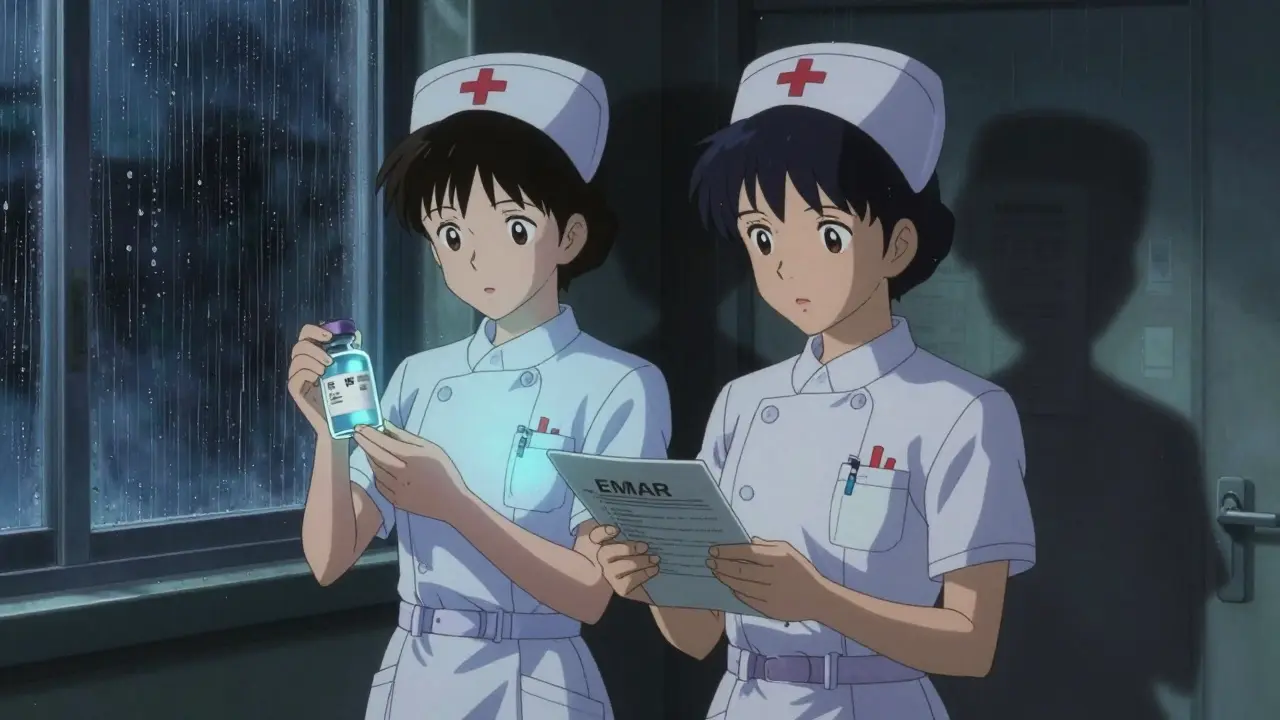
An independent double check (IDC) is not two people standing side by side quickly nodding at a label. It’s a structured, separate verification process where two licensed clinicians - typically a nurse and another nurse or pharmacist - verify the medication on their own, without influencing each other.According to VHA Directive 1195 (October 2024), an IDC must:
- Be performed by two licensed professionals
- Involve independent verification - no talking, no sharing expectations
- Include checking all five rights: right patient, right medication, right dose, right route, right time
- Require comparison of results only after both individuals have completed their checks
- Be documented electronically with both signatures in the eMAR system
Think of it like two pilots checking a flight plan before takeoff. One doesn’t tell the other what they see. They both look independently, then compare notes. If there’s a mismatch, they stop and resolve it before moving forward.
Studies show this method works - when done right. ECRI Institute found that properly executed IDCs prevent up to 95% of high-alert medication errors. But if the checks are rushed, done together, or skipped because of time pressure, effectiveness drops to as low as 40%.
Which Medications Actually Need a Double Check?
Not every high-alert medication requires a double check in every setting. This is where many institutions get it wrong. The ISMP explicitly warns against blanket policies. Overusing double checks leads to fatigue, workarounds, and false confidence.Expert consensus - backed by ECRI Institute, ASHP, and the VHA - recommends targeting only the highest-risk medications and situations:
- Always require IDCs: IV insulin, concentrated potassium, chemotherapy, neuromuscular blockers, IV heparin infusions, PCA opioids.
- Require IDCs in high-risk settings: ICU, ED, pediatrics, oncology - even if the drug isn’t on the core list.
- Consider alternatives: For lower-risk high-alert meds (like oral anticoagulants), use smart pumps, barcode scanning, or automated alerts instead.
For example, Providence Health System limits IDCs to specific categories listed on their MAR, while WVU Medicine requires them for 10 key medications. The VHA mandates IDCs for all high-alert meds - but even they acknowledge that technology (like smart pumps) can reduce the need for manual checks in some cases.
The key is risk stratification. Ask: What’s the likelihood of error? What’s the potential harm? If the answer is high on both, then a double check is essential. If not, other safeguards may be more effective and sustainable.
How to Perform a Proper Independent Double Check
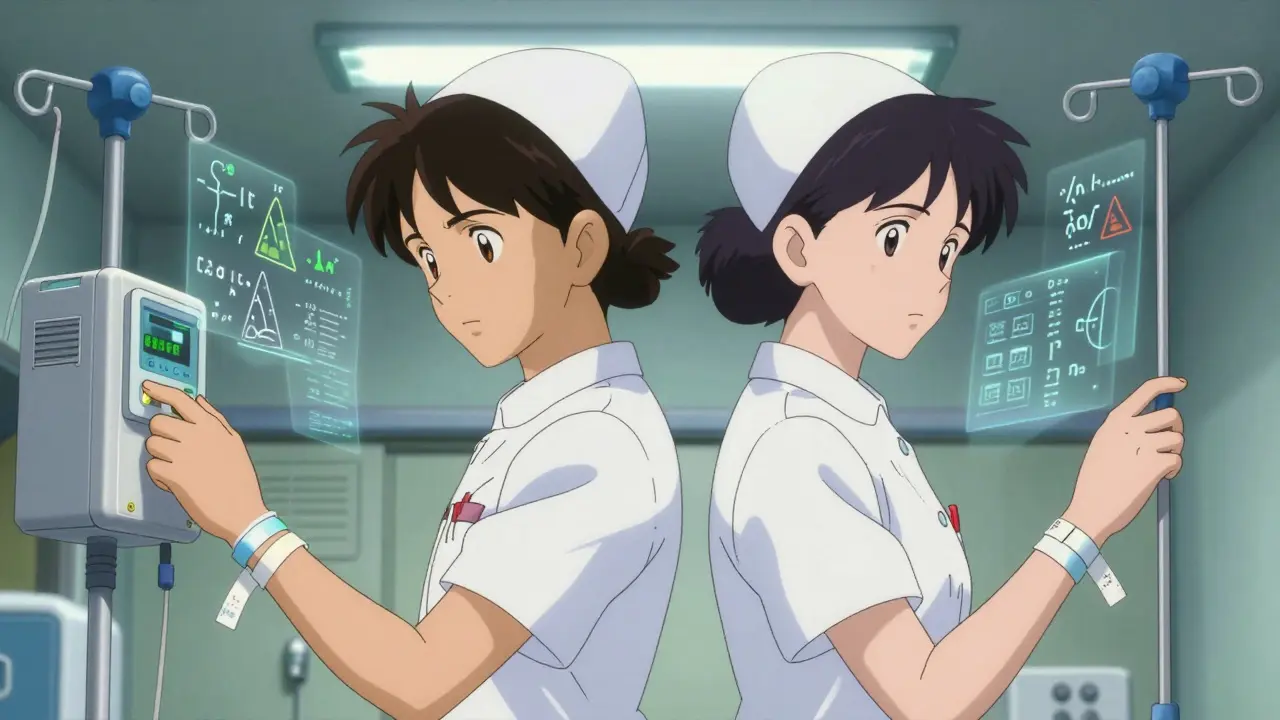
A good double check follows a strict protocol. Here’s how it should work in practice:- Prepare separately. One clinician retrieves the medication. The other prepares to verify - without seeing what’s been selected.
- Verify independently. Each person checks the five rights using the same tools: the eMAR, the medication label, the patient’s wristband, and the actual vial or bag.
- Calculate independently. If the dose requires calculation (like an infusion rate), both clinicians do the math on their own. No sharing results until both are done.
- Compare results. Only after both have completed their checks do they compare what they found. If there’s a mismatch, they stop. They recheck the order, the label, the pump settings - until they find the error.
- Document. Both sign electronically in the eMAR system. No signature = no administration.
Common mistakes to avoid:
- Checking together - one person reads the label while the other just nods. This is not independent.
- Skipping the calculation - assuming the dose is correct because it’s on the order.
- Not verifying the route - giving IV heparin as an IM injection by accident.
- Using the same person twice - the same nurse checking their own work.
At Johns Hopkins Hospital, implementing this protocol for IV heparin reduced dosing errors from 12.7% to 2.3% over 18 months. Nurses initially complained about the extra time - each check added 2-3 minutes. But once they saw how many errors were caught, resistance faded.
Why Double Checks Often Fail - And How to Fix It
Even the best protocols fail if they’re not implemented correctly. Here are the top reasons double checks don’t work - and how to fix them.Problem 1: Staff don’t understand independence. Many nurses think “double check” means two people look at the same thing at the same time. That’s not enough. One nurse might say, “It’s 10 units,” and the other just agrees because they assume it’s right.
Solution: Train staff on what “independent” really means. Use role-playing scenarios. Show videos of real errors caught during true IDCs. Make it part of competency checks.
Problem 2: Time pressure. In busy units, nurses feel they can’t afford to spend 5 extra minutes per medication. During emergencies, double checks get skipped entirely.
Solution: Build time into staffing models. Mayo Clinic includes IDC time in nurse-to-patient ratios. Use technology to reduce manual steps - smart pumps that auto-calculate doses and lock out unsafe settings cut down the need for manual math.
Problem 3: Poor documentation. If the eMAR doesn’t require dual signatures, or if staff just click “done” without verifying, the check is meaningless.
Solution: Make dual electronic signatures mandatory. Audit eMAR records weekly. Flag cases where only one signature appears.
Problem 4: Workarounds during crises. In the ER or ICU, when a patient is crashing, there’s no time for two nurses to verify. So staff bypass the system.
Solution: Have a clear policy for emergencies. Allow one licensed clinician to administer if no second person is available - but only if the drug is pre-drawn and labeled by a pharmacist, and the order is double-checked electronically before the code starts. Follow up immediately after the event.
Technology Is Changing the Game
Manual double checks are still vital - but they’re no longer the only tool. Technology is making them more effective and less burdensome.- Smart pumps with dose error reduction systems (DERS) can flag incorrect infusion rates and block unsafe doses. 65% of large hospitals now use them.
- Barcode scanning at the bedside ensures the right drug goes to the right patient.
- eMAR systems with mandatory dual signatures prevent skipped checks.
- AI-assisted verification tools are in pilot at 12% of academic medical centers - they flag discrepancies between orders and dispensed meds before the nurse even reaches the patient.
At Magnet-recognized hospitals, 78% use electronic dual-signature systems. These systems don’t replace human judgment - they support it. They make it harder to skip steps and easier to track compliance.
ECRI Institute predicts manual double checks will drop by 40% by 2028 as technology takes over routine verification. But for the most dangerous medications - IV insulin, chemotherapy, paralytics - human verification will remain essential.
What Your Facility Should Do Today
You don’t need to overhaul your whole system to make a difference. Start here:- Review your list. Compare your facility’s high-alert medication list to the ISMP 2024 guidelines. Are you missing any? Are you including ones that don’t need it?
- Train your staff. Hold a 90-minute session on what independent double checks really mean. Use real case examples.
- Fix your eMAR. Make sure dual signatures are required for all high-alert meds. Audit logs weekly.
- Measure compliance. Do random chart audits. How often are double checks done correctly? How often are they skipped?
- Involve pharmacists. They’re often the best at catching dosing errors. Make them part of the verification process.
Don’t aim for perfection. Aim for consistency. Even a 20% improvement in proper double-check execution can prevent dozens of errors per year.
Final Thought: Safety Isn’t a Checklist - It’s a Culture
The goal isn’t just to tick boxes. It’s to create a culture where no one feels pressured to skip a check. Where nurses speak up when something doesn’t feel right. Where leadership supports time for safety over speed.High-alert medications are dangerous. But they don’t have to be deadly. With the right list, the right training, and the right mindset, we can stop these errors before they start.
What are the most common high-alert medications that require double checks?
The most common high-alert medications requiring independent double checks include IV insulin, concentrated potassium chloride (1 mEq/mL or higher), IV heparin infusions, neuromuscular blocking agents (like succinylcholine), chemotherapy drugs, and injectable narcotic patient-controlled analgesia (PCA) devices. These are listed in the 2024 ISMP High-Alert Medications List and are consistently flagged by hospitals, the VHA, and ECRI Institute due to their high risk of severe harm from even minor errors.
Is a double check always required for every high-alert medication?
No. The Institute for Safe Medication Practices (ISMP) advises against universal double checks. Instead, they recommend a risk-based approach. Only the highest-risk medications - like IV insulin or chemotherapy - should require independent double checks. For others, technology like smart pumps, barcode scanning, or automated alerts may be more effective and sustainable. Overusing double checks leads to fatigue and workarounds, which actually increase risk.
What’s the difference between a double check and a witness check?
A double check requires two licensed clinicians to independently verify all components of the medication order - without communicating or influencing each other - before comparing results. A witness check is when one person administers the medication while another observes, often without verifying details like dose, route, or calculation. Only independent double checks meet safety standards; witness checks are not sufficient for high-alert medications.
Can a pharmacist perform the second check?
Yes. Pharmacists are licensed clinicians and are often the best choice for the second check, especially for complex infusions or calculations. Many hospitals use pharmacists to verify high-alert medications before they’re sent to the unit. In some cases, a second nurse may perform the check if a pharmacist isn’t available - but the key is that both must be licensed and independent.
What happens if there’s no second nurse available during an emergency?
In emergencies, if no second licensed clinician is immediately available, one qualified provider may administer the medication - but only under strict conditions. The drug must be pre-drawn and labeled by a pharmacist, the order must be verified electronically, and the administration must be documented with a note explaining the exception. A full review must follow to ensure no safety lapses occurred. This is not a loophole - it’s a controlled exception to prevent delay in life-saving care.
How do you train staff to do proper independent double checks?
Effective training includes hands-on simulations, video examples of real errors caught by double checks, and clear written protocols. Staff must practice verifying all five rights independently - without talking - then comparing results. Competency assessments are required, with annual refreshers. Cleveland Clinic uses a 2-hour mandatory module with a 95% passing rate. The goal is to make independence second nature, not just a formality.
Are double checks required by law?
While not mandated by federal law, the Joint Commission’s National Patient Safety Goal (NPSG.01.01.01), effective January 1, 2024, requires accredited hospitals to identify high-alert medications and implement safeguards - and independent double checks are the most widely accepted method. CMS Conditions of Participation also require safe medication systems. Failure to implement proper safeguards can lead to citations, fines, or loss of accreditation.
Next steps: Audit your facility’s high-alert medication list. Compare it to the ISMP 2024 guidelines. Then schedule a training session focused on what true independent verification looks like. Don’t wait for an error to happen - build the safety in now.
Jan Hess
January 16, 2026 AT 16:51Man I wish more hospitals took this seriously. I saw a guy get a 10x dose of insulin because the nurse just assumed the pump was set right. Took him 3 days to come out of it. Double checks aren't bureaucracy, they're lifelines.
Niki Van den Bossche
January 17, 2026 AT 11:31Ah yes, the sacred ritual of the independent double-check - where two professionals stare at the same vial in silence like monks deciphering ancient scripture, then nod solemnly as if they’ve just witnessed divine intervention. Truly, the last bastion of human dignity in our algorithm-driven healthcare dystopia. The real tragedy? We still haven’t fixed the fact that 80% of these meds are mislabeled at the pharmacy to begin with.
Gloria Montero Puertas
January 19, 2026 AT 07:29Oh, please. You think this is about safety? No. This is about liability. Hospitals don’t want to save lives - they want to avoid lawsuits. That’s why they make you do double-checks on insulin but let nurses give morphine without verifying the patient’s allergies. It’s not about care - it’s about covering their butts. And don’t get me started on the eMAR systems that auto-populate signatures…
Iona Jane
January 19, 2026 AT 22:00They’re watching us. The double-checks? The eMAR logs? The timestamps? It’s all tied to the national health surveillance grid. They track every dose, every signature - building profiles on every nurse who ever made a mistake. You think they care about patient safety? They’re harvesting compliance data for the next phase of automated healthcare control. Wake up.
Jaspreet Kaur Chana
January 20, 2026 AT 15:09Back home in India we don’t have all these fancy eMAR systems or smart pumps but we still do double checks - just differently. One nurse holds the vial, another reads the label out loud, third person confirms the patient’s name on the wristband - all in one breath. No time for silence, no time for ego. Just teamwork. And you know what? We don’t have half the errors. Maybe we need less tech and more trust in each other.
Haley Graves
January 21, 2026 AT 00:44This post is spot on. I’ve been a floor nurse for 14 years and I’ve seen too many shortcuts. The moment you start treating the double-check like a box to tick, someone’s going to die. I’ve started doing mine out loud - ‘Right patient, right med, right dose, right route, right time’ - and I make my partner repeat it back. It’s not about being slow, it’s about being sure.
Diane Hendriks
January 21, 2026 AT 06:53Let’s be precise. The ISMP does not mandate double-checks - it recommends them. The Joint Commission requires safeguards - not necessarily dual signatures. Misrepresenting guidelines as law is irresponsible. If your facility is enforcing this as a federal requirement, you are misinformed. And misinformation in healthcare is more dangerous than any medication error.
ellen adamina
January 21, 2026 AT 13:44I’ve worked in three different hospitals and every one had a different list of what needed a double check. Why? Because nobody agrees on what ‘high-risk’ actually means. One place thought TPN was critical, another didn’t even track it. We need national standards - not 500 different hospital policies.
Tom Doan
January 23, 2026 AT 01:28Interesting. So we’re now treating nurses like air traffic controllers, and pharmacists like co-pilots, while the actual system - the one that mislabels drugs, under-staffs units, and ignores burnout - remains untouched. The double-check is a Band-Aid on a severed artery. Kudos for documenting the symptom. Now, who’s going to fix the disease?
Sohan Jindal
January 24, 2026 AT 12:22USA is falling apart. We used to have real nurses who knew their meds. Now we got computers and rules and checks for everything. Even my grandma could tell insulin from salt water. But now? We got people who can’t read a label without a barcode scanner. This isn’t safety - it’s weakness. We need to stop coddling people and start teaching them their job.