

How to Ensure Accurate Dosing Devices with Liquid Prescriptions
 Jan, 16 2026
When giving liquid medicine to a child or elderly person, getting the dose right isn’t just important-it’s life-or-death. A 2023 study found that between 15% and 43% of caregivers make dangerous mistakes when measuring liquid prescriptions. These aren’t small slips. They’re errors of 20% or more from the prescribed dose. That could mean giving a child twice the intended amount of antibiotics or half the needed dose of seizure medication. The problem isn’t usually that people are careless. It’s that the tools they’re given are confusing, poorly designed, or just plain wrong.
Why Household Spoons Are Dangerous
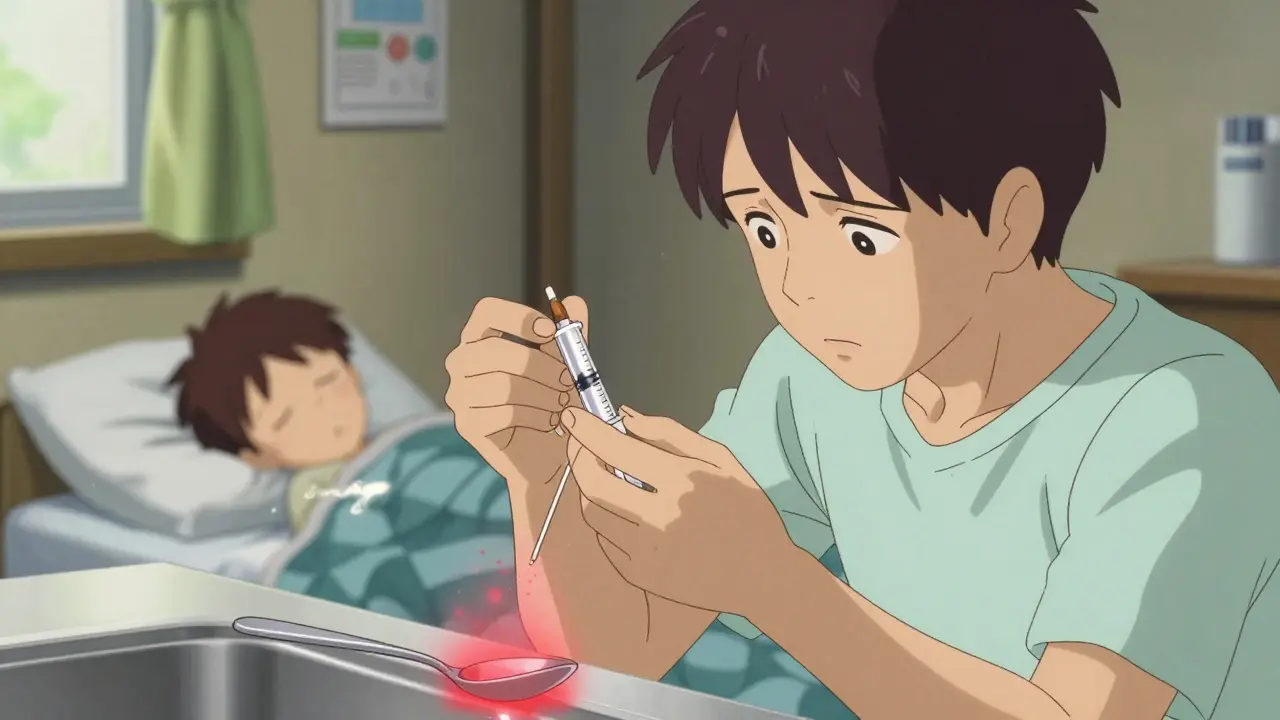
You’ve probably heard someone say, "Just use a teaspoon." But a regular kitchen teaspoon isn’t a medical tool. It holds anywhere from 3 to 7 milliliters, depending on how full it is, how you hold it, or even the shape of the spoon. The Institute for Safe Medication Practices says household spoons cause about 40% of all liquid medication errors in children. That’s not a myth. It’s data. The FDA has been clear since 2011: stop using teaspoons and tablespoons on labels. Yet, as of 2023, nearly 28% of liquid medications still list doses in these units. Why? Legacy labeling. Outdated prescriptions. And pharmacy systems that haven’t updated. When a label says "1 tsp," caregivers reach for a spoon-not a syringe. And that’s where the risk starts.The Right Tool: Oral Syringes
The most accurate device for measuring liquid medicine is the oral syringe. It’s not glamorous. It doesn’t look like a cup you’d use for cereal. But it’s precise. A 2009 study in the Annals of Pharmacotherapy found that when measuring a 5 mL dose, 66.7% of people got it right with an oral syringe. Only 14.6% did with a dosing cup. Oral syringes are marked in milliliters (mL), with fine lines for 0.1 mL increments-perfect for small pediatric doses. They eliminate parallax error (the distortion you get when you look at a cup from an angle). You don’t have to guess where the meniscus is. You just line up the plunger with the mark. Even better: syringes don’t spill. A parent in a Reddit thread wrote, "The 1 mL syringe with 0.1 mL markings saved my infant from an overdose when the prescribed dose was 1.6 mL. The cup that came with the medication only had 1 mL and 2 mL markings." That’s not an outlier. It’s the norm.Why Dosing Cups Fail
Dosing cups are still the most common device included with prescriptions. In a 2022 audit of 10,000 prescriptions, 58% came with cups. Only 35% came with syringes. Why? Tradition. Perceived ease. But the data doesn’t lie. Cups have too many markings. One JAMA study found that 81.1% of dosing cups include unnecessary lines-like 3 mL, 4 mL, 6 mL, 8 mL-on a cup meant for a 5 mL dose. That’s not helpful. It’s confusing. People pick the closest mark, not the right one. Cups also encourage bad habits. Caregivers fill them to the top, not to the line. They tilt them. They hold them at eye level only if they remember to. A pediatric nurse with 12 years of experience said on Reddit, "I’ve seen more medication errors from cups than any other device. The parallax error is real, and most parents don’t understand how to read the meniscus properly."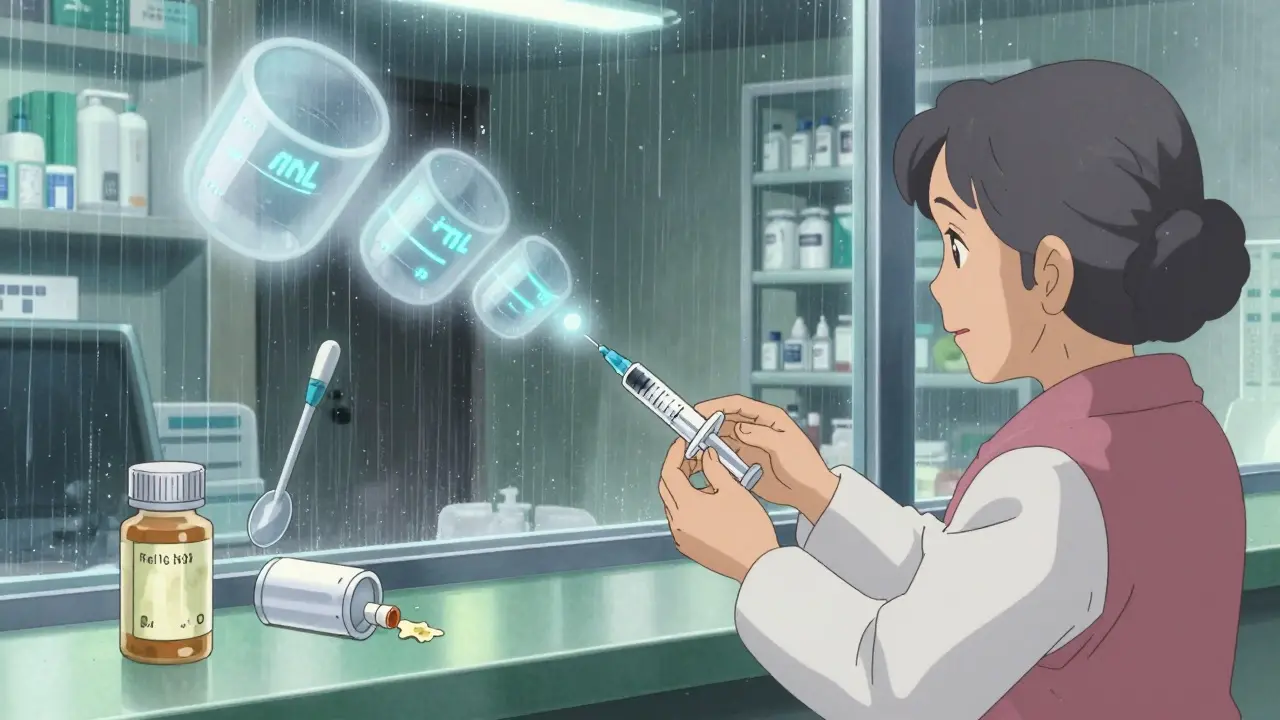
What the Experts Say
The American Academy of Pediatrics has said since 2015: "All liquid medications should be dosed exclusively in milliliters, with devices marked only in milliliters." The FDA reinforced this in 2022, stating that "the use of teaspoons and tablespoons on labels may encourage the use of non-calibrated household spoons." The United States Pharmacopeia (USP) sets the gold standard: any dosing device must measure within 10% of the labeled amount. Oral syringes consistently meet this. Cups often don’t. Dosing spoons? They’re even worse-deviations can hit ±15%. Dr. Shonna Yin’s 2014 study showed parents who used milliliter-only labels and devices made 42% fewer dosing errors. That’s not a small improvement. That’s the difference between a child recovering safely and ending up in the ER.How to Get It Right
Here’s how to ensure accurate dosing every time:- Ask for an oral syringe. Don’t wait for the pharmacy to offer one. Request it for any liquid dose under 10 mL. For doses over 10 mL, a syringe still works-but make sure the pharmacy gives you one with clear, minimal markings.
- Check the label. Does it say "5 mL" or "1 tsp"? If it says teaspoons or tablespoons, ask the pharmacist to rewrite it in milliliters. You have the right to request this.
- Use only milliliters. Never convert. Never estimate. Never use a kitchen spoon. Even if the bottle says "1 tsp," treat it as 5 mL. But better yet, get the label changed.
- Practice with water. Before giving medicine, fill the syringe with water. Draw it up. Hold it at eye level. Read the line. Pour it out. Do it again. Muscle memory saves lives.
- Use the teach-back method. Ask the pharmacist or nurse: "Can you show me how to use this? Then let me do it back to you." Studies show this cuts errors by 35%.
What Pharmacies Should Do
Pharmacies are on the front lines. They’re the last checkpoint before a dose goes home. Yet, only 63% of community pharmacies follow metric-only labeling standards, compared to 87% in hospitals. The American Pharmacists Association recommends giving oral syringes for all liquid prescriptions under 10 mL. That’s not optional. It’s standard care. But most pharmacies still hand out cups by default. Some chains are changing. CVS launched "DoseRight" in 2022-a QR code on every prescription label that links to a video showing how to use the syringe. Walgreens introduced "PrecisionDose" with Bluetooth-enabled syringes that sync to a phone app to confirm the dose. These aren’t gimmicks. They’re safety tools.The Bigger Picture
This isn’t just about devices. It’s about systems. Only 41% of prescription labels include clear dosing instructions, according to the FDA. In low-income areas, patients get cheaper, less accurate devices 63% of the time. That’s a health equity issue. The good news? Pediatric liquid medication errors have dropped 37% since 2015. That’s because more pharmacies are using syringes. More labels are in mL. More parents are asking for better tools. But progress is uneven. Only 12 states regularly check pharmacy compliance. Older medications still use teaspoon labeling. And many caregivers still don’t know the difference between a syringe and a cup.What You Can Do Today
You don’t need to wait for policy changes. You can act now:- If your child’s medicine comes with a cup, throw it away. Get a syringe.
- If the label says "teaspoon," call the pharmacy and ask them to re-label it in mL.
- If you’re unsure how to use the syringe, ask for a demo. No judgment. No rush.
- Teach everyone who gives medicine to the child: grandparents, babysitters, school nurses. Show them the syringe. Let them practice.
Don’t let a cup, a spoon, or a confusing label put your child at risk. Ask for the syringe. Use milliliters. Double-check. It’s not just good practice. It’s the only way to be sure.
Why shouldn’t I use a kitchen spoon to give liquid medicine?
Kitchen spoons aren’t calibrated. A teaspoon can hold anywhere from 3 to 7 milliliters, depending on how you fill it. That’s a huge range when giving medicine. The Institute for Safe Medication Practices says household spoons cause about 40% of liquid medication errors in children. Always use a medical-grade device like an oral syringe.
Is an oral syringe really better than a dosing cup?
Yes. Studies show oral syringes are far more accurate. For a 5 mL dose, 66.7% of people measured correctly with a syringe, but only 14.6% did with a cup. Syringes eliminate parallax error and have fine 0.1 mL markings. Cups often have too many confusing lines and require reading a meniscus, which most people don’t know how to do.
What unit should liquid medicine doses be written in?
Always milliliters (mL). The FDA, American Academy of Pediatrics, and USP all require metric units. Avoid teaspoons (tsp), tablespoons (tbsp), or cc’s. These are outdated and lead to errors. If your prescription says "1 tsp," ask the pharmacist to change it to "5 mL." You have the right to request this.
How do I read an oral syringe correctly?
Hold the syringe at eye level. Look straight at the plunger’s edge, not from above or below. The top of the liquid (the meniscus) should line up with the correct mL mark. Tap the side gently to remove air bubbles before giving the dose. Always double-check the number on the syringe against the prescription label.
Can I reuse an oral syringe?
No. Oral syringes are single-use devices. Reusing them can lead to contamination, inaccurate measurements from residue buildup, or broken parts. Always use a new one for each dose. Most pharmacies provide them for free with prescriptions.
What should I do if my pharmacy won’t give me a syringe?
Ask again. If they say no, ask to speak to the pharmacist. You have the right to request a proper dosing device. If they still refuse, go to another pharmacy or buy a syringe at a drugstore-most are under $2. Don’t settle for a cup or spoon. Accuracy matters.
Jake Moore
January 18, 2026 AT 06:32Just got my kid’s amoxicillin today-pharmacy handed me a dosing cup. I threw it in the trash and asked for a syringe. They acted like I was being weird. I told them if they don’t stock them, I’ll take my business elsewhere. This isn’t optional. It’s basic safety.
Joni O
January 18, 2026 AT 14:05i did the water practice thing before giving my daughter her first dose and it saved me so much stress. i thought i knew how to read the lines but turns out i was holding it wrong. now i always double-check at eye level. small habit, huge difference.
Pat Dean
January 19, 2026 AT 08:17Of course the system is broken. Big Pharma doesn’t want you using syringes-it cuts into their cup profits. And don’t get me started on pharmacies that still print 'tsp' on labels. They’re not lazy, they’re complicit. This is corporate negligence disguised as convenience.
Selina Warren
January 20, 2026 AT 15:33Listen. I used to be one of those people who just grabbed a spoon because it was easier. Then my nephew almost went into a seizure because his dose was halved. I didn’t know the difference between 2.5 mL and 5 mL. That’s not my fault-it’s the system’s. We need mandatory syringe distribution. No exceptions. No excuses. Every. Single. Time.
It’s not about being perfect. It’s about not killing someone because we’re too lazy to change.
Robert Davis
January 21, 2026 AT 03:12Interesting how everyone blames the tools but nobody talks about the real issue: caregivers are just bad at math. You give someone a syringe with 0.1 mL markings and they still mess it up. The real solution? Train people. Not replace cups with syringes. We’re treating symptoms, not causes.
Ryan Otto
January 22, 2026 AT 04:43Let me guess-the FDA, AAP, and USP are all in on this. Syringes are cheaper? No. They’re a Trojan horse. Next thing you know, they’ll be embedding RFID chips in them to track your child’s medication intake. This isn’t about safety. It’s about control. Who benefits from monitoring every drop?
Max Sinclair
January 24, 2026 AT 02:38Big thank you to the OP for laying this out so clearly. I’ve seen grandparents use spoons and think they’re being careful. They’re not. They’re just trusting their instincts. A simple demo-showing them how a cup can be off by 30%-changes everything. Knowledge is power, but tools make it possible.
Eric Gebeke
January 25, 2026 AT 06:09So now we’re supposed to trust a $1.50 plastic syringe more than a trained pharmacist? You know what’s worse than a bad dose? A syringe that’s been sitting in a dusty back room for six months. Who’s checking the quality? Who’s ensuring it’s sterile? Nobody. This is just performative safety.
Praseetha Pn
January 26, 2026 AT 17:09Oh honey, you think this is bad? In India, they give you a spoon and a prayer. I once saw a nurse use a dropper from a perfume bottle to give a baby antibiotics. No joke. No one even blinked. We need global standards. Not just FDA lip service. Real enforcement. And someone needs to burn every teaspoon label on earth.
And yes, I’ve bought 12 syringes from Amazon and mailed them to my cousin’s village. They’re still using spoons. But now they have tools. And that’s a start.
Nishant Sonuley
January 27, 2026 AT 15:17Look, I get it. Syringes are more accurate. But let’s be real-most parents are juggling three kids, a job, and a broken dishwasher. You’re asking them to become pharmacists overnight. Maybe instead of blaming them, we should make the system idiot-proof. Like… pre-filled syringes. Or smart bottles that beep if you’re off by more than 10%. Or QR codes that play a 10-second video when you scan. Tech exists. We just need to stop pretending ‘just ask for a syringe’ is enough.
Emma #########
January 29, 2026 AT 12:59I used to hate asking for help. Thought it made me look incompetent. But when I asked the pharmacist to show me how to use the syringe, she smiled and said, 'I wish everyone did this.' We all need a little hand-holding sometimes. No shame in that.
Jay Clarke
January 29, 2026 AT 23:24You know what’s wild? The same people who scream about 'government overreach' are the ones who’ll use a kitchen spoon to give their kid medicine. Hypocrisy isn’t just a vibe-it’s a public health crisis.