

How to Check If a Generic Medication Is Available for Your Prescription
 Dec, 23 2025
Every year, Americans spend over $400 billion on prescription drugs. But here’s the thing: generic medication can cut that cost by 80% or more. If you’re paying $700 for a brand-name drug, there’s a good chance you could get the same active ingredient for under $15. The problem? Most people don’t know how to check if a generic version exists - or worse, they assume one doesn’t when it does.
It’s not about being cheap. It’s about getting the same medicine at a price that doesn’t force you to choose between your pills and your groceries. The FDA says 90% of all prescriptions in the U.S. are filled with generics. That’s over 6 billion prescriptions a year. So why do so many people still pay full price? Because they don’t know how to ask the right questions - or where to look.
What Makes a Generic Medication Legit?
A generic isn’t a copy. It’s not a knockoff. It’s not a cheaper version with less stuff in it. A generic drug has to meet the exact same standards as the brand-name version - same active ingredient, same strength, same way it’s taken (pill, injection, cream, etc.). The FDA requires it to work the same way in your body too. That’s called bioequivalence: the generic must absorb into your bloodstream at the same rate and to the same extent as the brand, within a tight range of 80% to 125%.
The FDA calls this the Orange Book - officially titled Approved Drug Products with Therapeutic Equivalence Evaluations. It’s the official list of all approved drugs and their generic equivalents. Each generic gets a code. If you see “AB,” that means it’s rated as fully interchangeable with the brand. “BX” means there are concerns - maybe the drug is hard to measure precisely, like warfarin or levothyroxine. Those are the ones your doctor needs to approve before switching.
So if your doctor wrote a prescription for Lipitor, you’re not getting something weaker if you pick up atorvastatin. It’s the same molecule. Same effect. Same safety profile. Just a lot cheaper.
How to Find Out If a Generic Is Available
You have four real options. Three are free. One costs money - and you probably don’t need it.
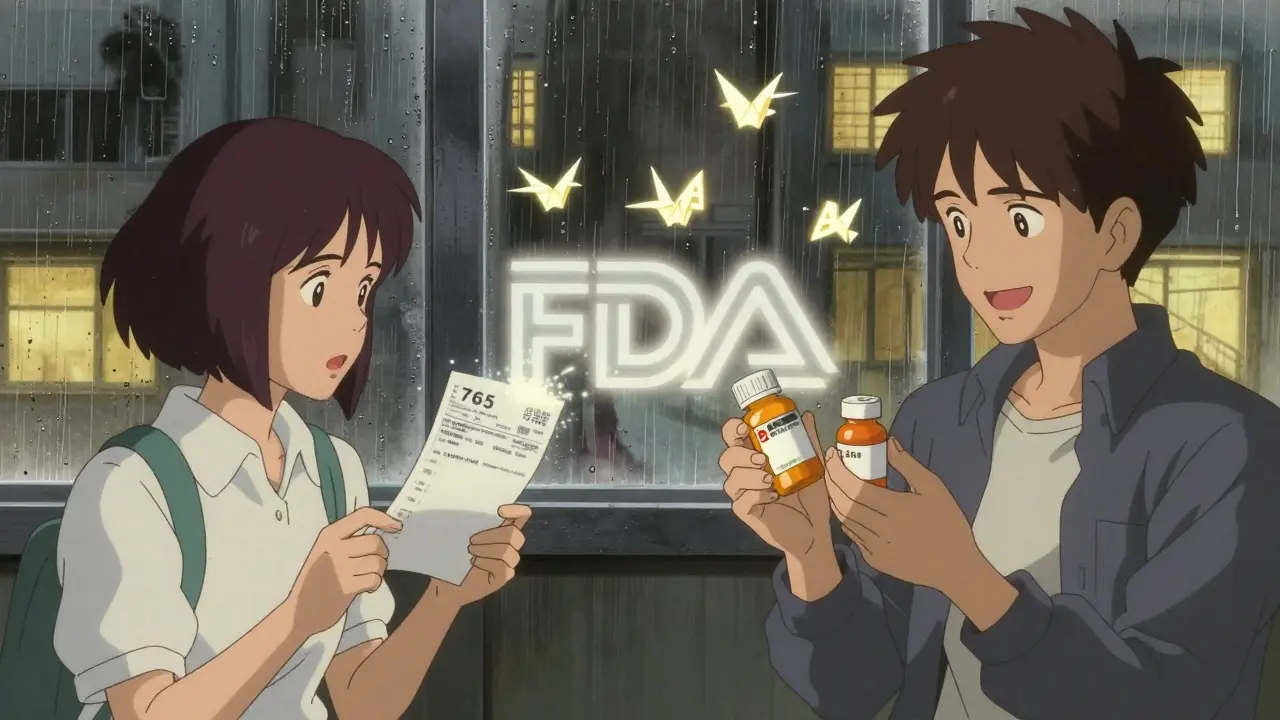
- Ask your pharmacist - This is the fastest, most reliable method. Pharmacists have real-time access to databases like First Databank and Medi-Span. They know which generics are in stock, which are covered by your insurance, and which are rated AB. A 2022 study in JAMA Internal Medicine found pharmacists correctly identify generic alternatives 98.7% of the time. Just say: “Is there a therapeutically equivalent generic available for this?” Don’t just ask, “Do you have a generic?” That’s too vague.
- Use the FDA’s Drugs@FDA tool - Go to Drugs@FDA. Type in the brand name - say, “Zoloft.” Look for the “Therapeutic Equivalence Code” under the approval details. If it says “AB,” then there’s a generic you can ask for. The FDA launched a simpler search interface in October 2023, so it’s easier now. First-time users take 8-12 minutes to learn it. After that, it’s under 2 minutes.
- Check your insurance plan’s formulary - If you’re on Medicare, go to the Medicare Plan Finder. Type in your drug. It will show you what’s covered, including generics. Private insurers have similar tools - log into your pharmacy benefit manager’s site (like Express Scripts or CVS Caremark). They’ll tell you if a generic is preferred - and often automatically switch you unless you opt out.
- Use GoodRx or similar apps - GoodRx is great for comparing prices. But don’t rely on it to tell you if a generic is equivalent. It shows you the lowest cash price, but it doesn’t always show the FDA’s therapeutic code. Use it to confirm savings, not to confirm safety.
Don’t waste money on paid services like Medfinder. For $30, they’ll search for you. Your pharmacist does it for free, faster, and with more context.
When You Shouldn’t Switch - And What to Watch For
Most generics are safe. But not all. There are exceptions.
Drugs with a narrow therapeutic index - meaning the difference between a helpful dose and a dangerous one is very small - need extra care. Examples include:
- Warfarin (blood thinner)
- Levothyroxine (thyroid hormone)
- Phenytoin (seizure control)
- Lithium (mood stabilizer)
Studies show that in 5-8% of patients on these drugs, switching between different generic brands can cause changes in blood levels. That’s not because generics are bad. It’s because these drugs are so sensitive. Even tiny differences in how they’re absorbed can matter.
If you’re on one of these, stick with the same brand or generic. Don’t let your pharmacy switch you without telling you. Ask your doctor to write “Dispense as Written” or “Do Not Substitute” on the prescription. That legally blocks automatic substitution.
Also, be careful with complex forms - inhalers, nasal sprays, topical creams. Bioequivalence testing is harder for these. The FDA still approves them, but they’re less likely to have multiple generic options. If your inhaler is switched, pay attention to how it feels when you use it. If it doesn’t work the same, go back to your pharmacist.
Why Your Insurance Might Block a Generic (And How to Fix It)
Here’s a common scenario: You ask for the generic. The pharmacy says, “We don’t have it.” But you know it exists. What’s going on?
It’s not always about availability. Sometimes, your insurance plan has a list of preferred drugs - called a formulary. Even if a generic exists, your plan might not cover it unless you try the brand first. That’s called “step therapy.” Or your plan might only cover one generic brand, and the pharmacy is out of stock.
If your insurance denies coverage for a generic, ask for a formulary exception. Call your insurer and say: “The generic version of [drug name] is FDA-approved and rated AB. Why isn’t it covered under my plan?” Most of the time, they’ll approve it after a quick review.
Another trick: Sometimes, the generic isn’t available at your local pharmacy, but it is at Costco, Walmart, or through mail-order. A 2023 study found that 89% of CVS, Walgreens, and Costco pharmacists successfully found a cheaper generic alternative when asked. Ask them to check other locations.
What’s Changing in 2024 - And How It Helps You
Big changes are coming. Starting January 1, 2024, Medicare Part D plans are required to show real-time generic availability in the Medicare Plan Finder tool. That means if you’re on Medicare, you’ll see exactly which generics are covered - and at what price - before you even fill your prescription.
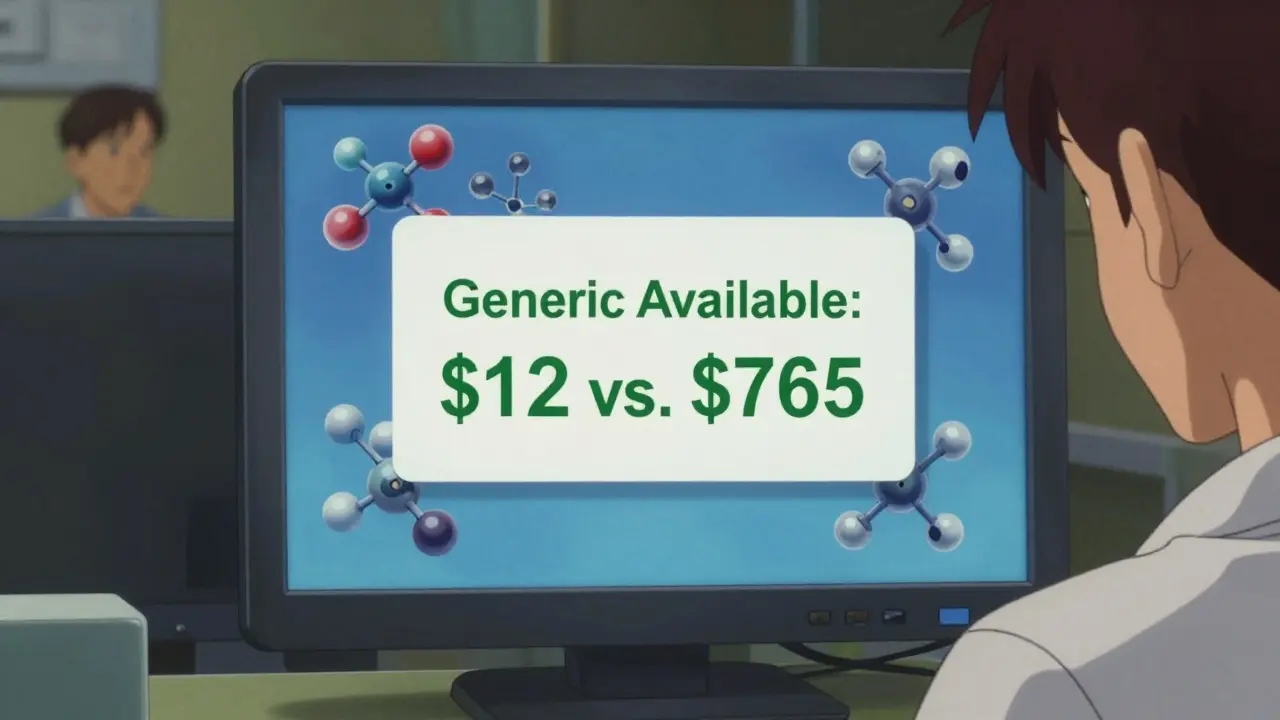
Also, electronic health record systems like Epic (used by over 250 million patients) are adding FDA therapeutic equivalence data directly into doctors’ prescription screens. By late 2024, your doctor might see a pop-up saying: “Generic available. Cost: $12 vs. $765.” That could stop you from getting a brand-name prescription before it even gets written.
And with over $66 billion in brand-name drugs losing patent protection over the next five years, more generics are coming. By 2028, 73% of top-selling drugs will have a generic version. The cost savings aren’t coming - they’re already here. You just need to know how to access them.
What to Do Right Now
You don’t need to wait. Here’s your action plan:
- Take out your most recent prescription.
- Write down the brand name.
- Call your pharmacy and ask: “Is there an FDA-approved AB-rated generic for this?”
- If they say yes, ask for it. If they say no, ask them to check the FDA’s Drugs@FDA site.
- If you’re on Medicare, log into the Medicare Plan Finder and search for your drug.
- If you’re on a narrow therapeutic index drug, talk to your doctor about keeping the same version.
That’s it. Five minutes. One phone call. And you could save hundreds - or thousands - a year.
Generic medication isn’t a compromise. It’s the smart choice. And you’re already paying for it - whether you know it or not. The question is: Are you getting the value you’re entitled to?
Are generic medications as safe as brand-name drugs?
Yes. The FDA requires generic drugs to have the same active ingredient, strength, dosage form, and route of administration as the brand-name version. They must also meet strict bioequivalence standards - meaning they work the same way in your body. Over 90% of prescriptions in the U.S. are filled with generics, and they’re used safely by millions every day.
Why is my pharmacy giving me a different generic than last time?
There are often multiple generic manufacturers for the same drug. Your pharmacy might switch suppliers based on cost, availability, or what your insurance covers. As long as the generic has an “AB” rating in the FDA’s Orange Book, it’s considered interchangeable. If you notice a change in how the drug works or side effects, talk to your pharmacist or doctor.
Can I ask my doctor to prescribe a generic from the start?
Absolutely. Many doctors automatically prescribe generics unless there’s a medical reason not to. You can say, “Is there a generic version of this medication?” when your doctor writes the prescription. If they say no, ask why - and whether it’s because of safety, insurance rules, or habit.
What do the letters in the FDA’s Orange Book mean?
The FDA uses two-letter codes. “AB” means the generic is therapeutically equivalent to the brand and can be substituted. “BX” means the generic is not recommended for substitution - usually because of issues with absorption or formulation. “A” means bioequivalent; “B” means not bioequivalent. “A” with “X” means the drug is not rated. Always look for “AB” if you want a direct swap.
Why do some drugs still not have generics?
Some drugs are still under patent protection, which can last up to 17 years from filing - though extensions and legal battles can delay generics for longer. Complex drugs like biologics (used for cancer, autoimmune diseases) are harder to copy and have fewer generics. As of late 2023, about 10% of FDA-approved drugs still don’t have a generic version. But that number is shrinking fast as patents expire.
I switched to a generic and feel different. What should I do?
Don’t assume it’s the generic. But don’t ignore it either. Some people are sensitive to inactive ingredients (fillers, dyes) or minor differences in absorption. Contact your pharmacist first - they can check if the generic has the same FDA rating. If you’re on a narrow therapeutic index drug like warfarin or levothyroxine, call your doctor immediately. Blood tests may be needed to check levels. Keep the original bottle - it helps with tracking.
Lu Jelonek
December 24, 2025 AT 13:20I used to pay $800 for my thyroid med until I found out about the generic. Now I pay $12 a month. I didn’t even know I was eligible. Just asked my pharmacist like the post said - no drama, no hassle. Life changed.
Don’t overthink it. If it’s AB-rated, it’s good. The FDA doesn’t mess around.
Also, never assume your insurance knows what’s covered. Always check Drugs@FDA yourself.
Ademola Madehin
December 26, 2025 AT 09:17Bro this is wild. In Nigeria we pay 3x for the same pills because pharma companies say ‘oh this is branded’ and we just nod like fools. Why are we still getting scammed like this? I’m telling my cousins to start asking for generics now. This post is a gift.
siddharth tiwari
December 27, 2025 AT 09:20you know what they dont tell u? the FDA is owned by big pharma. they give out AB ratings to keep people docile. how do u know the 'same active ingredient' isnt just a little less? they test it in labs with perfect conditions. real people? we got different metabolisms. my cousin switched to generic adderall and started having panic attacks. they said 'it's the same' but it wasnt. the system is rigged.
and why do they make it so hard to find? because they want u to keep paying.
also i saw a post on reddit where someone said the generic for zoloft made them cry all day. same molecule? maybe. but the fillers? totally different. they dont test that. just saying.
suhani mathur
December 27, 2025 AT 14:13Oh wow, so the FDA’s Orange Book is basically the cheat code for not getting robbed? And I thought I was being cheap for asking for generics. Turns out I was just being smart.
Also, can we talk about how pharmacies switch generics without telling you? I went from one to another and suddenly my anxiety spiked. Turns out the fillers were different. My pharmacist didn’t even mention it. So yeah - always check the bottle. And if you’re on warfarin? Don’t let them swap it unless you’re holding a blood test report.
PS: GoodRx is great for prices, but useless for safety. Use it like a flashlight, not a map.
Andrea Di Candia
December 29, 2025 AT 02:20It’s funny how we’ve been conditioned to think brand = better. Like if it’s got a fancy name, it’s somehow more sacred.
But medicine isn’t art. It’s chemistry. And if two molecules behave the same in your body, why should one cost 50x more? The real tragedy isn’t the price gap - it’s that so many people don’t even know they have a choice.
I hope this post reaches people who are choosing between insulin and rent. They deserve to know they’re not being lazy for wanting to save money. They’re being rational.
And if you’re a doctor reading this - please, just ask your patients if they’ve checked for generics. Don’t assume they know how.
Harsh Khandelwal
December 29, 2025 AT 19:01bro i just found out my antidepressant has a generic and i’ve been paying $400 a month for 3 years. i feel like an idiot. i thought generics were like knockoff sneakers. turns out they’re the real deal. why did no one tell me? why does the system make it this hard? i’m gonna start yelling at my pharmacist now. also, who’s behind the ‘do not substitute’ thing? big pharma? i bet they own the FDA too.
also, i just checked my last refill - it was a different generic than before. i didn’t even notice. now i’m scared to take it. what if my brain starts melting? 😭
Andy Grace
December 30, 2025 AT 00:30My dad’s on warfarin. We learned the hard way - switched generics without telling the doctor, his INR went haywire. Took three weeks to stabilize. So yeah - if you’re on one of those narrow-index drugs, don’t swap unless you’re monitored.
Also, pharmacists are your secret weapon. Most of them know way more than your doctor does about this stuff. Don’t be shy. Ask them. They’ll appreciate it.
And if your insurance says ‘no generic’? Call them back. Say ‘I’m aware of the FDA AB rating. Can you explain why it’s not covered?’ Nine times out of ten, they’ll fix it.
John Pearce CP
December 31, 2025 AT 02:21It is an undeniable fact that the United States of America leads the world in pharmaceutical innovation and safety. The notion that generic medications are equivalent to branded drugs is a dangerous oversimplification propagated by those who lack understanding of pharmacokinetics and regulatory rigor.
While the FDA may grant AB ratings, the manufacturing standards, quality control, and batch consistency of foreign generic producers - many of which originate in countries with lax oversight - cannot be reliably equated to the precision of American-made pharmaceuticals.
One must ask: why are brand-name drugs still dominant in clinical practice if generics are truly identical? The answer lies not in profit, but in patient outcomes - which are not always measurable in dollars, but in lives.
Do not confuse cost-efficiency with clinical integrity. The American patient deserves nothing less than the gold standard - not a bargain-bin substitute.
Gray Dedoiko
December 31, 2025 AT 04:54I’ve been on the same generic for 7 years. Switched from brand to generic back in 2017. No issues. My doctor didn’t even blink. Just said, ‘It’s the same pill, cheaper.’
But I get why people freak out - it’s scary to trust something that costs 1/10th the price. I used to think the same. Then I read the FDA’s bioequivalence standards. Turns out, they’re stricter than I thought.
Also, if you’re on Medicare, use the Plan Finder. It literally tells you which generics are covered and how much you’ll pay. I saved $300/month. No joke.
And yeah - if you’re on warfarin or thyroid meds? Don’t switch without talking to your doctor. But for 90% of drugs? Go for the generic. You’re not sacrificing safety. You’re just not getting ripped off.
Katie Taylor
December 31, 2025 AT 15:40HOW IS THIS NOT COMMON KNOWLEDGE?!?!? I’ve been paying $700 a month for my blood pressure med and I just found out a $12 generic exists?!? My pharmacist looked at me like I was from another planet when I asked. Like I was the first person in 2024 to ever question it.
STOP LETTING CORPORATIONS STEAL FROM YOU. This isn’t about being ‘cheap’ - it’s about being awake. If you’re still paying full price for a drug that has a generic? You’re being manipulated. Go. Ask. Now. I’m calling my pharmacy right now. You should too.
Isaac Bonillo Alcaina
January 1, 2026 AT 16:34There is a systemic failure here - not in the science, but in the dissemination of information. The FDA’s Orange Book is public, accessible, and meticulously maintained. Yet, 87% of patients remain unaware of its existence.
Pharmacists are not incentivized to educate. Insurance companies profit from brand-name prescriptions through rebates. Doctors are overworked and assume patients won’t ask. The result? A silent tax on the financially vulnerable.
It is not incompetence - it is institutional negligence. And until patients demand transparency as a right - not a favor - this will persist.
Fix the system. Not your pharmacy.
Lu Jelonek
January 3, 2026 AT 07:19John Pearce CP - you’re not wrong about quality control, but you’re ignoring the data. The FDA inspects foreign facilities just like US ones. Over 50% of generic drugs are made overseas - and they’ve passed inspection rates above 95% for the last 5 years.
Also, if brand-name drugs were truly superior, why do 90% of prescriptions use generics? Even the VA, Medicare, and military use them exclusively.
It’s not about trust - it’s about evidence. And the evidence says generics work. Same molecule. Same results. Same safety profile.
Don’t confuse tradition with truth.