

How Insurer-Pharmacy Negotiations Set Generic Drug Prices in the U.S.
 Jan, 13 2026
Every time you fill a prescription for a generic drug, you’re caught in a hidden pricing game between insurers, pharmacy benefit managers (PBMs), and pharmacies. The price you pay at the counter doesn’t come from a simple formula. It’s the result of secret deals, opaque contracts, and financial incentives that often work against you-even when you have insurance.
Who Really Sets the Price of Generic Drugs?
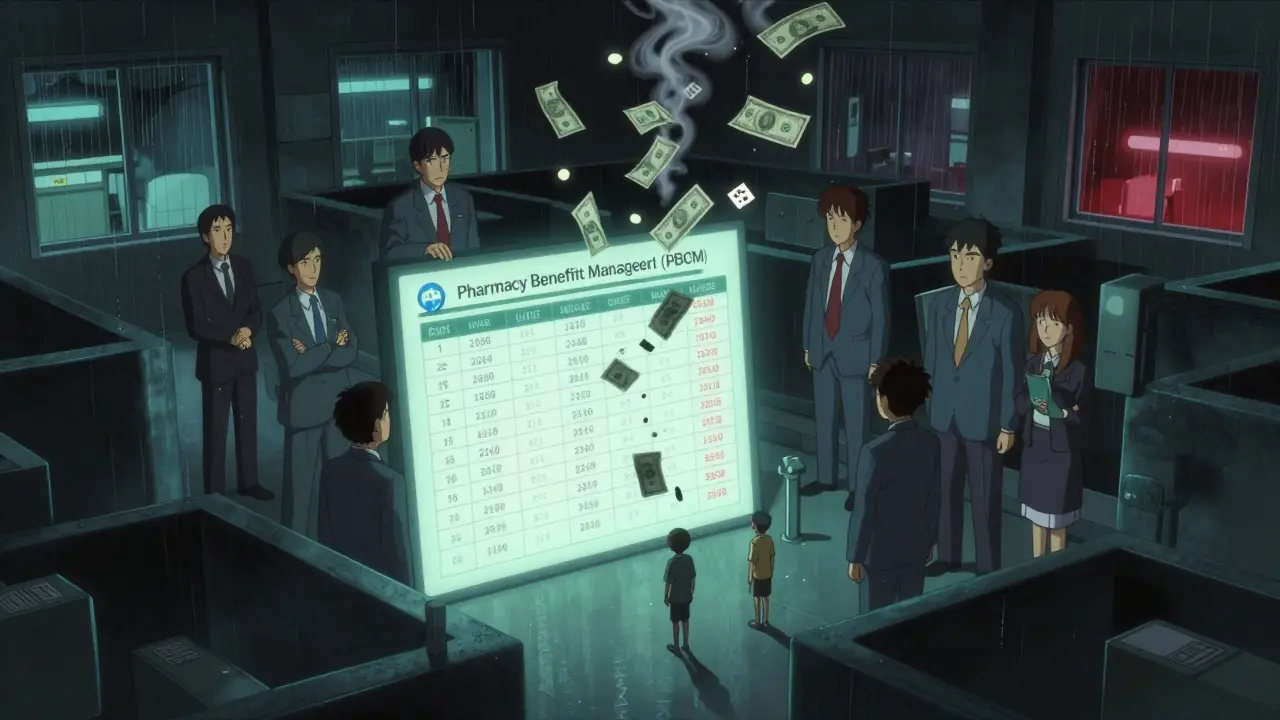
The real power behind generic drug pricing doesn’t sit with your doctor, your pharmacist, or even the drug manufacturer. It sits with Pharmacy Benefit Managers-middlemen like CVS Caremark, OptumRx, and Express Scripts. These three companies control about 80% of the U.S. PBM market. They negotiate with insurers to decide which generic drugs are covered, how much pharmacies get paid to dispense them, and what you pay out of pocket.
Here’s how it works: PBMs create a list called the Maximum Allowable Cost (MAC) for each generic drug. This is the maximum amount they’ll reimburse a pharmacy. But here’s the catch: the MAC isn’t based on what the drug actually costs. It’s based on outdated benchmarks like the Average Wholesale Price (AWP) or the National Average Drug Acquisition Cost (NADAC), which often don’t reflect real market prices.
The Hidden Profit: Spread Pricing
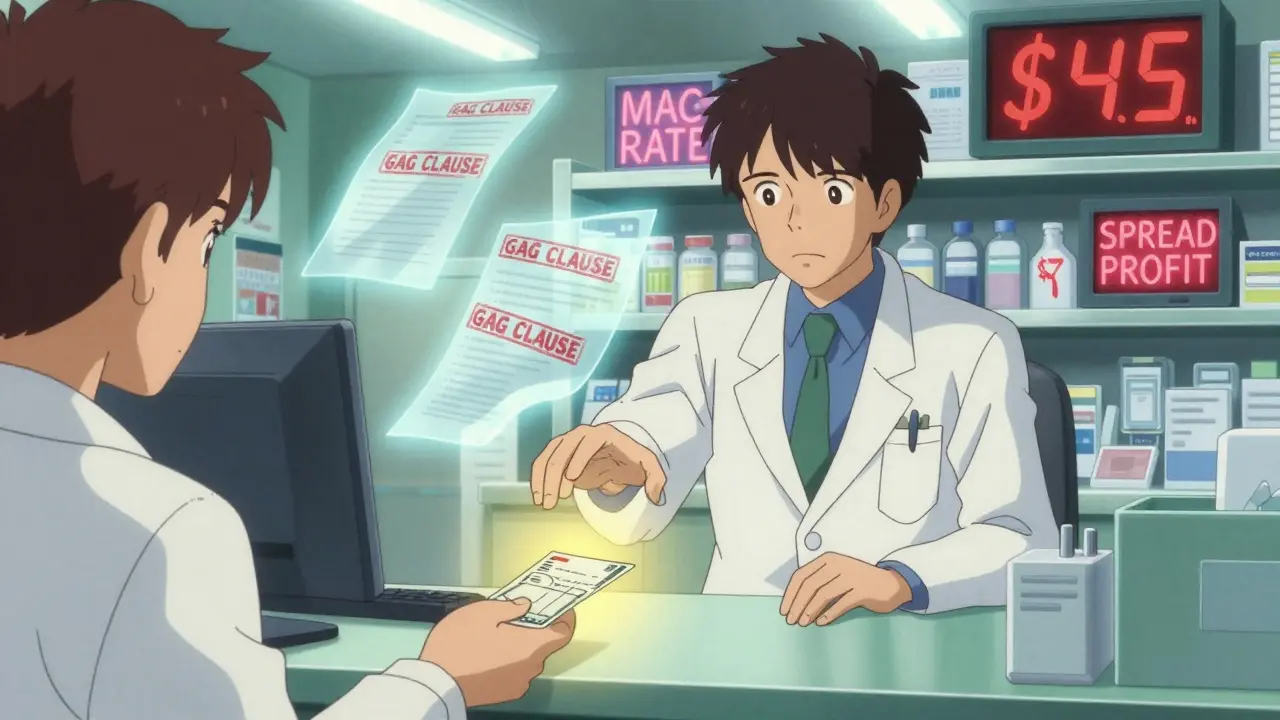
The biggest reason generic drug prices feel so broken is something called spread pricing. This is when a PBM charges your insurance plan $45 for a generic pill but only pays the pharmacy $10 to fill it. The $35 difference? That’s the PBM’s profit-and you never see it.
It gets worse. In many cases, your insurance plan doesn’t even know how much it’s being charged. PBMs hide these spreads in complex contracts. A 2024 report from Pharmacy Times estimated that spread pricing generates $15.2 billion a year in undisclosed revenue, with 68% of that coming from generic drugs.
And because your copay is often tied to the inflated price your insurer pays-not the pharmacy’s actual cost-you end up paying more than someone who walks in and pays cash.
Why Your Insurance Copay Is Higher Than Cash
You’ve probably heard stories like this: a patient pays $45 for a generic blood pressure pill through insurance, then finds out the same pill costs $4 if paid out of pocket. It’s not a glitch. It’s the system.
According to a 2024 Consumer Reports survey, 42% of insured adults have paid more for a generic drug through their insurance than the cash price. For some drugs-like those used to treat multiple sclerosis or cancer-the gap can be even wider. The Wall Street Journal found cases where insured patients paid over 10 times more than cash-paying customers.
This happens because PBMs structure copays as a flat fee or percentage of the inflated MAC price. So even if the pharmacy’s actual cost is $2, your copay might be $10, $15, or even $45. Meanwhile, someone without insurance can walk into a pharmacy and pay the true wholesale price-often under $10-for the same drug.
Gag Clauses and Lack of Transparency
Here’s another layer: most PBM contracts include gag clauses. These legally prevent pharmacists from telling you that you could pay less by skipping insurance and paying cash. In fact, 92% of PBM contracts contain these clauses, according to Truth in Rx.
So even if your pharmacist knows the cash price is $7 and your copay is $40, they can’t say a word. You’re forced to go through the insurance system without knowing you’re being overcharged.
These clauses are slowly being outlawed-thanks to the No Surprises Act and state-level reforms-but enforcement is inconsistent. Many pharmacies still operate under the old rules, and patients remain in the dark.
How PBMs Influence What Drugs You Get
PBMs don’t just set prices-they decide which drugs are covered at all. They create formularies, or lists of approved medications, that insurers use to determine coverage. But these lists aren’t based on medical need. They’re based on financial deals.
If a drug manufacturer offers a bigger rebate to a PBM, that drug gets placed on a lower tier with a cheaper copay. Even if it’s not the best option for you, it might be the most profitable for the PBM. This creates a perverse incentive: higher list prices lead to bigger rebates, which means PBMs benefit when drugs cost more-even if you pay more at the counter.
Dr. Joseph Dieleman of the Institute for Health Metrics and Evaluation put it bluntly: “The current PBM system creates perverse incentives where higher list prices generate larger rebates, ultimately increasing patient cost-sharing burdens.”
The Human Cost: Pharmacies in Crisis
It’s not just patients who lose. Independent pharmacies are being squeezed out.
PBMs pay pharmacies so little for generics that many operate at a loss. To make up the difference, they rely on volume-but when PBMs change reimbursement rates overnight-or claw back payments after the fact-small pharmacies get crushed.
Between 2018 and 2023, over 11,300 independent pharmacies closed. The National Community Pharmacists Association says 63% of them have experienced retroactive reimbursement cuts. Many spend 200 to 300 hours a year just trying to decode PBM contracts.
And it’s not just time. Setting up the software to handle multiple PBM systems costs pharmacies $12,500 or more. Some hire PBM specialists for $100,000 a year just to keep from going under.

What’s Changing? New Rules and Real Pressure
Change is coming-but slowly.
In September 2024, the Biden administration issued an executive order banning spread pricing in federal programs, effective January 2026. That won’t fix the private market, but it sets a precedent. Fourteen states already require PBMs to disclose their pricing practices. The Pharmacy Benefit Manager Transparency Act of 2025 would force PBMs to pass 100% of rebates to insurers, cutting out the hidden profits.
The Medicare Drug Price Negotiation Program, expanded in 2025, is also starting to influence private markets. If the government can negotiate lower prices for 20 drugs, insurers and PBMs may have to follow suit-or risk losing leverage.
But the pharmaceutical industry isn’t backing down. They argue that rebates and negotiated deals fund innovation. Yet the numbers tell a different story: generics make up 90% of prescriptions but only 23% of total drug spending. The real money is in brand-name drugs. Generic pricing is a profit machine for PBMs, not a savings tool for patients.
What You Can Do Right Now
You don’t have to wait for policy changes to protect yourself.
- Always ask for the cash price. Even if you have insurance, ask the pharmacist: “What’s this drug if I pay out of pocket?”
- Use discount apps. GoodRx, SingleCare, and RxSaver often show prices lower than your insurance copay.
- Check your plan’s formulary. Know which generics are covered and at what tier. If your drug is on a high tier, ask your doctor if there’s a cheaper alternative.
- Switch pharmacies. Some pharmacies have better PBM deals than others. If you’re consistently overpaying, try a different one.
And if you’re paying more than $10 for a common generic-like metformin, lisinopril, or atorvastatin-you’re likely being overcharged. The true cost of these drugs is often under $5. Insurance isn’t helping you save. It’s making you pay more.
The Bigger Picture
The system wasn’t designed to help patients. It was built to manage risk and maximize profit for insurers and PBMs. The idea was that volume discounts would lower costs. But instead, it created a labyrinth of hidden fees, inflated prices, and broken incentives.
Generic drugs are supposed to be the solution to high drug costs. But when the middlemen take the savings, and patients pay more than cash buyers, the system has failed.
The real question isn’t whether we can fix it. It’s whether we’ll demand change before more pharmacies close, more patients are priced out, and more families are left wondering why their insurance didn’t help at all.
Why is my generic drug more expensive with insurance than without?
Because your insurance plan pays a higher price to the Pharmacy Benefit Manager (PBM), and your copay is based on that inflated price-not the actual cost of the drug. Meanwhile, the pharmacy gets reimbursed far less. The difference, called spread pricing, is kept by the PBM as profit. If you pay cash, you’re paying the true wholesale price, which is often much lower.
What is spread pricing?
Spread pricing is when a PBM charges your insurer more for a drug than it pays the pharmacy to fill it. The difference is kept by the PBM as profit. For example, if your insurer pays $45 for a generic pill and the pharmacy only gets $10, the $35 spread is hidden income for the PBM. This practice is common with generic drugs and has been criticized for driving up patient costs.
Can my pharmacist tell me the cash price?
Legally, they often can’t. Most PBM contracts include gag clauses that prevent pharmacists from informing patients about lower cash prices. While federal law and some state laws are phasing these out, many pharmacies still follow the old rules. Always ask anyway-some pharmacists will tell you if you push.
Are generic drugs really cheaper than brand-name drugs?
Yes-but only if you pay the real price. Generic drugs cost 80-85% less than brand-name versions on average. But when PBMs inflate reimbursement rates and tie copays to those inflated numbers, patients can end up paying more than the actual cost. So while generics are inherently cheaper, the system can make them feel expensive.
What’s being done to fix this?
Several changes are underway. The Biden administration banned spread pricing in federal programs starting January 2026. Over 40 states now require PBM transparency. The Pharmacy Benefit Manager Transparency Act of 2025 would force PBMs to pass all rebates to insurers. And Medicare’s new price negotiation program is pushing private insurers to follow suit. But progress is slow, and PBMs still hold most of the power.
Should I always pay cash for generic drugs?
Not always-but you should always check. If your cash price is lower than your insurance copay, paying cash is smarter. For common generics like metformin or levothyroxine, cash prices are often under $10. But if your plan has a low copay and you’ve met your deductible, insurance might still be better. Always compare before you pay.
Gregory Parschauer
January 14, 2026 AT 02:47This is the exact kind of systemic corruption that makes me want to burn the whole healthcare industrial complex to the ground. PBMs aren't middlemen-they're vultures in suits, feasting on the blood of diabetics and hypertensives while sipping champagne in their Manhattan offices. The fact that pharmacists are legally silenced? That's not capitalism-that's fascism with a Rx pad. And don't even get me started on how they weaponize 'rebates' to inflate list prices. It's a Ponzi scheme disguised as insurance.
Lethabo Phalafala
January 14, 2026 AT 07:26I cried reading this. My mom had to choose between her blood pressure meds and groceries last winter. She paid $48 for lisinopril through insurance-then found out the cash price was $6. She didn’t tell anyone. She just skipped doses. I found the empty bottles in the trash. We’re not just talking about money here-we’re talking about people dying because a corporation decided profit matters more than life. I’m so angry I can’t even breathe right now.
jefferson fernandes
January 14, 2026 AT 23:36Let’s be clear: this isn’t a bug-it’s a feature. PBMs were engineered to extract value, not deliver care. The MAC system? A joke. The gag clauses? Illegal under federal law since 2020, but enforcement? Zero. And guess who’s lobbying hardest to keep this going? Big Pharma. They profit from high list prices. PBMs profit from spreads. Insurers profit from premiums. Everyone wins-except the patient. We need structural reform, not Band-Aids.
Acacia Hendrix
January 15, 2026 AT 14:51It's fascinating how the neoclassical economic model of 'efficient markets' completely collapses under the weight of asymmetric information in the PBM ecosystem. The principal-agent problem is exacerbated by the third-party payer structure, which creates a perverse incentive alignment wherein the agent (PBM) internalizes externalities that should be borne by the principal (insured patient). The MAC pricing mechanism, rooted in archaic benchmarks like AWP, is a textbook example of regulatory capture masquerading as cost containment. Truly, a dystopian triumph of financial engineering over pharmacological ethics.
Adam Rivera
January 15, 2026 AT 15:41Hey, I just want to say-this stuff is wild, but there’s hope. I work at a small pharmacy in Ohio, and we started using GoodRx last year. Our customers are stunned when they see the cash price. We’ve even started printing little cards with common generic prices-metformin $3, atorvastatin $5, levothyroxine $4. People are starting to ask. And guess what? Pharmacists are finally speaking up. We’re not silent anymore. Small wins matter.
Rosalee Vanness
January 17, 2026 AT 10:48I’ve been reading this over and over because I need to believe that change is possible. I used to work in a hospital pharmacy, and I watched patients cry because they couldn’t afford their insulin-even though they had insurance. I’d quietly hand them a GoodRx coupon and say nothing. But now? I say everything. I tell them the truth. I tell them to ask for the cash price. I tell them that their copay is a lie. And I tell them they’re not alone. You’re not broken. The system is. And if enough of us speak up, if enough of us pay cash, if enough of us demand transparency-maybe, just maybe, they’ll have to listen. I’m not giving up. Not anymore.
lucy cooke
January 18, 2026 AT 05:06Ah, the great American farce: we worship individualism, yet we surrender our health to faceless oligarchs who profit from our suffering. It’s Nietzschean, really-Nietzsche would have called this the ‘will to power’ disguised as healthcare. The PBM is the new priest, the MAC list the new scripture, and the patient? The sacrificial lamb. We’ve built a temple where the gods demand blood-not in ritual, but in copays. And we bow. We bow because we’ve been taught to trust the system. But the system is a lie. And the lie is killing us.
Trevor Davis
January 18, 2026 AT 14:02I work in healthcare finance. I’ve seen the spreadsheets. The numbers are even worse than this article says. One PBM I worked with had a 127% markup on generic metformin. They charged the insurer $52. Paid the pharmacy $2.30. Kept $49.70. And the patient paid a $35 copay. Meanwhile, the same drug was available at Walmart for $4. I tried to blow the whistle. Got fired. Now I’m a whistleblower blogger. If you’re paying more than $10 for a common generic, you’re being robbed. And yes-I’m still mad.
John Tran
January 19, 2026 AT 09:39ok so like… i read this whole thing and i just… i dont even know what to say. like, the fact that pharmacists cant tell you the cash price? that’s just… insane. like, imagine if your mechanic told you ‘hey, this oil change is $80 through my ‘plan’ but if you pay cash it’s $25’ and then they’re not allowed to tell you? that’s what’s happening. and i just… i feel so stupid for never knowing. i’ve been paying $40 for atorvastatin for years. i just found out it’s $5 cash. i’m gonna go cry now.
mike swinchoski
January 20, 2026 AT 16:53This is why you can't trust anyone. PBMs, insurers, Big Pharma-they're all crooks. And you? You're the sucker. You think insurance helps? It doesn't. It makes you pay more. You think your doctor cares? They don't. They get paid by the system too. The only person who wins is the guy who owns the PBM. And you? You're just a number. Stop being naive. Pay cash. Always. And never trust a system that profits from your sickness.
Trevor Whipple
January 22, 2026 AT 09:44Wait wait wait-so you're telling me that people are paying $45 for metformin when it's $5 cash? That's not a bug, that's a crime. And why is no one talking about how PBMs also charge pharmacies 'clawbacks' after the fact? Like, you fill the script, get paid $10, then 3 weeks later they say 'oops, we overpaid, give us back $6'? That's why so many pharmacies are going under. And don't even get me started on how they use 'network tiers' to force patients to use specific pharmacies that give them kickbacks. This is all so messed up. I'm gonna start a subreddit.
sam abas
January 24, 2026 AT 02:38Yeah, but isn't this just capitalism? The whole point is to maximize profit. Why are people surprised? If you want cheap drugs, go to India. Or Canada. Or Mexico. Stop expecting free healthcare in a country where the only thing that matters is the bottom line. This isn't a scandal-it's the natural outcome of a market without moral constraints. Also, GoodRx? That's just a Band-Aid. The real fix? Single-payer. But nobody wants that because then the PBMs would lose their $15B/year gravy train. So we're stuck. Enjoy your $45 metformin.
vishnu priyanka
January 25, 2026 AT 05:25In India, we pay $0.10 for metformin. Seriously. No insurance. No middlemen. Just a local pharmacy with a chalkboard price. I came to the U.S. and almost cried when I saw my first insulin bill. I didn’t know how broken it was here. This isn’t healthcare. It’s a casino where the house always wins-and the players are sick people. I feel so lucky I grew up where medicine was simple. You don’t need a PhD to understand this: if the price is higher than the cost, someone’s stealing. And it’s not the pharmacist.
Angel Tiestos lopez
January 25, 2026 AT 19:15bro this is wild 😭 i just paid $32 for my blood pressure med through insurance… then i checked goodrx… $7?? i feel like i’ve been scammed my whole life… also why do they even have insurance if it makes things more expensive?? 🤡 i’m switching to cash from now on. also i’m telling my grandma. she’s 78 and still thinks insurance = help. she’s gonna lose it. 🙏
Alan Lin
January 26, 2026 AT 19:48It is imperative to underscore that the current pharmaceutical benefit management infrastructure constitutes a structural failure of fiduciary duty, wherein the agent (PBM) systematically violates the principle of utmost good faith in its contractual obligations to the principal (insured individual). The practice of spread pricing, coupled with the suppression of price transparency via gag clauses, constitutes a material breach of consumer protection statutes under the Federal Trade Commission Act and state-level insurance codes. Furthermore, the retroactive reimbursement clawbacks imposed upon community pharmacies represent a form of economic coercion that violates the Sherman Antitrust Act. It is not merely unethical-it is illegal. Legal recourse, class-action litigation, and legislative intervention are not merely advisable-they are morally obligatory.