

How Generic Drugs Control Healthcare Spending Costs
 Mar, 31 2026
Here is a startling fact about American healthcare: in 2024, roughly 90% of every prescription filled in the United States was a generic medicine. Yet, these generic drugs accounted for just 12% of total drug spending. That disparity exists because Generic Drugs cost significantly less than their brand-name counterparts. This shift isn't accidental; it's the result of decades of regulatory engineering designed to lower costs while keeping treatments safe. If you have ever watched your pill bottle change from a blue cap to a white one, you have witnessed this economic engine in action.
The conversation often centers on whether switching to a generic affects your health. The short answer is no. Generic medications contain the same active ingredients as brand-name drugs but are priced much lower, typically offering 80-85% savings. Understanding how this works, why it matters for the national budget, and what challenges remain requires looking closer at the machinery behind the price tag.
The Mechanics of Cost Reduction
To understand the savings, we need to look at the numbers. According to the 2025 report by the Association for Accessible Medicines, the U.S. healthcare system filled 3.9 billion prescriptions that year. Of those, 3.5 billion were generics. Despite making up nearly four-fifths of all medicines dispensed, they represented less than one-eighth of the bill. Brand-name drugs, filling only 10% of prescriptions, consumed 88% of the money-roughly $700 billion compared to the $98 billion spent on generics.
This massive gap creates a safety net for healthcare affordability. In 2023 alone, cumulative savings reached $445 billion. These aren't marginal adjustments; they are structural shifts that keep insurance premiums and out-of-pocket costs from spiraling. Without this mechanism, paying for chronic medications like statins or blood pressure pills would become impossible for millions. A standard statin might cost $300 a month as a brand but drops to $4 as a generic. That difference adds up quickly when multiplied across millions of patients managing long-term conditions.
Regulatory Foundations and Safety Standards
You might wonder how manufacturers can sell a cheaper version without testing it exactly like the original. The secret lies in the 1984 Hatch-Waxman Act. Before this law, generic companies had to repeat expensive clinical trials even though the chemistry was identical. This act created a pathway called the Abbreviated New Drug Application (ANDA).
Under the ANDA process, generic makers do not need to prove that a drug cures disease again-they only need to prove the drug is bioequivalent. This means the medication behaves in the body the same way as the reference listed drug. The Food and Drug Administration requires rigorous testing showing that the generic delivers between 80% and 125% of the exposure (pharmacokinetics) of the brand name. For example, if the brand raises blood concentration levels by 10 units, the generic must reach between 8 and 12.5 units.
These tests happen under strict conditions, often involving healthy volunteers over several days with dozens of blood draws. Once approved, the product gets listed in the FDA's Orange Book, which tells pharmacists and doctors that the drug is therapeutically equivalent. Currently, there are over 14,000 approved products in this database. This transparency allows substitution to happen automatically at the pharmacy counter in 48 states.
The Economic Reality of Manufacturing
Developing a brand-new drug is incredibly expensive. It takes an average of 10-15 years and roughly $2.6 billion to get a new molecule from lab bench to shelf. Companies protect this investment through patents. Once the patent expires, competitors flood in. The more competitors, the lower the price.
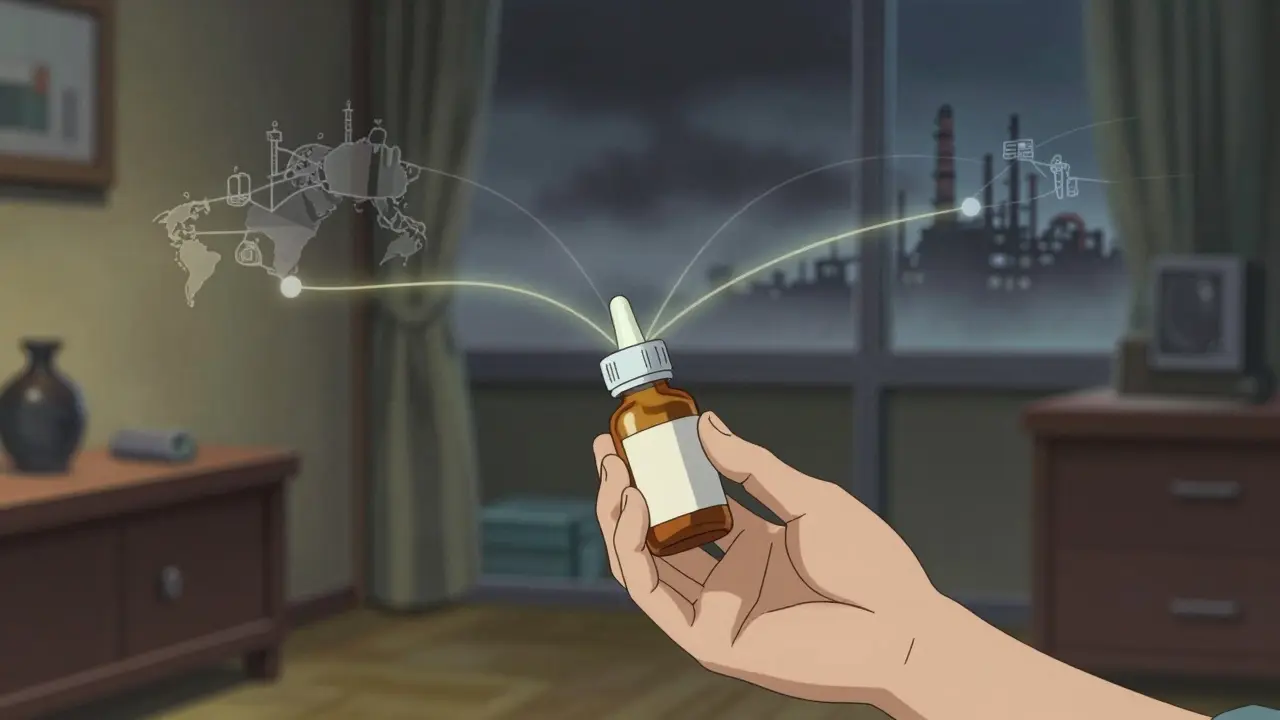
Data shows that the first generic entry usually drops prices by about 40%. When a second competitor enters, prices fall another 30%. By the time four or five generic versions are available, the cost plummets to a fraction of the original. This is why the market share of generics has grown so fast since the 1980s. However, the manufacturing side faces its own hurdles. About 80% of Active Pharmaceutical Ingredients (APIs) come from overseas, primarily India and China. During the global pandemic, reliance on imported components caused shortages for over 300 drugs, highlighting a vulnerability in the supply chain.
Supply stability is critical because the cheap price of a generic relies on efficient mass production. When quality issues arise at a plant, the FDA steps in, sometimes halting imports. In 2023, the Generic Drug Shortage Task Force identified 127 drugs at risk due to manufacturing quality lapses. While rare, these events remind us that low cost depends on consistent oversight.

Challenges and Market Barriers
Despite the benefits, generic availability isn't always perfect. One major hurdle is the "patent thicket." Big pharmaceutical companies often file dozens of extra patents on minor aspects of a drug-like the size of a capsule or the color of a tablet-to block generic entry. In 2019, the Federal Trade Commission found that brand makers filed an average of 140 patents per drug to extend exclusivity.
Another barrier involves "pay-for-delay" settlements. Sometimes, a brand company sues a generic challenger and pays them off to wait five years before entering the market. The FTC estimates these delays cost consumers billions annually. Additionally, some drugs are simply hard to copy. Complex molecules, like injectables or inhalers, require intricate delivery systems. Bioequivalence is harder to prove for these, leading to higher development costs.
There is also the "biosimilar void." Unlike simple chemical generics, complex biologic drugs (like insulin or antibodies) require slightly different alternatives called biosimilars. Even though the technology exists, 90% of biologics losing protection soon have no biosimilar in development. This leaves expensive options without competition. While small-molecule generics save money immediately, this gap in biologics represents a trillion-dollar opportunity for future savings.
Patient Experience and Real-World Usage
From the patient perspective, generics are a lifeline. Reports indicate that 68% of people skip doses when costs get too high. Switching to a generic can mean the difference between buying medication and eating. On forums like Reddit, users frequently share stories of switching from branded insulin ($350/month) to generic versions ($25/month) with identical results. However, trust issues persist.
About 23% of users complain about adverse reactions to inactive ingredients. While the active drug is the same, fillers or dyes might differ. Some people notice changes in energy levels or digestion when the manufacturer switches. Most cases resolve once the body adjusts, but for sensitive individuals, especially those on narrow therapeutic index drugs like warfarin, consistency matters. Doctors often recommend staying with one manufacturer to avoid variability.
Despite these quirks, ratings for generic efficacy remain high. An analysis of over a million reviews showed generics scored 4.1 out of 5 stars, nearly matching brand names. The real difference is affordability. Users consistently rate generics higher on cost, acknowledging that the savings allow them to actually buy the meds they need. This aligns with data showing Medicare Part D beneficiaries experience far less non-adherence with generics compared to brand names.
Future Outlook and Policy Changes
The landscape is shifting again with the Inflation Reduction Act. This legislation allows Medicare to negotiate prices for certain high-cost drugs. While negotiation saves money, experts note that generic competition still beats negotiation. Negotiation might cut prices by 30%, but open generic competition can cut them by 90%. The best approach combines both: negotiate for unpatented drugs where generics aren't yet available, and incentivize generic entry wherever possible.
Looking ahead, the FDA's new fee structures, known as GDUFA III, aim to speed up approvals for complex generics. There is a push to reduce review times to encourage more competition in difficult categories. As more patents expire in the next decade, the potential savings are estimated to rise, provided supply chains stabilize. The goal is to maintain the 90% generic usage rate while closing the biosimilar gap, ensuring expensive therapies eventually have affordable alternatives.
Frequently Asked Questions
Are generic drugs exactly the same as brand-name drugs?
Yes, they must contain the same active ingredient, strength, and dosage form. They may differ in inactive ingredients like fillers or colors, which generally does not affect effectiveness.
Why are generic medications cheaper?
Generics do not need to repeat expensive clinical trials required for brand-name drugs. Manufacturers only need to prove bioequivalence, allowing them to sell the product at a fraction of the R&D cost.
Does my pharmacist need permission to substitute generics?
In 48 states, pharmacists can automatically substitute a generic unless the doctor writes "dispense as written." However, some states require authorization for narrow therapeutic index drugs.
What is the difference between a generic and a biosimilar?
Generics copy simple chemical drugs, while biosimilars copy complex biological drugs made from living cells. Biosimilars are not identical copies but highly similar versions with no clinically meaningful differences.
Can I request the brand name instead of a generic?
You can, but insurance may charge a higher copay. Your insurance plan often covers generics fully while requiring out-of-pocket payment for brand names if a generic is available.
Do generic drugs expire sooner than brands?
No, expiration dates are determined by stability testing. Both generic and brand drugs undergo rigorous testing to ensure potency lasts until the date printed on the label.
Who makes most generic drugs?
Major players include Teva, Viatris, and Sandoz. However, many smaller domestic companies exist alongside large international manufacturers based in India and China.
Calvin H
April 1, 2026 AT 09:29Another article claiming price drops solve everything like we live in a magical utopia instead of reality. The stats look nice on paper but the actual execution feels half-baked at best.
Victor Ortiz
April 1, 2026 AT 19:12You clearly do not understand the complexities of Active Pharmaceutical Ingredients sourcing from China or India properly. Most people lack the technical knowledge to grasp why supply chain fragility exists. Stop pretending you know how global logistics work when you rely on domestic policies.
Dan Stoof
April 3, 2026 AT 09:55This is such a bright future!!! The numbers show so much progress!!! Health security is becoming accessible!! Everyone should be excited about the savings!! We can fix this together!!!
Amber Armstrong
April 4, 2026 AT 23:34I remember when my grandfather lost his medication coverage because prices spiked too high during brand exclusivity periods.
He spent months trying to negotiate payment plans with pharmacies just to get basic cholesterol management.
Seeing him suffer financially broke our whole family's spirit for quite some time back then.
That personal tragedy shaped how I view pharmaceutical economics today completely and utterly.
Generic competition is honestly the only real mechanism that keeps things somewhat stable for average folks.
When the patent wall finally crumbles after all those years of protection, the market corrects itself violently.
Prices drop so fast sometimes that supply chains actually struggle to keep up with sudden demand spikes globally.
Manufacturers need reliable access to raw ingredients from overseas facilities without constant customs delays happening.
We tend to forget that stability relies heavily on trust between government regulators and foreign production plants constantly.
If quality controls slip even slightly during the bioequivalence testing phase we risk public health safety entirely.
Some patients report subtle differences in how their bodies react to different filler compounds in the tablets now.
These minor irritations often fade away once the immune system adjusts to the new formulation profile fully.
Yet the cost benefit overwhelmingly outweighs these small hurdles for most households struggling with bills monthly.
Accessibility remains the core goal behind every single policy change introduced by recent legislative acts passed recently.
We must keep advocating for transparent labeling so everyone knows exactly what goes into their pills every day.
Hope springs eternal whenever new biosimilar pathways finally open up to include complex biological treatments soon.
Jonathan Sanders
April 6, 2026 AT 13:15Sharing all this sadness drains me completely. You people always focus on the negative parts without seeing the bigger picture.
Michael Kinkoph
April 6, 2026 AT 18:26One must maintain high intellectual standards when discussing medical economics! Virtuous choices define society! People ignoring the nuance are simply ignorant!
Ruth Wambui
April 7, 2026 AT 15:33The deep state definitely manipulates drug patents for control purposes! Hidden agendas drive these policy shifts! Big pharma owns the regulators deeply!
Brian Yap
April 7, 2026 AT 22:34Makes total sense.
Carolyn Kask
April 8, 2026 AT 14:24American pharmaceutical dominance ensures quality unlike other nations! Foreign dependencies weaken national security significantly! We should not trust imported ingredients blindly.
Katie Riston
April 8, 2026 AT 18:51The ethical implications of commodifying life-saving chemistry remain profound indeed. Economic efficiency serves humanity only when moral frameworks align perfectly with profit motives.
emma ruth rodriguez
April 9, 2026 AT 19:50Please note that regulatory approval processes vary by jurisdiction significantly. Clinical trial requirements differ between the United States and other nations.