

How Dextromethorphan (DXM) Abuse Happens with OTC Cough Syrups
 Mar, 2 2026
Every year, thousands of teens and young adults turn to something they can buy without a prescription: a bottle of cough syrup. It’s cheap, legal, and sitting right there on the pharmacy shelf. But what they’re looking for isn’t a cure for their cold-it’s a high. That high comes from dextromethorphan, or DXM, an ingredient in over 70 over-the-counter cough and cold medicines. When taken as directed, DXM is safe and effective. But when someone drinks five, ten, or even twenty bottles at once, it becomes something dangerous-and sometimes deadly.
How DXM Works (When Used Right)
Dextromethorphan was approved by the FDA in 1958 as a non-narcotic cough suppressant. Unlike codeine, it doesn’t relieve pain or cause physical dependence when used properly. At normal doses-15 to 30 mg every 4 to 8 hours-it works by quieting the cough reflex in the brainstem. You take it, you stop coughing, and you go about your day. Products like Robitussin DM, Coricidin, NyQuil, DayQuil, and Benylin DM all contain DXM. You’ll often see "DM" on the label, which stands for "dextromethorphan" or "dextromethorphan hydrobromide." Some brands even use "Tuss" in the name, like Tussin DM.
These medicines are meant to be taken in small amounts, for a few days. But the problem starts when people realize that if a little helps stop coughing, a whole lot might make them feel something else entirely.
The High: How DXM Abuse Works
At doses far beyond what’s on the label-anywhere from 240 mg to over 1,500 mg-DXM stops being a cough suppressant and starts acting like a dissociative drug. It blocks certain receptors in the brain, leading to feelings of detachment, altered senses, and hallucinations. This is why it’s nicknamed "the poor man’s PCP." Unlike illegal drugs, you don’t need a dealer. You just need a grocery store, a few bucks, and a bottle labeled "cough syrup."
There are several ways people abuse it:
- Drinking multiple bottles-Some users call this "robo tripping" or "dexing." They’ll chug entire bottles of syrup, sometimes over several hours, to reach the high.
- The "robo shake"-This is a more advanced method. Users drink a large amount of syrup, then induce vomiting to get rid of the sugar, alcohol, and other ingredients that cause nausea. They keep the DXM in their system and flush out the rest.
- Extracting pure DXM-Some users go further. They use chemical methods-often learned from online guides-to strip away everything but the DXM. This leaves behind a powder, capsule, or pill form that’s far more potent and easier to snort or overdose on.
The National Institute on Drug Abuse found that about 3% of teens admitted to abusing OTC cough medicines in 2016. That’s 1 in 30. In 2015, nearly 5% of high school seniors had tried it. The numbers might seem small, but when you consider how many bottles are sold every year, the risk is real.
The Plateaus: What Happens at Different Doses
DXM doesn’t just give you one kind of high. It has distinct "plateaus"-levels of effect based on how much you take.
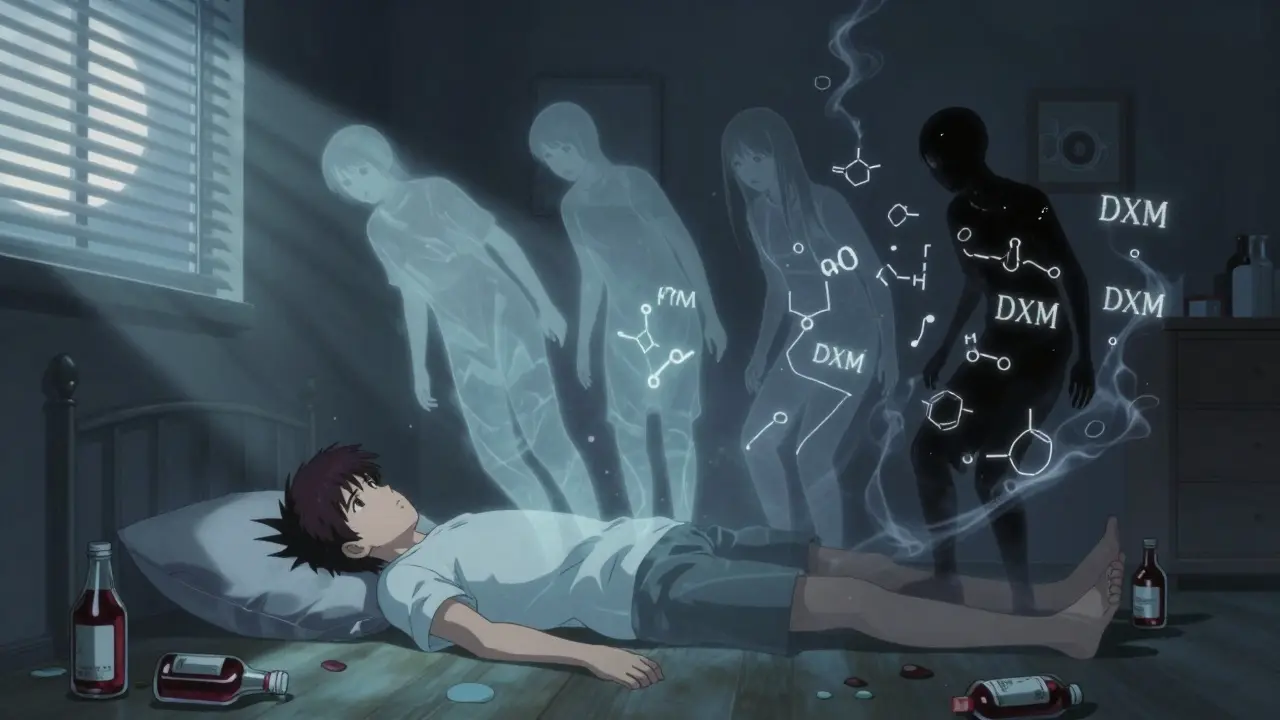
- First plateau (100-200 mg): Mild euphoria, slight dizziness, altered perception of colors or sounds. People often mistake this for just being "buzzed." Many don’t realize they’re already crossing into abuse territory.
- Second plateau (200-400 mg): More intense. Distorted time, blurred vision, slurred speech, loss of coordination. Users may feel detached from their body.
- Third plateau (400-600 mg): Strong dissociation. Out-of-body experiences. Hallucinations. Confusion. Some users describe it as "floating" or "being outside myself."
- Fourth plateau (600+ mg): Near-complete loss of contact with reality. Severe dizziness, seizures, coma, or death. This is where overdose happens.
These effects aren’t fun. They’re disorienting, terrifying, and dangerous. People have fallen down stairs, walked into traffic, or passed out and choked on their own vomit.
When DXM Gets Dangerous
DXM alone is risky. But when it’s mixed with other substances, it becomes deadly.
- Alcohol: Combining DXM with alcohol increases the risk of respiratory depression. It can shut down your breathing. This combination has caused multiple deaths.
- SSRIs: Many teens take antidepressants. Mixing DXM with SSRIs like Prozac or Zoloft can trigger serotonin syndrome-a dangerous spike in brain serotonin that causes fever, seizures, muscle rigidity, and death.
- MDMA or stimulants: This combo raises body temperature dangerously high. Hyperthermia can cause brain damage or organ failure.
- Pure DXM powder: Extracted DXM is far more concentrated. A single teaspoon can contain 500 mg or more. One mistake, one miscalculation, and it’s too much.
Mount Sinai Health System warns that overdose from pure DXM can lead to brain damage, seizures, or death. And survival? It depends on how fast you get to the hospital.
Why People Abuse It
It’s not about rebellion. It’s about access.
Unlike cocaine, meth, or heroin, DXM is legal, cheap, and easy to find. A 12-ounce bottle of Robitussin DM costs less than $10. It’s sold in gas stations, pharmacies, and online. Teens don’t need to know a dealer. They don’t need to sneak into a club. They just need to walk into a store.
And because it’s sold as medicine, many don’t see it as a drug. "It’s just cough syrup," they say. But that’s the trap. It’s not just syrup. It’s a powerful psychoactive substance. And when taken in large doses, it rewires perception.
What’s Being Done
Some states have started restricting sales. A few require ID to buy cough syrup with DXM. Others limit how many bottles you can buy at once. The CHPA (Consumer Healthcare Products Association) has worked with manufacturers to add warning labels and reduce the amount of DXM in single doses.
But the real problem? The internet. There are dozens of forums, YouTube videos, and Reddit threads that teach exactly how to extract DXM, how much to take, and what to expect. These aren’t hidden. They’re easy to find. And they’re targeting teens who think they’re just experimenting.
What You Need to Know
If you or someone you know is using cough syrup to get high, here’s the truth:
- DXM is not harmless. Even "one time" can lead to overdose.
- It’s not addictive like heroin or nicotine-but it can become a compulsive behavior. People keep going back because the dissociation feels like escape.
- There is no safe recreational dose. The line between "feeling good" and "needing emergency care" is razor-thin.
- Parents: Check your medicine cabinet. Look for bottles labeled "DM," "Tuss," or "Cough Suppressant." If you find empty bottles or large quantities gone missing, it’s not just a cold.
DXM was designed to help people breathe easier. It wasn’t designed to make them lose touch with reality. But when you take too much, your body doesn’t know the difference between medicine and poison.
Can you overdose on DXM from cough syrup?
Yes. Overdosing on DXM is possible and dangerous. Signs include extreme dizziness, blurred vision, vomiting, rapid heartbeat, high blood pressure, confusion, seizures, and loss of consciousness. If someone shows these signs after drinking cough syrup, call emergency services immediately. Survival depends on how fast they get medical help.
Is DXM addictive?
DXM isn’t physically addictive like opioids or alcohol, but it can lead to psychological dependence. People who use it regularly may feel they need it to cope with stress, anxiety, or emotional pain. Treatment centers report increasing cases of compulsive DXM use requiring counseling and behavioral therapy.
What products contain DXM?
Common brands include Robitussin DM, Coricidin HBP Cough & Cold, NyQuil, DayQuil, Benylin DM, Drixoral, St. Joseph Cough Suppressant, Alka-Seltzer Plus Cold and Cough, Tylenol Cold, and Dimetapp DM. Look for "DM" on the label or "cough suppressant" in the active ingredients.
Can you get DXM in powder or pill form?
Yes. DXM is now sold online as a pure powder, capsule, or tablet. These forms are far more dangerous than syrup because they’re concentrated. A small amount can contain enough DXM to cause overdose. Snorting or swallowing pure DXM bypasses the body’s natural limits and increases the risk of death.
Why is DXM abuse common among teens?
DXM is cheap, legal, and easy to buy without ID in many places. Teens often don’t realize it’s a powerful drug. They think it’s just "cough medicine" and don’t understand the risks. Online forums and social media also normalize the behavior, making it seem like a harmless experiment.
What should I do if someone I know is abusing DXM?
Don’t ignore it. Talk to them calmly. If they’re showing signs of overdose-vomiting, confusion, seizures, or unconsciousness-call 911 immediately. For long-term use, seek help from a counselor or addiction specialist. Treatment centers now regularly see cases of DXM dependence, and early intervention makes a big difference.
Dean Jones
March 3, 2026 AT 08:44Dextromethorphan isn’t some harmless syrup. It’s a dissociative that rewires your perception when you push past the label. People think they’re just having a weird night, but they’re flirting with psychosis. The plateaus aren’t fun zones-they’re warning signs written in brain chemistry. That third plateau? That’s where you stop being in your body. That’s not transcendence, that’s neurological overload. And the fourth? That’s where your lungs forget how to breathe. No one wakes up saying, 'I want to die tonight.' But they do wake up in an ER because they thought 'a few extra bottles' wouldn’t matter. It does. Always.
There’s no 'just once.' Once is enough to scar your nervous system. And the internet doesn’t care if you live. It just posts guides like they’re recipe cards.
They call it 'the poor man’s PCP' like that’s a compliment. It’s not. It’s a death sentence with a cough syrup label.
Matt Alexander
March 4, 2026 AT 14:06Just keep it simple: if you’re drinking more than one bottle, you’re not treating a cough. You’re poisoning yourself. DXM isn’t magic. It’s a chemical that messes with your brain’s signals. At high doses, it blocks what keeps you breathing normally. Combine it with alcohol or antidepressants? That’s like playing Russian roulette with two bullets. No one’s coming to save you because you thought it was 'just medicine.' Your body doesn’t care what the bottle says. It only knows how much poison you gave it.
Check the label. If it says 'DM' or 'cough suppressant' and you’re taking more than the max dose? You’re abusing it. Plain and simple.
Gretchen Rivas
March 5, 2026 AT 05:49My cousin did this for months. Said it helped with anxiety. Then she started missing work, forgetting her own birthday, and talking to walls. We didn’t know what was wrong until we found ten empty bottles under her bed. It’s not rebellion. It’s self-destruction disguised as escape. If you’re using this to feel better, you’re just trading one problem for ten worse ones.
Mike Dubes
March 6, 2026 AT 01:14Man i heard about this from a buddy who tried robo shaking. Said it was like floating through a dream you cant wake up from. Then he puked for 3 hours straight and passed out in the shower. Took 20 mins for his roommate to notice. He was lucky. A lot of these kids dont have someone watching. Just some kid alone with a bottle and a youtube video saying 'youll feel godlike.'
its not godlike. its your brain screaming.
Helen Brown
March 6, 2026 AT 04:59They’re hiding this in plain sight. The government lets this stuff sit next to aspirin because they’re paid off by Big Pharma. You think they care if teens OD? No. They make billions off these syrups. The 'warning labels' are jokes. They put them in tiny font. The real solution? Ban DXM from OTC sales. Period. This isn’t freedom. It’s corporate negligence with a smiley face.
John Cyrus
March 7, 2026 AT 16:57Parents are lazy. They don’t check their medicine cabinets. They don’t talk to their kids. They think 'it’s just cough syrup' so they leave it out like a candy dish. Then they cry when their kid ends up in a coma. You want to stop this? Lock up your meds. Talk to your kids. Don’t wait for a hospital visit to become a parent.
And stop acting like this is some new epidemic. This has been around since the 90s. People just ignore it until it hits their family.
John Smith
March 9, 2026 AT 04:52Let’s be real-this ain’t about science. It’s about kids who feel invisible. They don’t have money for club drugs. They don’t have access to therapists. So they grab the one thing the system lets them have: a bottle labeled 'medicine.' They’re not trying to get high. They’re trying to feel something that isn’t numb. The real villain isn’t DXM. It’s a society that lets kids drown in silence while selling them syrup like it’s soda.
Sharon Lammas
March 9, 2026 AT 19:56I’ve seen this in my counseling work. The teens who use DXM aren’t thrill-seekers. They’re the quiet ones. The ones who sit in the back, smile politely, and disappear after school. They don’t want to party. They want to stop feeling like they’re floating through a nightmare. The drug doesn’t fix it. It just makes the nightmare longer. And when they come to me, they’re ashamed. They don’t know it’s not their fault. They think they’re broken. They’re not. They’re just lost.
marjorie arsenault
March 10, 2026 AT 05:12My daughter tried this once. Said she just wanted to feel 'light.' She ended up in the ER with a heart rate of 160. We didn’t know what was wrong until the nurse asked if she’d taken cough syrup. I didn’t even know we had any left. Since then, I’ve thrown out every bottle with 'DM' on it. I check every medicine cabinet monthly. I talk to her every day. Not to lecture. Just to listen. She’s okay now. But it took a near-death experience to wake us up.
Deborah Dennis
March 10, 2026 AT 14:44This article is so overly dramatic. Everyone knows DXM is dangerous. Why are we acting like this is news? People have been doing this for decades. It’s not a 'crisis.' It’s a choice. If you’re dumb enough to drink ten bottles, you deserve what you get. Stop coddling teens. Teach them responsibility. Don’t hand them a pamphlet and call it prevention.
Shivam Pawa
March 12, 2026 AT 03:32In India, this is rare. But we have similar issues with codeine syrups. The root cause is the same: lack of mental health infrastructure. When there’s no one to talk to, people turn to whatever numbs the noise. DXM isn’t the problem. The silence is. We need more counselors in schools. Not more restrictions. More connection.
Diane Croft
March 12, 2026 AT 20:46You’re not alone if you’ve struggled with this. Recovery isn’t about willpower. It’s about support. I’ve been there. I’m here now. If you need to talk, find a counselor. Or just text someone. You don’t have to do this alone. There’s help. And it’s never too late to ask for it.
Richard Elric5111
March 13, 2026 AT 23:47It is axiomatic that the pharmacological manipulation of central nervous system receptors, particularly those governing sensory integration and autonomic regulation, constitutes an inherently perilous endeavor when conducted outside the parameters of clinical supervision. The ontological dislocation experienced during the third plateau is not merely a subjective phenomenon-it is a neurochemical rupture, a temporary dissolution of the ego’s perceptual scaffolding. To equate this with recreational indulgence is to commit a category error of monumental proportions. The substance, in its unadulterated form, is neither medicine nor intoxicant; it is a threshold. And thresholds, when crossed without preparation, invariably lead to the precipice.
Moreover, the commodification of psychoactive substances under the guise of over-the-counter therapeutics reflects a systemic epistemological failure of regulatory institutions. The FDA’s 1958 approval was predicated upon a model of usage that no longer obtains. The cultural normalization of 'robo tripping' via digital subcultures represents a profound alienation from medical epistemology. We are not dealing with drug abuse. We are dealing with a civilization that has outsourced its existential distress to pharmacological convenience.
Jeff Card
March 15, 2026 AT 21:11Richard, you just described the whole thing better than any article ever could. I’ve worked in ERs for 12 years. I’ve seen kids come in after taking DXM. They’re not high. They’re terrified. They’re screaming that they can’t feel their arms, that the walls are breathing, that they’re floating but can’t move. They’re not asking for help. They’re begging to wake up.
It’s not about punishment. It’s about someone saying, 'I see you. You’re not alone.' That’s what matters.