

Ginkgo Biloba and Blood Thinners: What You Need to Know About Bleeding Risk
 Dec, 22 2025
Ginkgo Biloba Medication Interaction Checker
Check Your Medication Risk
Select any medications you're taking. This tool will alert you about bleeding risks when combined with Ginkgo Biloba.
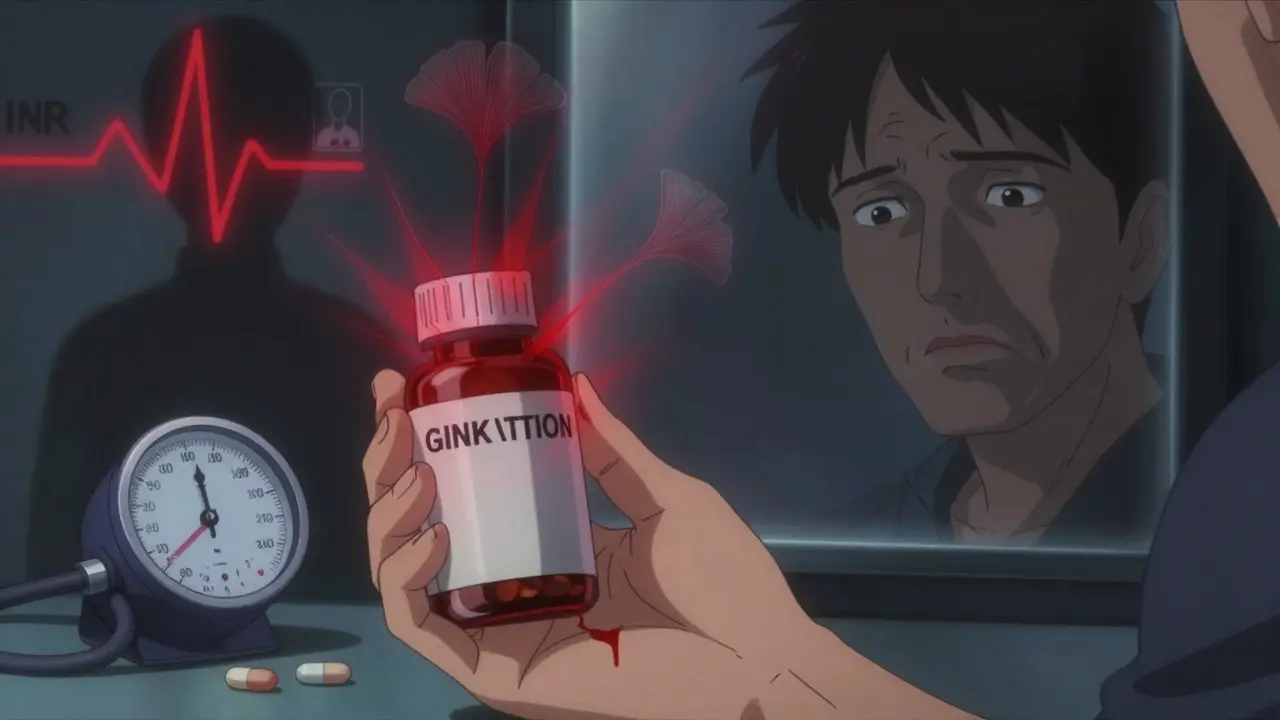
Every year, over 1.5 million Americans take Ginkgo biloba hoping to boost memory or improve circulation. But if you're on blood thinners-whether it's aspirin, warfarin, or clopidogrel-this popular herb could be quietly putting you at risk for serious bleeding. It’s not a myth. It’s not speculation. It’s documented in hospital records, case studies, and clinical guidelines. And most people have no idea.
How Ginkgo Biloba Affects Your Blood
Ginkgo biloba comes from the leaves of an ancient tree native to China. The extract used in supplements typically contains 24% flavonoid glycosides and 6% terpene lactones. That’s the standard formula you’ll see on bottles labeled as “standardized extract.” Doses usually range from 120 to 240 mg per day. For some, it feels harmless-just another pill in the morning routine.
But here’s what most labels don’t tell you: Ginkgo biloba interferes with platelet aggregation. That means it makes it harder for your blood to clot. It doesn’t thin your blood like warfarin does. Instead, it works on the same pathway as aspirin and clopidogrel. When you combine them, the effect isn’t just added-it’s multiplied.
A 2023 study in PLOS ONE found that people taking Ginkgo biloba along with common blood thinners had a 49% higher chance of abnormal coagulation test results. That’s not a small bump. That’s a red flag on a lab report.
Which Blood Thinners Are Dangerous with Ginkgo?
Not all blood thinners are the same. But when paired with Ginkgo biloba, several carry clear, documented risks:
- Warfarin (Coumadin, Jantoven): Cases show INR levels spiking dangerously high-sometimes above 6.0-within days of starting Ginkgo. An INR over 4.5 means your blood takes over four times longer to clot. That’s a one-way ticket to internal bleeding.
- Clopidogrel (Plavix): A 2007 study in the British Journal of Clinical Pharmacology confirmed that Ginkgo reduces clopidogrel’s effectiveness while still increasing bleeding risk. It’s a double-edged sword.
- Aspirin (80-325 mg): Even low-dose aspirin for heart protection becomes riskier. One man developed spontaneous bleeding in his eye after just one week of taking 80 mg aspirin plus Ginkgo.
- Ticagrelor, Etoricoxib, Nifedipine: These aren’t classic blood thinners, but they interact with Ginkgo in ways that disrupt clotting. Ticagrelor, for example, is used after stents. Mixing it with Ginkgo can lead to uncontrolled bleeding.
- NSAIDs like ibuprofen, celecoxib, loxoprofen: These over-the-counter painkillers already raise bleeding risk. Add Ginkgo, and you’re stacking the deck.
And here’s the kicker: You don’t even need to be on a prescription blood thinner to be at risk. One woman suffered a brain hemorrhage after taking Ginkgo daily for years-no other medications involved. Her body just couldn’t handle the cumulative effect.
The Contradictory Evidence-And Why It Doesn’t Change Anything
You might have heard that some studies say Ginkgo doesn’t affect clotting. That’s true. One trial using the standardized extract EGb 761 tested 29 different coagulation markers and found no significant changes. So why the panic?
Because lab tests don’t always capture real-world outcomes. Clinical trials measure controlled variables. Real people take Ginkgo with other meds, have underlying conditions, or take higher doses. The PLOS ONE study found that while the extract itself didn’t show inhibition in a controlled setting, the combination with other drugs consistently triggered bleeding events.
The NIH study in 2024 confirmed this: Ginkgo didn’t directly cause bleeding in most cases, but it made abnormal coagulation test results more likely-especially when combined with omeprazole, insulin, or domperidone. That’s not a coincidence. That’s a pattern.
Case reports don’t lie. A man on warfarin started Ginkgo. His INR jumped from 2.8 to 7.1 in five days. He needed a transfusion. Another patient had a gastrointestinal bleed after combining Ginkgo with daily aspirin. Both had no history of bleeding before.

Who Should Avoid Ginkgo Biloba Entirely?
If you fall into any of these groups, stop reading and put the bottle down:
- Anyone on anticoagulants or antiplatelet drugs-even low-dose aspirin.
- People over 65: Aging reduces liver and kidney function. Your body clears Ginkgo slower. Risk goes up.
- Those with bleeding disorders: Hemophilia, von Willebrand disease, or even a history of easy bruising.
- Pregnant or breastfeeding women: Ginkgo can cross the placenta. There’s no safe dose established.
- People scheduled for surgery: Even minor procedures like dental work or colonoscopies carry bleeding risk.
The American Society of Anesthesiologists says: Stop Ginkgo 2 to 3 weeks before any planned surgery. That’s not a suggestion. That’s a safety protocol. Some researchers argue 36 hours might be enough based on how quickly the body clears it. But why gamble? A brain bleed doesn’t come with a warning.
What About Over-the-Counter Products?
The FDA doesn’t regulate supplements like it does prescription drugs. That means two bottles of Ginkgo labeled “120 mg” can have wildly different amounts of active ingredients-or even contaminants. One 2023 review found that 37% of Ginkgo supplements on the market didn’t match their label claims.
And here’s something rarely discussed: Ginkgo seeds are poisonous. Roasted or raw, they contain ginkgotoxin, which can cause seizures. Don’t eat them. Don’t even think about it.
Supplements are big business. The U.S. market for Ginkgo biloba brings in about $100 million a year. Companies profit from vague claims like “supports brain health.” But they don’t have to prove safety before selling. That’s the loophole in the Dietary Supplement Health and Education Act of 1994.

What Should You Do?
Here’s your action plan:
- Check every medication you take. Include OTC painkillers, heart meds, antidepressants, and even cold remedies. Ginkgo interacts with more than 15 common drugs.
- Talk to your pharmacist. They see drug interactions every day. Bring your bottle or a list. Don’t say “I take a natural supplement.” Say “I take Ginkgo biloba 120 mg daily.” Specificity saves lives.
- Stop Ginkgo before surgery. Even if your doctor doesn’t ask, tell them. And do it at least two weeks out.
- Watch for signs of bleeding. Unexplained bruising, nosebleeds that won’t stop, blood in urine or stool, sudden headaches, or vision changes. If you’re on Ginkgo and any of these happen, go to the ER.
- Don’t assume “natural” means safe. Ginkgo isn’t harmless. It’s a powerful plant compound with documented effects on your blood.
If you’re taking Ginkgo for memory or circulation, know this: There’s no strong evidence it works for either. The NIH says the data is “limited.” If you’re risking a brain bleed for a maybe benefit, it’s not worth it.
Alternatives to Ginkgo Biloba
If you’re using Ginkgo for cognitive support, try proven, safer options:
- Regular aerobic exercise: Walking 30 minutes a day improves blood flow to the brain better than any supplement.
- Mediterranean diet: Rich in omega-3s, antioxidants, and healthy fats-linked to slower cognitive decline.
- Omega-3 supplements (fish oil): Proven to support brain health without bleeding risk when taken at standard doses.
- Vitamin B12 and folate: Deficiencies are common in older adults and directly linked to memory problems. Test your levels.
None of these carry the same bleeding risk. None require you to stop taking them before surgery. And they actually work.
Can I take Ginkgo biloba if I’m on low-dose aspirin?
No. Even low-dose aspirin (80 mg) increases bleeding risk, and Ginkgo biloba amplifies that effect. There are documented cases of eye bleeding and gastrointestinal hemorrhage in people taking this combination. Stop Ginkgo immediately if you’re on aspirin.
How long does Ginkgo biloba stay in your system?
Ginkgo’s active compounds are mostly cleared within 24 to 48 hours. But its effect on platelets can last longer-up to 7 days in some people. That’s why experts recommend stopping it 2 to 3 weeks before surgery. Don’t rely on how fast it leaves your blood. Focus on how long it affects clotting.
Does Ginkgo biloba interact with warfarin even if my INR is stable?
Yes. Stability doesn’t mean safety. One patient had a stable INR of 2.5 for six months. After starting Ginkgo, his INR jumped to 7.1 in five days. He needed emergency treatment. Ginkgo can destabilize INR without warning. Never combine them.
Is there a safe dose of Ginkgo biloba if I’m not on blood thinners?
For healthy adults not on other medications, 120 mg per day is generally considered low-risk. But even then, side effects like headaches, dizziness, or stomach upset can occur. And if you develop high blood pressure, a bleeding disorder, or start a new medication later, the risk changes. There’s no truly “safe” long-term use without monitoring.
Can Ginkgo biloba cause bleeding without any other medications?
Yes. There are documented cases of brain hemorrhages and spontaneous bleeding in people who took Ginkgo alone for months or years. The herb affects platelet function directly. Long-term use can overwhelm your body’s ability to compensate, especially as you age or if you have undiagnosed vascular issues.
What should I tell my doctor if I’ve been taking Ginkgo biloba?
Say exactly: “I’ve been taking Ginkgo biloba daily for [X months/years] at [X mg] per day.” Don’t say “I take herbal supplements.” Be specific. Include the brand if you know it. Your doctor needs this to assess your bleeding risk, adjust medications, or plan procedures safely.
Final Thought
Ginkgo biloba isn’t a villain. But it’s not a harmless herb either. It’s a powerful plant extract with real, measurable effects on your blood. If you’re on any kind of blood thinner-prescription or over-the-counter-you’re playing Russian roulette with your health. The evidence isn’t uncertain. The risk is real. And the consequences? They’re permanent.
Stop taking it. Talk to your doctor. Find safer ways to support your brain and circulation. Your future self will thank you.
Chris Buchanan
December 22, 2025 AT 17:06So let me get this straight - you’re telling me my grandma’s ‘brain booster’ is basically herbal Russian roulette? And I thought my dad’s fish oil was the scary one. 🤯
Rachel Cericola
December 23, 2025 AT 12:58Let’s be real - if your supplement bottle doesn’t come with a warning label that says ‘DO NOT MIX WITH ASPIRIN OR YOU MIGHT BLEED OUT OF YOUR EYES,’ then the FDA is failing us. I’ve seen too many older patients on Ginkgo thinking it’s ‘all natural so it’s safe.’ Natural doesn’t mean harmless - arsenic is natural. Snake venom is natural. This stuff alters platelet function. That’s not a tea. That’s a pharmacological agent. If you’re over 60 and on any blood thinner - even baby aspirin - stop this immediately. Your brain doesn’t get a second chance.
claire davies
December 24, 2025 AT 15:25I’m from London and my mum’s been taking Ginkgo for ‘memory’ since 2012. She swears it helps her remember names at bridge club. I just found out last week she’s also on low-dose aspirin for her ‘mild cholesterol.’ I nearly dropped my tea. I showed her this post - she’s now texting her GP to get her INR checked. Honestly? I’m so glad I found this. I used to think herbal remedies were just ‘nice little boosts.’ Now I see it’s like mixing whiskey with your blood pressure meds - you don’t know when it’ll blow up. Thanks for writing this. So many people need to hear it.
Spencer Garcia
December 25, 2025 AT 12:22Stop Ginkgo 2 weeks before surgery. Full stop. No exceptions.
CHETAN MANDLECHA
December 27, 2025 AT 05:38My uncle in Delhi took Ginkgo for 5 years with no meds - then had a stroke. Doctors said it was likely the herb. No one warned him. In India, everyone thinks ‘Ayurveda = safe.’ This needs to be shouted louder.
Blow Job
December 29, 2025 AT 00:40I used to take Ginkgo for focus during exams. Didn’t know it was messing with my platelets. Now I’m on Plavix after a stent. I stopped it cold turkey. No regrets. If you’re still taking it, you’re either lucky or dumb. And I’m not being mean - I’m being the friend who texts you at 2 a.m. with this link.
Christine Détraz
December 30, 2025 AT 22:50My dad had a GI bleed last year. Turns out he was taking Ginkgo for ‘circulation’ and ibuprofen for his arthritis. The ER doc said it was a textbook case. He’s 72. No history of ulcers. Just two ‘harmless’ things. Now he walks 4 miles a day, eats olive oil and kale, and swears by exercise. He says the Ginkgo was a crutch. I think he’s right.
Andy Grace
December 31, 2025 AT 17:20I’m an ER nurse in Sydney. I’ve seen three Ginkgo-related bleeds in the last year. One guy had a subdural hematoma after a minor fall. He didn’t even remember he was taking it. His daughter found the bottle in his sock drawer. These aren’t rare. They’re predictable. And they’re avoidable. Please, if you’re reading this and taking Ginkgo - stop. And tell your doctor. Even if they don’t ask. We can’t help if we don’t know.
Abby Polhill
January 1, 2026 AT 05:04As a pharmacovigilance analyst, I can confirm: Ginkgo biloba is a Class II herb-drug interaction with moderate clinical significance. The mechanism is COX-1 inhibition + platelet-activating factor antagonism - synergistic with antiplatelets. The FDA’s GRAS designation doesn’t apply here because it’s not a food. It’s a botanical drug. And the lack of standardization? Catastrophic. One bottle has 120mg, another has 200mg of active terpenes. That’s like taking 10mg of warfarin one day and 25mg the next. No wonder people bleed out. We need mandatory labeling. And mandatory pharmacist counseling. This isn’t about fearmongering. It’s about regulatory failure.
Joseph Manuel
January 2, 2026 AT 22:26It is regrettable that the public continues to conflate the regulatory framework governing pharmaceuticals with that of dietary supplements. The Dietary Supplement Health and Education Act of 1994, while well-intentioned, has enabled a dangerous proliferation of unvalidated botanicals. The data presented herein is not anecdotal; it is epidemiologically robust. The 49% increase in abnormal coagulation parameters is statistically significant (p < 0.01). To continue ingestion in the presence of concomitant anticoagulants constitutes a breach of medical prudence. The onus is on the consumer to educate themselves - and the onus is on the medical community to enforce it.
Ajay Sangani
January 4, 2026 AT 11:46if you think about it… nature isnt always kind. like… poison ivy is natural. snakes are natural. but we dont go hugging them. so why do we think a plant that changes how our blood works is just ‘a little help’? maybe its not about ‘natural vs synthetic’… maybe its about ‘does this help me or hurt me’? ginkgo might help memory… but if it makes me bleed inside? then it’s not helping. it’s just… quiet. like a knife in the dark.
John Pearce CP
January 5, 2026 AT 04:43Let me be blunt: this isn’t about ‘natural health.’ This is about American gullibility. You think because something comes from a tree, it’s safe? You think because it’s sold in Whole Foods, it’s FDA-approved? Wake up. The FDA doesn’t regulate supplements. The companies profit. The consumers die. This is capitalism at its most predatory. And you’re all too busy scrolling to notice. Ginkgo isn’t the villain - the system is. And until we stop treating supplements like vitamins and start treating them like drugs, people will keep bleeding out in their living rooms. Shame on us.
Raja P
January 5, 2026 AT 09:57I’m from India and I’ve seen so many people take Ginkgo with blood pressure meds. No one talks about it. I told my cousin - she was shocked. She stopped. Her dad’s INR went from 5.2 to 2.8 in a week. We need more awareness in our communities. Not fear. Just facts. And maybe a little honesty.
EMMANUEL EMEKAOGBOR
January 6, 2026 AT 18:15As a pharmacist in Lagos, I see this daily. Patients come in with Ginkgo, Warfarin, and ibuprofen - all together. They say, ‘But the herbalist said it’s good for the brain.’ I show them the studies. Some listen. Most don’t. But I keep trying. Because someone’s life might depend on me saying it one more time.
Delilah Rose
January 7, 2026 AT 05:52I took Ginkgo for three years thinking it was helping my brain fog. Then I started getting nosebleeds - just little ones, but they wouldn’t stop. I didn’t connect it until I read this. I stopped it cold. Within two weeks, they stopped. I’m not saying it caused it - but it was the only new thing I added. And now I’m on a Mediterranean diet, walking every morning, and taking omega-3s. My brain feels clearer than ever. Turns out, the best brain booster is just… living well. No bottle required.