

Fracture Prevention: Calcium, Vitamin D, and Bone-Building Medications That Actually Work
 Dec, 1 2025
Fractures aren’t just accidents-they’re often the result of weak bones, especially after age 50. In the U.S., about 2 million osteoporosis-related fractures happen every year, costing the healthcare system over $52 billion. But here’s the truth: most people are taking the wrong supplements, or skipping the real treatments that make a difference. It’s not enough to pop a calcium pill and call it a day. You need the right combination, at the right dose, for the right person.
Calcium and Vitamin D: The Basics That Often Don’t Work
For years, doctors told everyone over 50 to take 1,000 mg of calcium and 400 IU of vitamin D daily. That advice came from good intentions-but the science doesn’t back it up. The Women’s Health Initiative, a massive study of over 36,000 postmenopausal women, found that this low-dose combo did nothing to lower fracture risk. Not for hips. Not for wrists. Not even for spine fractures.
Why? Because those doses are too low. If your vitamin D level is below 20 ng/mL (a common deficiency), you need more. If you’re eating less than 700 mg of calcium a day from food, you need more. The real magic happens when you combine 800-1,000 IU of vitamin D3 with 1,000-1,200 mg of calcium daily. That’s the sweet spot shown in multiple trials to reduce hip fractures by 16% and any fracture by 6%.
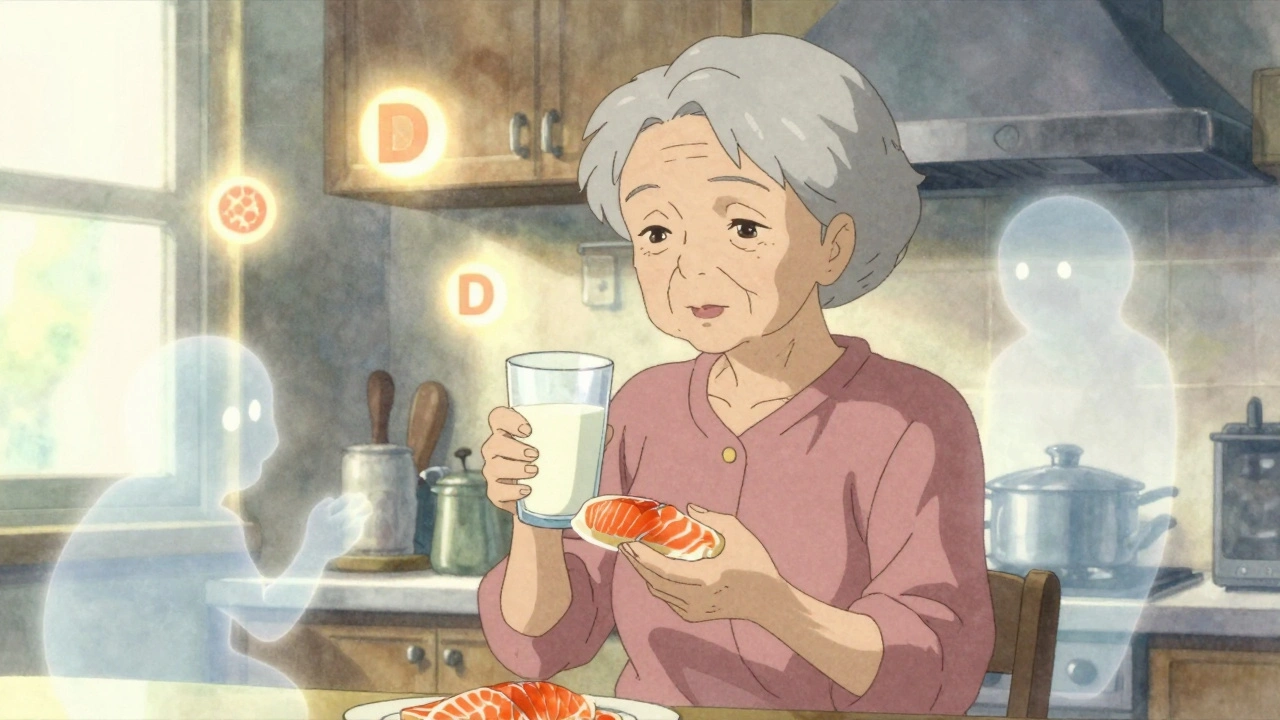
But here’s the catch: this only works for people who are truly deficient or have low dietary intake. If you’re already getting enough vitamin D from sunlight, fortified milk, or fatty fish, adding more won’t help. And if you’re eating yogurt, cheese, leafy greens, or canned salmon regularly, you might not need extra calcium at all.
Who Actually Benefits from Supplements?
Not everyone. The people who see real results are:
- Residents of nursing homes or assisted living facilities
- People with 25-hydroxyvitamin D levels below 20 ng/mL
- Those who eat less than 700 mg of calcium daily
- Older adults who’ve already had a fracture
The landmark 1992 Chapuy study showed a 43% drop in hip fractures among nursing home residents given 800 IU of vitamin D and 1,200 mg of calcium. These were people who rarely saw sunlight, ate poorly, and had severely low vitamin D levels-around 12 ng/mL. For them, the supplements were life-changing.
But for healthy, active older adults living at home? The RECORD trial found no benefit. Their average vitamin D level was already 18.5 ng/mL-close to the threshold. They didn’t need more. They needed better food, more movement, and maybe a stronger bone drug.
The Real Game Changers: Bone-Building Medications
If you’ve had a fracture after age 50, supplements alone aren’t enough. You need medication that actually rebuilds or protects bone. The most common are bisphosphonates-like alendronate (Fosamax) and zoledronic acid (Reclast). These drugs don’t just slow bone loss; they cut fracture risk dramatically.
Alendronate reduces spine fractures by 44% and hip fractures by 25-30%. Zoledronic acid, given as a yearly IV infusion, cuts hip fracture risk by 41% over just 18 months. That’s not a small win-it’s a major shift in survival and independence.
Other options include:
- Denosumab (Prolia): A twice-yearly injection that blocks bone breakdown. Reduces spine fractures by 68% and hip fractures by 40%.
- Teriparatide (Forteo) and Abaloparatide (Tymlos): Daily injections that stimulate new bone growth. Used for severe osteoporosis. Teriparatide reduces spine fractures by up to 70%.
- Romosozumab (Evenity): A monthly injection that builds bone and slows loss at the same time. Reduces spine fractures by 73% in the first year.
These aren’t magic bullets. They’re powerful tools-and they’re underused. A 2022 survey found that nearly half of primary care doctors still prescribe low-dose calcium and vitamin D to patients who’ve already broken a bone. That’s like giving a bandage to someone with a broken leg.
The Hidden Risks: What No One Tells You
Everything has a downside. Calcium supplements can raise your risk of kidney stones by 17%. High doses (over 1,000 mg/day) may also slightly increase heart attack risk, according to data from the Women’s Health Initiative. That’s why it’s better to get calcium from food when you can-yogurt, sardines, tofu, kale, and fortified plant milks are safer sources.
Bisphosphonates come with rare but serious risks: osteonecrosis of the jaw (about 1 in 10,000 patients) and atypical femur fractures (about 1 in 1,000 after 5+ years). That sounds scary-but the risk of breaking your hip without treatment is far higher. Still, you need to know the signs: jaw pain, loose teeth, or new thigh pain that doesn’t go away. Tell your doctor right away.
And yes, side effects are common. Two out of five people on oral bisphosphonates quit within a year because of stomach upset, heartburn, or esophageal irritation. That’s why many switch to the yearly IV version or switch to denosumab.
How to Know What You Need
You don’t need to guess. There’s a simple, proven way to find out:
- Get your 25-hydroxyvitamin D level tested. If it’s below 20 ng/mL, you’re deficient. If it’s between 20-30 ng/mL, you’re insufficient. Aim for 30-50 ng/mL.
- Use the FRAX® tool. It’s free online and calculates your 10-year risk of major fracture based on age, sex, weight, past fractures, steroid use, smoking, and alcohol. If your risk is over 20%, you’re a candidate for medication.
- See a dentist. If you’re considering bisphosphonates or denosumab, get a dental checkup first. No cavities, no extractions needed before starting.
- Check your kidney function. Zoledronic acid needs a creatinine clearance above 35 mL/min. If your kidneys are weak, other options exist.
Most people don’t do any of this. They just take what their neighbor swears by. That’s not how medicine works.
What Works in Real Life
At Mayo Clinic, researchers followed 127 patients who’d already broken a bone. Half got only calcium and vitamin D. The other half got those plus alendronate. After two years, the group on the drug had 58% fewer new fractures. That’s not a statistical fluke-it’s life-changing.
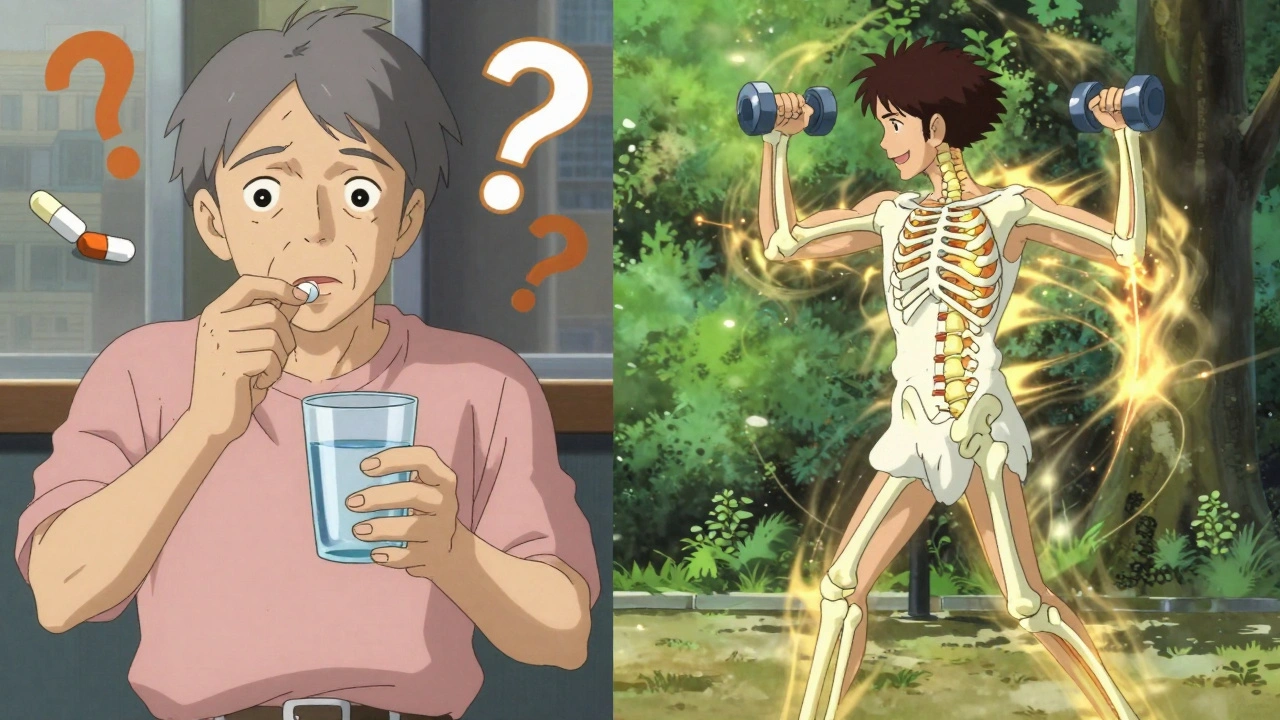
And it’s not just about pills. People who combine medication with weight-bearing exercise-walking, lifting weights, tai chi-have even better results. Movement tells your bones to get stronger. No pill can replace that.
What’s Coming Next
The osteoporosis field is evolving fast. In 2023, the FDA approved abaloparatide for men with osteoporosis, expanding treatment options. The European Society just recommended starting with bone-building drugs like teriparatide before switching to antiresorptives-a strategy that cuts new spine fractures by 73% more than bisphosphonates alone.
And a new trial called VITAL-DEP is testing whether high-dose vitamin D (2,000 IU/day) helps older adults with depression and low vitamin D levels avoid fractures. Results are due in late 2025. We might learn that vitamin D only helps when paired with mental health support.
Meanwhile, the market is growing. The global osteoporosis drug market hit $10.7 billion in 2022. But here’s the problem: more than half of people stop their bisphosphonates within a year. Why? Side effects. Cost. Confusion. That’s the biggest barrier-not the science.
What to Do Right Now
If you’re over 50 and haven’t had a fracture:
- Get your vitamin D level checked. Don’t guess.
- Calculate your FRAX® score. If it’s under 20%, you probably don’t need drugs yet.
- Focus on food: 3 servings of calcium-rich foods daily. Walk 30 minutes most days.
If you’ve already broken a bone:
- Don’t wait. See a specialist. Supplements won’t cut it.
- Ask about bisphosphonates, denosumab, or anabolic agents.
- Get a dental exam before starting any bone drug.
- Combine treatment with strength training. Even light weights help.
Fracture prevention isn’t about taking more pills. It’s about taking the right ones-based on your body, your history, and your real risk. The science is clear. The tools are available. You just need to ask the right questions.
Do calcium and vitamin D supplements prevent fractures for everyone?
No. Low-dose supplements (400 IU vitamin D and 1,000 mg calcium) don’t help healthy, community-dwelling adults. Only people with vitamin D deficiency (below 20 ng/mL), low calcium intake, or who live in nursing homes see real benefits from combined high-dose calcium and vitamin D. For most people, getting these nutrients from food and sunlight is enough.
Are bone-building medications dangerous?
They carry rare but serious risks, like atypical femur fractures or osteonecrosis of the jaw-but these affect fewer than 1 in 1,000 people. The risk of breaking a hip without treatment is far higher. For someone who’s already fractured, the benefits outweigh the risks. Always get a dental checkup before starting and report any new thigh or jaw pain immediately.
What’s the best way to get calcium without supplements?
Yogurt, cheese, sardines with bones, tofu made with calcium sulfate, fortified plant milks, kale, and bok choy are excellent sources. Three servings a day-like one cup of yogurt, half a cup of cooked kale, and a 3-ounce serving of canned salmon-can easily meet your daily needs without pills.
Can I just take vitamin D alone to prevent fractures?
No. Multiple large studies, including the 2019 JAMA Network Open meta-analysis of over 34,000 people, show vitamin D alone doesn’t reduce fracture risk. It must be paired with adequate calcium to have any effect. Even then, it only helps people who are deficient.
How do I know if I need a bone drug?
If you’ve had a fragility fracture (from a fall from standing height or less), or if your FRAX® score shows a 20% or higher 10-year risk of major fracture, you’re a candidate. A DEXA scan showing T-score below -2.5 also confirms osteoporosis. Talk to your doctor-don’t wait for another fracture.
Jack Arscott
December 3, 2025 AT 05:25Just took my vitamin D test today-18 ng/mL 😩 Guess I’m in the ‘needs more’ club. Ordered the 1000 IU D3 + 1200 mg calcium combo. Fingers crossed I don’t end up with kidney stones 🤞
Lydia Zhang
December 5, 2025 AT 05:21Calcium pills are a scam
Lucinda Bresnehan
December 5, 2025 AT 12:44I love how this post breaks it down so clearly. I’m a nurse and I see so many older patients just popping calcium tabs because their aunt did it. But the real game-changer? Getting them on a bone drug after a fracture. One woman I cared for-78, broke her hip, refused meds for a year. Then she got another fracture. Started on denosumab. Now she’s walking with a cane, not a walker. It’s not magic, but it’s real. Also, please get your D levels checked. I’ve seen people with levels at 8 ng/mL and no idea why they’re falling apart. And yeah, food first-yogurt, sardines, kale. I make a smoothie with spinach, fortified almond milk, and chia seeds. Tastes like grass but my bones thank me 🙏
Shannon Gabrielle
December 5, 2025 AT 22:22Oh wow so now we’re blaming the American diet again? You know what’s worse than low vitamin D? Living in a country where your doctor thinks a pill fixes everything. You want to prevent fractures? Stop being a couch potato. Stop eating processed garbage. Stop letting Big Pharma sell you snake oil. I’m 62, never took a supplement, eat real food, lift dumbbells, and my D is 42. No pills. No IVs. Just not being lazy. Also why are we still using ng/mL? Use nmol/L like the rest of the world. 🤦♀️
ANN JACOBS
December 6, 2025 AT 20:50It is with profound gratitude and a deep sense of responsibility that I acknowledge the meticulous, evidence-based clarity presented in this post. The synthesis of clinical trials, real-world outcomes, and patient-centered recommendations represents a paradigm shift in how we conceptualize skeletal health in aging populations. The data on bisphosphonates and anabolic agents is not merely statistically significant-it is profoundly life-altering. I urge all individuals over the age of fifty, particularly those with a history of fragility fractures, to consult with a qualified endocrinologist or geriatric specialist. The FRAX® tool, when used appropriately, is not merely a calculator-it is a compass. And let us not forget: movement is medicine. Weight-bearing exercise, even in modest doses, triggers osteoblastic activity in ways no pharmaceutical can replicate. May we all be so fortunate as to live with strength, dignity, and unbroken bones.
Priyam Tomar
December 7, 2025 AT 12:55Everyone is wrong. The real issue is lack of sunlight in northern latitudes. You don’t need supplements-you need to go outside. Also, calcium supplements cause heart attacks? That’s just because Americans take too much. In India, people get 400mg from diet and walk everywhere. No pills. No problems. Your bones are weak because you sit too much, not because you’re deficient. And why are you trusting American studies? They overmedicate everything. I’ve seen 80-year-olds in Delhi carry 50kg sacks and never break a bone. No D3. No Fosamax. Just life.
Kay Lam
December 9, 2025 AT 06:34I’ve been following this advice since my mom broke her hip last year. We started with the D test-it was 16. We switched her to 800 IU D3 and 1000 mg calcium from food-yogurt, sardines, kale smoothies. She walks every morning now, even in the rain. No meds yet, but her doctor says her bone density is stabilizing. I just wish more people knew how simple this can be. You don’t need fancy injections or expensive pills. You need to move, eat real food, and get your levels checked. And if you’re scared of meds? Talk to someone who’s been there. It’s not scary once you know the numbers. I’m not a doctor but I’ve sat in enough waiting rooms to know: the fear is worse than the treatment.
Adrian Barnes
December 10, 2025 AT 01:42Let’s be clear: this is a classic example of medical overreach disguised as prevention. The entire osteoporosis industry is built on fear, not science. The FRAX® tool is a black box with arbitrary thresholds. The ‘16% reduction in hip fractures’ sounds impressive until you realize it’s a 0.8% absolute risk reduction. The number needed to treat is over 100. Meanwhile, bisphosphonates carry rare but devastating risks that are systematically downplayed. The fact that half of patients discontinue treatment within a year isn’t a failure of compliance-it’s a failure of the paradigm. This isn’t medicine. It’s a marketing campaign funded by pharmaceutical conglomerates. If you’re healthy, move. Eat real food. Avoid falls. Don’t let your doctor turn your skeleton into a profit center.