

FDA Authorization of Generics: Legal Basis and Approval Process Explained
 Jan, 10 2026
The U.S. healthcare system runs on generics. Right now, 9 out of 10 prescriptions filled in America are for generic drugs. That’s not luck. It’s the result of a carefully designed legal and scientific process that lets safe, affordable versions of brand-name medicines reach patients quickly. But how does the FDA actually approve these drugs? And what’s the law behind it?
The Hatch-Waxman Act: The Foundation of Generic Drug Approval
Everything starts with the Drug Price Competition and Patent Term Restoration Act of 1984-better known as the Hatch-Waxman Act. This law, signed on September 24, 1984, didn’t just tweak regulations. It completely rewrote how generic drugs enter the market. Before Hatch-Waxman, companies had to repeat every single clinical trial done by the original drugmaker. That meant years of research, millions in costs, and almost no competition. The result? Prices stayed high.
Hatch-Waxman changed that by creating the Abbreviated New Drug Application, or ANDA. This pathway lets generic manufacturers skip the expensive and time-consuming animal and human trials. Instead, they prove their drug is the same as the brand-name version in every way that matters-active ingredient, strength, dosage form, and how the body absorbs it. The FDA already confirmed the brand drug was safe and effective. The generic just has to match it.
The law also created a balance. Brand-name companies got extra patent protection to make up for time lost during FDA review. Generic makers got a clear path to challenge weak patents. And if they were the first to file a generic version of a drug with an expiring patent, they got 180 days of market exclusivity. That’s why you sometimes see two generics hit the market at once-they’re racing to be first.
What the FDA Actually Requires for Approval
Just saying a generic is "the same" isn’t enough. The FDA demands proof. Here’s what every ANDA must show:
- Same active ingredient: The exact chemical compound, no variations. If the brand has 10 mg of lisinopril, the generic must have 10 mg of lisinopril.
- Identical strength and dosage form: Tablet, capsule, injection, patch-it has to match. A 20 mg tablet can’t be sold as a 10 mg liquid unless it’s a different product entirely.
- Same route of administration: If the brand is taken orally, the generic must be too. No switching from pill to injection without a new application.
- Same intended use: The generic can’t be approved for fewer conditions than the brand. If the brand treats high blood pressure and heart failure, the generic must be approved for both.
- Bioequivalence: This is the core. The generic must deliver the same amount of active drug into the bloodstream at the same rate as the brand. The FDA requires studies in 24 to 36 healthy volunteers, measuring blood levels over time. The generic’s absorption rate must fall within 80% to 125% of the brand’s. That’s not a guess-it’s a strict statistical range.
- Same quality standards: The manufacturing site must meet the same Good Manufacturing Practice (GMP) rules as the brand’s. No corners cut on purity, stability, or contamination controls.
The FDA doesn’t just look at the drug itself. They inspect every facility involved-where it’s made, packaged, tested, and stored. A single failed inspection can delay approval by months.
The ANDA Review Process: From Submission to Approval
Submitting an ANDA isn’t like sending in a form. It’s a complex, highly technical document. A complete application includes:
- Chemistry, Manufacturing, and Controls (CMC) data-how the drug is made, tested, and stabilized
- Details on all facilities used in production
- Proposed labeling that matches the brand’s exactly
- Bioequivalence study reports with full raw data
- Patent certifications-listing every patent tied to the brand drug and stating whether the generic challenges them
Once submitted, the FDA’s Office of Generic Drugs (OGD) does a filing review. If anything’s missing-a signature, a data table, a facility ID-they issue a Refuse-to-Receive (RTR) letter. No review happens until it’s fixed, and the fee must be paid again.
If it passes filing, the clock starts. Under the Generic Drug User Fee Amendments (GDUFA), the FDA must review standard ANDAs within 10 months. Priority applications-like those for drugs in shortage or first generics-get reviewed in 8 months. That’s a big jump from the old 18-month average before GDUFA started in 2012.
One of the trickiest parts? Patent challenges. If a generic company files a Paragraph IV certification-saying a patent is invalid or won’t be infringed-the brand company can sue. That triggers a 30-month stay. The FDA can’t approve the generic during that time, even if the application is perfect. Many generics get held up this way. Some companies use this to delay competition, a practice called "patent evergreening." The FDA has been pushing back with new policies to stop these delays.
Why This Matters for Patients and the System
Generic drugs aren’t just cheaper-they’re essential. The average brand-name drug costs $1,500 a month. The generic version? Often under $30. That’s not a small difference. It’s the difference between someone taking their blood pressure medicine or skipping doses because they can’t afford it.
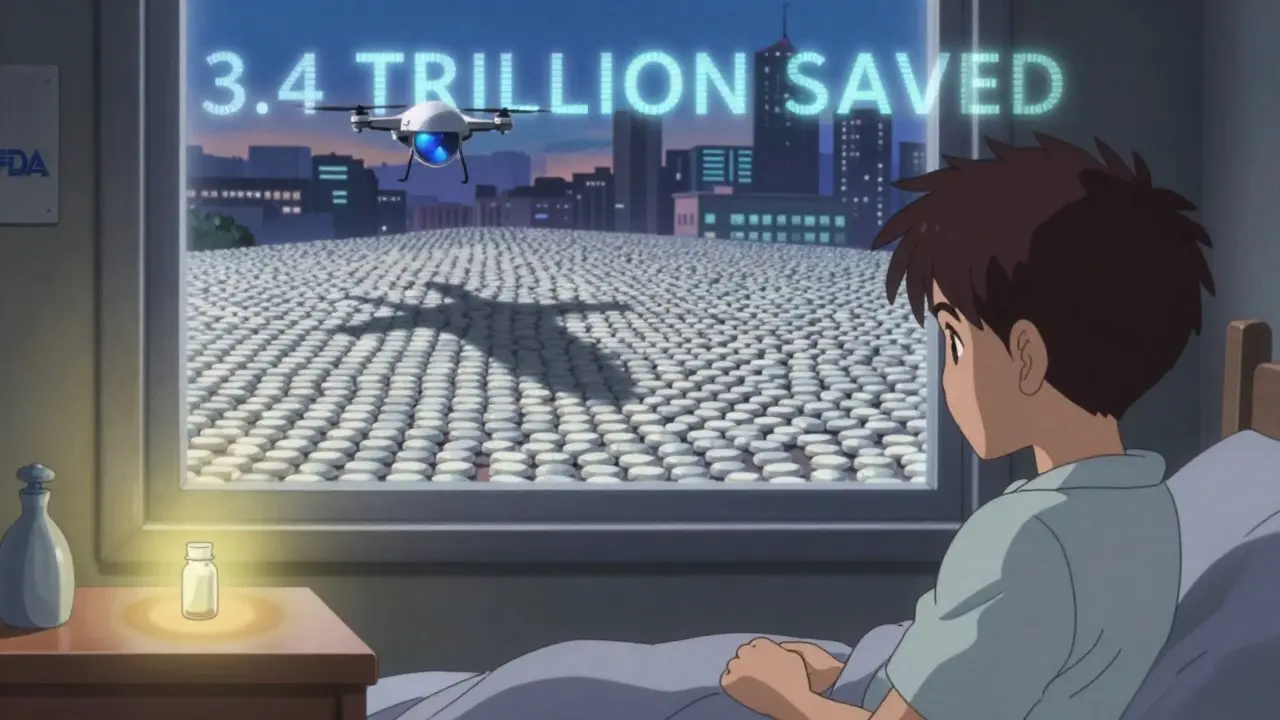
Since Hatch-Waxman, generic drugs have saved the U.S. healthcare system more than $3.4 trillion over the last decade. In 2023 alone, the FDA approved 90 new generic drugs. Many were for high-cost conditions: cancer, diabetes, mental health. One example? The first generic version of Vivitrol, an injectable treatment for opioid addiction, approved in 2023. The FDA called it "of prime importance" given the ongoing overdose crisis.
But it’s not all smooth sailing. Complex drugs-like inhalers, topical creams, or extended-release tablets-are harder to copy. The active ingredient might be the same, but how it’s delivered can change how well it works. The FDA is now running a special initiative called "Complex Generics" to develop better testing methods for these products. Some generics still take years to get approved because the science isn’t settled.
Who Makes These Drugs? And Where?
Most of the world’s generic drugs are made overseas-mainly in India and China. But the FDA inspects every facility, no matter where it is. In 2022, the agency conducted over 3,000 inspections globally. They’ve shut down plants for poor quality control, even if the drugs were already on the market.
Major players include Teva, Sandoz, Mylan (now Viatris), and Amneal. But there’s also a growing group of smaller U.S.-based companies focused on making complex generics and filling drug shortages. In October 2025, the FDA launched a new pilot program to speed up reviews for companies that test and manufacture their generics in the United States. It’s a direct response to supply chain concerns after the pandemic.
What’s Next for Generic Drugs?
The future isn’t just about more generics-it’s about better ones. The FDA is working on:
- Standardizing testing for complex formulations like nasal sprays and transdermal patches
- Using real-world data to support approval, not just lab studies
- Improving transparency in the Orange Book, which lists patents and exclusivity periods
- Encouraging more domestic manufacturing through faster review and incentives
Biosimilars-generic versions of biologic drugs like insulin or rheumatoid arthritis treatments-are a separate pathway under the BPCIA. They’re more complex than traditional generics and take longer to approve. But they’re growing fast, and they’ll be the next big wave of cost savings.
The bottom line? The system works. It’s not perfect. Patent fights, foreign manufacturing risks, and complex drugs are still hurdles. But the FDA’s ANDA pathway has delivered safe, affordable medicine to millions. And it continues to evolve to meet new challenges-because access to medicine shouldn’t depend on how much you can pay.
Are generic drugs as safe as brand-name drugs?
Yes. The FDA requires that generic drugs meet the same strict standards for safety, strength, quality, and performance as brand-name drugs. Every generic must prove it delivers the same amount of active ingredient into the bloodstream at the same rate. The FDA inspects manufacturing sites globally and pulls drugs from shelves if quality issues arise. There’s no difference in safety between a generic and its brand-name counterpart.
Why do generic drugs look different from brand-name drugs?
By law, generics can’t look exactly like the brand-name version-this prevents confusion and trademark infringement. So the color, shape, or inactive ingredients (like fillers or dyes) may differ. But the active ingredient, dose, and effect are identical. If you’re concerned about the appearance, talk to your pharmacist. They can confirm it’s the right medication.
How long does it take for a generic to be approved after a brand drug’s patent expires?
It varies. If no patents are challenged, and the company files an ANDA right after patent expiration, approval can happen in as little as 10 months under current FDA timelines. But if another company files first and gets 180-day exclusivity, others must wait. Patent lawsuits can delay approval by up to 30 months. Some generics enter the market quickly; others take years due to legal battles or complex formulations.
Can a generic drug be pulled from the market after approval?
Yes. The FDA monitors all drugs-brand and generic-after approval. If a generic is found to be defective, contaminated, or not bioequivalent, it can be recalled. The agency has removed dozens of generic drugs from the market in recent years due to impurities like nitrosamines or manufacturing failures. Patients should report any unusual side effects to their doctor and to the FDA’s MedWatch program.
What’s the difference between an authorized generic and a regular generic?
An authorized generic is made by the original brand-name company-or licensed to another manufacturer-and sold as a generic under a different label. It’s identical to the brand in every way, including inactive ingredients. Regular generics are made by separate companies and may differ in fillers or appearance. Authorized generics often enter the market when the brand company wants to compete with its own generic version, especially during the 180-day exclusivity period.
Priya Patel
January 12, 2026 AT 00:56Wow, this is actually one of those rare posts that makes you feel like the system kinda works. India makes most of the generics you guys take, and yeah, we got our own quality control issues too-but the FDA inspections? They don’t play. Saw a plant shut down in Hyderabad last year for mold in the packaging. Scary stuff.
Michael Patterson
January 13, 2026 AT 19:05So let me get this straight-generic manufacturers don’t have to do any clinical trials? That’s insane. I mean, what if the bioequivalence is off by just a little? Like what if my blood pressure med only hits 79% of the brand? That’s still in range but my head’s been spinning for weeks. Who’s monitoring that? Nobody. The FDA just takes their word for it. And don’t even get me started on the 180-day exclusivity loophole-pharma’s playing chess while patients lose pawns.
Sean Feng
January 15, 2026 AT 15:05Generic drugs are fine I guess
Priscilla Kraft
January 15, 2026 AT 17:06This is so important and honestly underappreciated 🙏 I work in pharmacy and every day I see patients choose generics because they can’t afford the brand. One lady told me she skipped her diabetes meds for 3 months because the brand was $400-her generic is $12. That’s not a savings, that’s a lifeline. Also, the FDA’s Complex Generics initiative? Huge step forward. Inhalers and patches are nightmares to replicate, but we’re getting closer. Keep pushing, FDA.
Matthew Miller
January 16, 2026 AT 06:49Let’s be real-the whole system is a corporate shell game. Hatch-Waxman was sold as consumer protection but it became a patent delay machine. Brand companies file 50 patents on one drug-10 for the molecule, 20 for the coating, 15 for the packaging, 5 for the color of the pill. Then they sue every generic that shows up. The FDA? They’re just the paper pushers. And don’t even mention how most of the active ingredients come from China, where environmental standards are a joke. This isn’t healthcare-it’s a profit pipeline with a bandage on it.
Adewumi Gbotemi
January 16, 2026 AT 10:53Back home in Nigeria, we get generics too. Sometimes they work, sometimes they don’t. But here you have rules. That’s good. I’m happy someone is checking. My cousin died because of fake malaria pills. So I’m glad FDA is doing inspections even in India and China. Not perfect but better than nothing.
Roshan Joy
January 18, 2026 AT 04:32Big up to the FDA for keeping this system somewhat honest. I’ve worked with ANDA submissions before-trust me, it’s not easy. The bioequivalence studies? 36 healthy volunteers, blood draws every 30 minutes for 72 hours. It’s grueling. And the data review? I’ve seen reviewers spend weeks just on one CMC section. People think generics are easy, but no-this is science with a side of legal warfare. Hats off to the OGD team.
Christian Basel
January 18, 2026 AT 07:04Bioequivalence range of 80-125%? That’s a 45% variance. You’re telling me a drug that delivers 80% of the active ingredient is considered equivalent? That’s not equivalence, that’s a statistical loophole dressed up as science. And the FDA calls this rigorous? Please. If I took a blood pressure med that delivered only 80% of the dose, I’d be in the ER. But somehow, it’s ‘FDA-approved.’
Alex Smith
January 19, 2026 AT 17:12So let me get this straight-you’re telling me a pill made in a factory in Hyderabad, inspected once every three years, with a different filler than the brand, is ‘the same’ as the one I used to pay $150 for? And you’re okay with that? Cool. Cool cool cool. Meanwhile, my grandma’s heart med from 2019 still works better than the 2024 generic. Coincidence? Or is the FDA just tired?
Madhav Malhotra
January 19, 2026 AT 20:25As someone from India, I’m proud we make so many of these meds. But honestly? We’re not perfect. Some factories cut corners. But the FDA doesn’t let that slide-they’ve shut down 12 of our plants in the last 5 years. That’s tough, but necessary. We’re learning. And the fact that your system checks us? That’s what keeps the world safe. Thanks for holding us accountable.
Jennifer Littler
January 19, 2026 AT 23:33The ANDA review process under GDUFA is a marvel of bureaucratic efficiency-when it works. But the patent litigation delays? That’s where the system breaks. 30-month stays aren’t about safety-they’re about market control. And the fact that the Orange Book is still a mess? Unacceptable. Someone needs to digitize that thing and make it searchable. I’ve spent hours trying to find which patent a generic is challenging. It’s 2025. This shouldn’t be a crossword puzzle.
Jason Shriner
January 20, 2026 AT 12:56They call it ‘affordable medicine’ but really it’s just cheaper poison with a better label. I’ve been on three different generics for my antidepressant. One made me cry for no reason. One gave me migraines. One made me feel like a zombie. The brand? Just worked. But the insurance won’t cover it. So I’m a lab rat for Big Pharma’s profit margins. And now they want to approve biosimilars? Good luck with that. Biologics aren’t pills-they’re living molecules. You can’t just ‘match’ them. You’re playing God with people’s brains.
Alfred Schmidt
January 22, 2026 AT 07:24Let’s not pretend this is some noble public health victory. The FDA approves 90 generics a year? Great. But how many of them are actually bioequivalent? How many are just ‘close enough’? And who’s paying for the lawsuits? You are. I’ve seen patients skip doses because the generic made them nauseous-but they can’t afford the brand. So they suffer. And the system? It shrugs. Hatch-Waxman didn’t save patients-it saved pharmaceutical executives from competition. And now they’re outsourcing the manufacturing to countries with zero oversight. This isn’t progress. It’s a slow-motion tragedy with a PowerPoint presentation.