

Cystic Fibrosis: Genetic Respiratory Disease and New Therapies That Are Changing Lives
 Feb, 1 2026
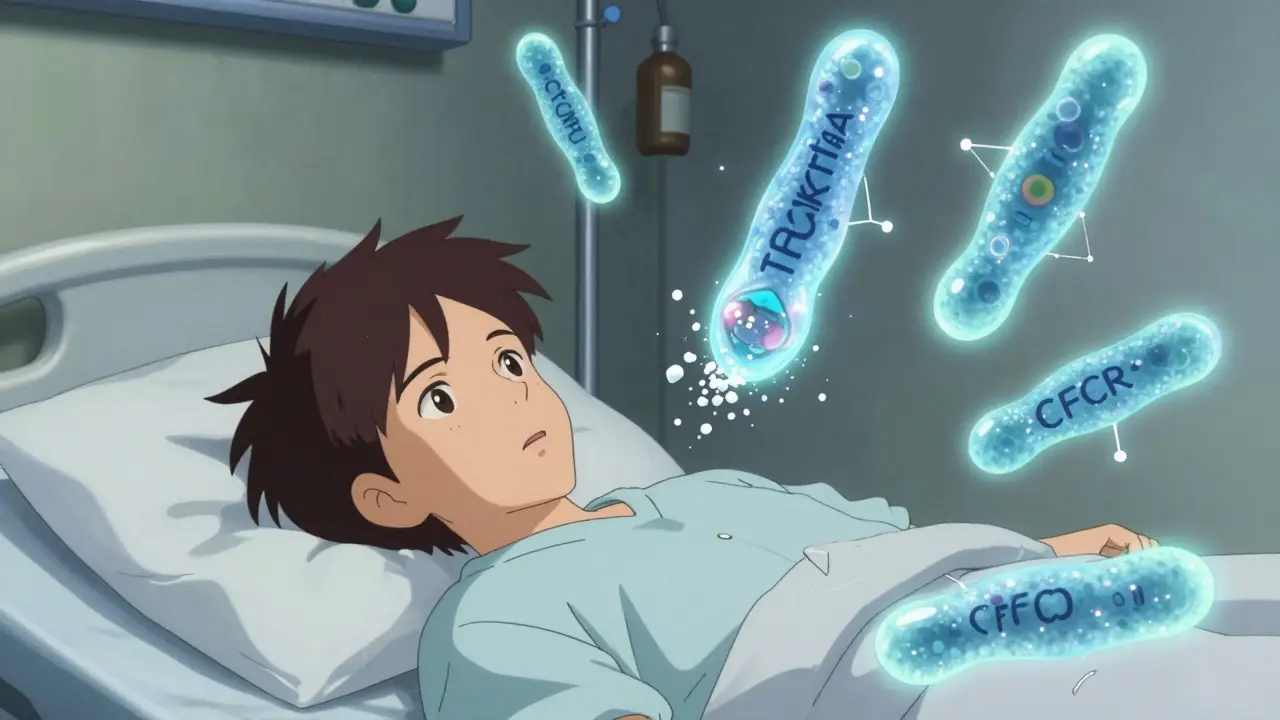
Cystic fibrosis isn’t just another lung disease. It’s a genetic condition that attacks the body from the inside out, turning mucus from a slippery protector into a thick, sticky trap. This isn’t something that happens later in life-it’s there from birth, quietly damaging lungs, pancreas, and liver long before symptoms show up. For decades, kids with cystic fibrosis didn’t live to see their teens. Today, many are hitting 50 and beyond. The shift didn’t come from better antibiotics or more oxygen tanks. It came from a breakthrough that targeted the root cause-not the symptoms.
What Actually Goes Wrong in Cystic Fibrosis?
The problem starts with a single gene: CFTR. When this gene works right, it acts like a gatekeeper for salt and water in your cells. But in people with cystic fibrosis, mutations in CFTR break that gate. The most common one, called F508del, shows up in about 70% of cases worldwide. When the gate fails, chloride can’t move properly. Water follows chloride, so the mucus that should be thin and slippery becomes thick and sticky. That’s the core issue.
This thick mucus clogs airways, making it impossible for the lungs to clear bacteria. Pseudomonas aeruginosa and Staphylococcus aureus don’t stand a chance-they thrive in this environment. Over time, the constant infection and inflammation destroy lung tissue. That’s why 85% of deaths in CF are from respiratory failure. But it’s not just the lungs. The pancreas gets blocked too. Digestive enzymes can’t reach the intestines, so even if you eat enough, your body can’t absorb nutrients. About 85% of people with CF need enzyme pills with every meal. Liver ducts get plugged. Sweat turns salty-so salty that a sweat test measuring chloride levels above 60 mmol/L is still the gold standard for diagnosis.
Why Cystic Fibrosis Is Different From Other Lung Diseases
People often confuse CF with conditions like primary ciliary dyskinesia (PCD). Both cause chronic lung infections. But PCD is about broken cilia-the tiny hairs that sweep mucus out of the airways. In CF, the cilia are fine. The problem is the mucus itself is too thick to move. That’s why treatments that help PCD don’t work for CF, and vice versa.
CF is also unique because it affects so many systems at once. You can’t just treat the lungs. You need to manage digestion, nutrition, liver health, and fertility. Nearly all men with CF are infertile because they’re born without the vas deferens. Women face fertility challenges too. This multi-system damage is what made CF so hard to treat for so long.
The Game-Changer: CFTR Modulators
Before 2012, treatment meant daily chest physiotherapy, inhaled drugs, enzymes, and hospital visits. Life expectancy hovered around 30. Then came ivacaftor (Kalydeco), the first drug that fixed the broken CFTR protein itself. It worked for people with the G551D mutation-only about 4% of patients. But it proved the idea: you could fix the root cause.
The real revolution came with Trikafta (elexacaftor/tezacaftor/ivacaftor), approved in 2019. It works for people with at least one F508del mutation-which covers about 90% of the CF population. Clinical trials showed a 13.8% jump in lung function (FEV1) and a 63% drop in flare-ups. That’s not a small improvement. That’s life-changing. One patient on a CF support forum said their daily airway clearance dropped from 90 minutes to 20 minutes. They could finally sleep through the night.
Today, 90% of people with CF in the U.S. have access to at least one modulator. Median survival has jumped from 14 years in 1960 to 50.9 years in 2022. For the first time, more adults than children live with CF. Fifty-two percent of the CF population is now over 18.

The Dark Side of Progress
But this miracle has a price tag. Trikafta costs about $300,000 a year in the U.S. Even with insurance, out-of-pocket costs average $1,200 a month. A 2022 survey of nearly 8,000 CF patients found 42% struggled with financial strain. In low- and middle-income countries, less than 10% have access. The World Health Organization calls this a global inequity crisis. Seventy-five percent of CF deaths now happen in places where modulators aren’t available.
There are also side effects. About 3.2% of patients in phase 4 studies had severe liver enzyme spikes, forcing them to stop treatment. Some developed cataracts. These risks are rare, but they’re real. And for the 10% of patients with rare mutations-like Class I nonsense mutations-modulators don’t work at all. For them, the old, brutal regimen is still the only option.
What Daily Life Looks Like Now
For someone without a modulator, life is a full-time job. Two to three hours a day go to airway clearance-using vests, handheld devices, or manual pounding. Four to six different inhaled medications. Six to twelve enzyme capsules with every meal. Vitamin supplements. Blood tests. Doctor visits. It’s exhausting. Compliance rates? Only 65-75% stick to it all the time.
With modulators, the routine shrinks. Many still do airway clearance, but for less time. Fewer hospital stays. Better weight gain-68% of users report putting on pounds. More energy. More school, more work, more travel. But the burden hasn’t vanished. You still need to manage nutrition. You still need to monitor liver function. You still need to fight infections. The disease is managed, not cured.

What’s Next? The Fight for the Remaining 10%
The Cystic Fibrosis Foundation has poured over $750 million into research since 1989. That’s not charity-it’s a venture philanthropy model that helped fund Vertex Pharmaceuticals’ early work. Now, they’re turning their focus to the 10% left behind.
There are 15 active clinical trials targeting unmet needs. mRNA therapies aim to fix nonsense mutations. CRISPR gene editing is being tested to permanently correct the CFTR gene. New inhaled antibiotics are being developed to beat stubborn Pseudomonas strains. In January 2023, Trikafta got approved for kids as young as 2-expanding coverage even further.
But the biggest hurdle isn’t science. It’s access. The global market for CF drugs hit $6.2 billion in 2022, with Vertex controlling 95% of it. Patents and pricing keep modulators out of reach for most of the world. The Foundation’s new $100 million "Path to a Cure" initiative is focused on finding solutions for those who don’t benefit from current drugs. That’s where the next breakthrough will come.
Why This Matters Beyond CF
Cystic fibrosis is no longer just a rare disease. It’s a model for how precision medicine can work. For the first time, a genetic disease has targeted drugs that fix the underlying defect. What worked for CF is now being studied for other conditions like sickle cell disease and certain forms of muscular dystrophy. The tools developed here-gene therapy, mRNA delivery, small molecule correctors-are being adapted everywhere.
But the story of CF also shows us the limits of medical progress. Science can move fast. But justice? That moves slower. A drug that extends life by decades means nothing if it’s only available to those who can afford it. The real challenge now isn’t just finding cures-it’s making sure no one is left behind because of where they live or how much money they have.
Is cystic fibrosis inherited?
Yes. Cystic fibrosis is an autosomal recessive disorder. That means a person must inherit two faulty copies of the CFTR gene-one from each parent-to have the disease. If someone has only one copy, they’re a carrier and won’t show symptoms, but they can pass the gene to their children. About 1 in 29 people of European descent are carriers.
Can you outgrow cystic fibrosis?
No. Cystic fibrosis is a lifelong genetic condition. You can’t outgrow it. But thanks to new therapies, many people now live well into their 40s, 50s, and beyond. The disease doesn’t disappear, but its impact can be dramatically reduced with CFTR modulators and consistent care.
Do CFTR modulators cure cystic fibrosis?
No, they don’t cure it. CFTR modulators fix how the faulty protein works, but they don’t replace the broken gene. People still have the mutation. They still need to manage lung health, nutrition, and infections. But these drugs have turned CF from a fatal childhood disease into a manageable chronic condition for most patients.
How do I know if I have a CFTR mutation?
Newborn screening in all 50 U.S. states catches CF shortly after birth. If symptoms appear later-like chronic cough, poor growth, or salty-tasting skin-a sweat test is used to measure chloride levels. Genetic testing can identify specific CFTR mutations. Carriers are often found during family planning or if a child is diagnosed.
Why are CFTR modulators so expensive?
They’re rare disease drugs with high R&D costs, small patient pools, and long development timelines. Vertex Pharmaceuticals, the main maker, invested heavily in early research backed by the Cystic Fibrosis Foundation. Pricing reflects the cost of innovation, but also market power-Vertex holds 95% of the CFTR modulator market. Critics argue the price doesn’t reflect production cost, but the value of extending life.
Matt W
February 3, 2026 AT 07:32Man, I remember when my cousin with CF used to spend hours every day with that vibrating vest. Now she just takes her pills and goes hiking on weekends. Wild how far we’ve come.
Solomon Ahonsi
February 3, 2026 AT 09:27So we spent billions to make rich people live longer while kids in India still die from coughing? Great job, capitalism.
George Firican
February 5, 2026 AT 09:08What’s striking isn’t just the science-it’s the philosophical pivot. For centuries, medicine treated symptoms like enemies to be crushed. CFTR modulators flipped that: they didn’t fight the body, they helped it fix itself. It’s not a cure, but it’s the first time we’ve treated a genetic disease like a software bug instead of a warzone. That shift echoes beyond medicine-it’s a new way of seeing human biology as something repairable, not doomed. And yet, the cost? That’s the real mutation here: one that corrupts equity. We engineered life extension, but forgot to engineer justice.
Nick Flake
February 6, 2026 AT 12:52This is the future. 🌟 Not just for CF, but for every rare disease that’s been ignored. Imagine if we applied this same energy to sickle cell, ALS, or Huntington’s. We’ve proven it’s possible to fix broken genes at the molecular level. But the real miracle? People are living full lives-graduating, falling in love, traveling, working. That’s the real data point. The stats are good. The human stories? They’re breathtaking.
phara don
February 7, 2026 AT 20:27Anyone know if Trikafta works for people with the R117H mutation? I’ve been digging around but can’t find a clear answer.
jay patel
February 9, 2026 AT 03:26lol at the ‘miracle drug’ hype. I’ve seen people on modulators still in the hospital 3x a year. And don’t get me started on the ‘better nutrition’ claims-my friend gained 10 lbs but still can’t digest broccoli without crying. It’s not a cure, it’s a Band-Aid with a $300k price tag. And yeah, I’m salty. But I’m also alive, so… I guess I’ll shut up.
Brittany Marioni
February 10, 2026 AT 03:38Let’s not forget the families who spent decades begging for research funding-parents who lost children before they turned 10, who still keep jars of their kids’ salty sweat as mementos. This isn’t just science. It’s legacy. It’s love turned into medicine.
larry keenan
February 10, 2026 AT 17:25While the clinical efficacy of CFTR modulators is well-documented, the pharmacoeconomic implications remain deeply concerning. The cost-per-QALY for Trikafta exceeds $1 million in many models, raising fundamental questions about resource allocation within public health systems. Furthermore, the market exclusivity granted under orphan drug designation has created a de facto monopoly, suppressing generic competition and perpetuating unsustainable pricing structures.
Anthony Massirman
February 10, 2026 AT 23:47They made it to 50. That’s the whole story right there.
Brett MacDonald
February 12, 2026 AT 14:31so like… if ur gene is broke but the drug fixes the protein… are u still technically sick? or just… fixed? like is cf now a disability or a chronic condition? idk man. i’m confused.
Vatsal Srivastava
February 12, 2026 AT 19:01Western medicine again pretending it solved everything. In 1980, Chinese herbalists were already treating lung stagnation with licorice and pinellia. Now they get a $300k pill and call it progress? Pathetic.
George Firican
February 13, 2026 AT 20:08You’re not wrong, but you’re also missing the point. Traditional medicine treated symptoms, yes-but it never touched the genetic root. What’s happening here isn’t just another treatment. It’s the first time we’ve corrected a disease at its origin using molecular precision. That’s not cultural superiority. That’s biology. And yes, the pricing is a moral failure. But dismissing the science because the system is broken is like refusing to use a lifeboat because the ship was built by greedy men. The tool is good. The hands holding it? Not so much.