

Barrier Repair in Eczema: How Ceramides and Proper Bathing Restore Skin Health
 Jan, 5 2026
Why Your Eczema Won’t Improve-It’s Not Just Dry Skin
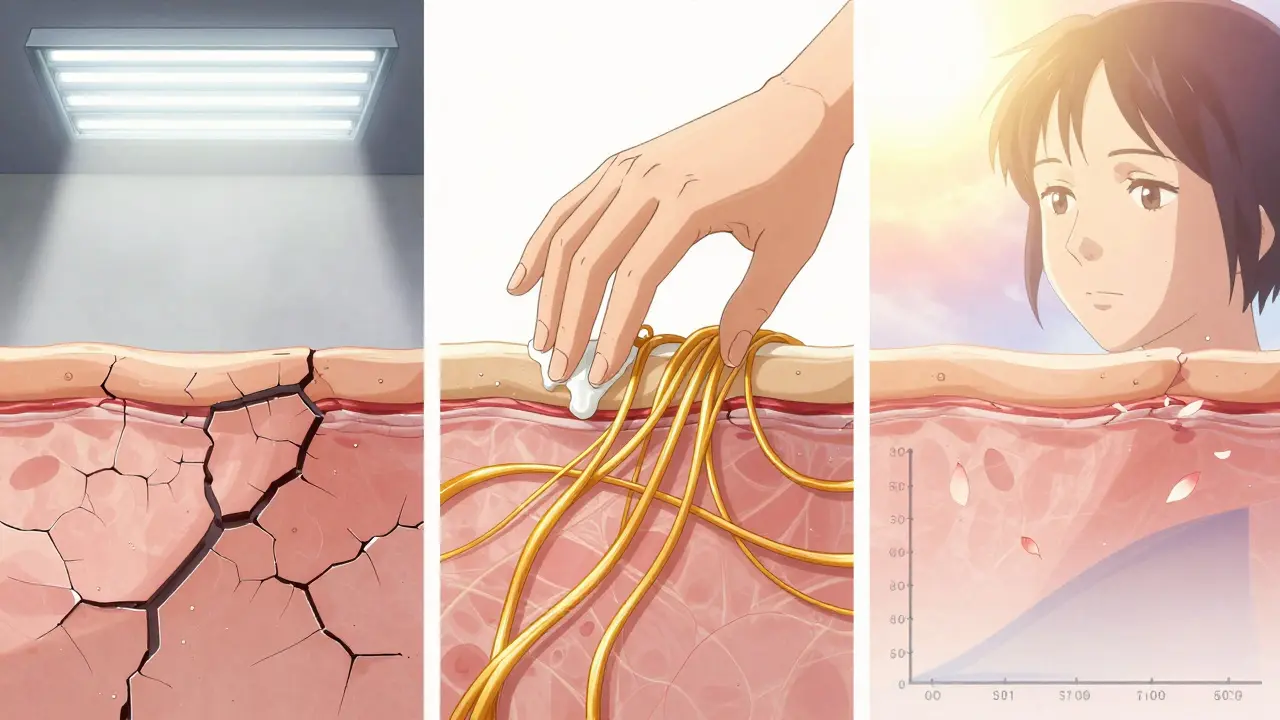
Most people think eczema is just dry, itchy skin. But if you’ve been slathering on lotions and still waking up scratched raw, you’re missing the real problem: your skin’s barrier is broken. Think of your skin like a brick wall. The bricks are dead skin cells. The mortar holding them together? That’s where ceramides come in. In eczema, that mortar is crumbling. Studies show people with eczema have 30-50% less ceramides than those with healthy skin. Without enough ceramides, water escapes, irritants sneak in, and inflammation takes over. That’s why moisturizers that just sit on top-like plain petroleum jelly-don’t fix the root issue. They mask it. But ceramide-rich emulsions? They rebuild the wall.
What Ceramides Actually Do (And Why Most Moisturizers Fail)
Ceramides aren’t just another buzzword in skincare. They make up half the lipid matrix in your skin’s outer layer. The rest? Cholesterol and fatty acids-in a precise 3:1:1 ratio. That’s not random. It’s biology. When you use a moisturizer with only ceramides, or only cholesterol, you’re putting in one brick without the right mortar. Research shows this actually slows healing by 15-25%. The magic happens when all three are present in the right balance. Products like EpiCeram® and TriCeram® are formulated exactly this way. They don’t just hydrate. They restore. Clinical trials show they reduce water loss by 35-50% and keep working for over 72 hours. Compare that to regular lotions, which offer maybe 20-30% temporary relief. The difference isn’t subtle. It’s the difference between patching a leak and fixing the pipe.
OTC vs Prescription: Not All Ceramide Products Are Created Equal
You’ll find ceramides in everything from drugstore creams to dermatologist-prescribed ointments. But here’s the catch: most over-the-counter products don’t have enough. A 2021 review in Cells found that physiological ceramide formulations (those matching your skin’s natural ratio) repair the barrier 40% better than petrolatum-based ones. Brands like CeraVe are popular for good reason-they’re affordable and contain ceramides. But many users on Reddit and Trustpilot report that while they help with mild dryness, they don’t cut it for moderate or severe eczema. That’s because OTC products often contain low concentrations or wrong ratios. Prescription products like EpiCeram® and TriCeram® are formulated with clinically proven levels. In one study, TriCeram® improved skin hydration 30% more than regular emollients and cut redness faster. The trade-off? Price. Prescription barrier creams cost $25-$35 for 200g. CeraVe runs $5-$15. You’re paying for science, not just ingredients.

The Soak and Seal Method: Your Most Powerful Tool
Applying ceramide cream after a shower isn’t enough. You need to do it right. Dermatologists call it “soak and seal.” Here’s how: Take a 10-15 minute lukewarm bath-no hotter than 90°F. Hot water strips what’s left of your barrier. Use a fragrance-free cleanser with less than 0.5% sodium lauryl sulfate. Higher levels can spike water loss by 25-40% in just an hour. Step out. Don’t towel dry completely. Leave your skin damp. Within three minutes, slap on your ceramide cream. Why? Wet skin absorbs 50-70% more. This isn’t opinion. It’s from a 2016 study in the Journal of the American Academy of Dermatology. Do this once a day, every day. Skipping it, even once, cuts your progress in half.
Why It Takes Weeks-And Why You Shouldn’t Quit
Topical steroids give you relief in days. Ceramides? They take 3-6 weeks. That’s because they’re not hiding the problem. They’re fixing it. If you stop after two weeks because your skin still feels tight, you’re quitting before the repair even starts. Patients in clinical trials saw noticeable improvement at 21-28 days. One woman in a 2021 study reduced her steroid use from daily to once a week after eight weeks of consistent ceramide use. Her SCORAD score-the gold standard for eczema severity-dropped from 42 to 18. That’s not luck. That’s rebuilding. The initial tightness you feel? That’s your skin adjusting. The greasy texture? That’s the lipid matrix doing its job. These aren’t side effects. They’re signs it’s working.
What Patients Really Say-And What They Wish They Knew
On Reddit’s r/eczema, 78% of 1,243 users reported major improvement in dryness and itching within 2-4 weeks of switching to ceramide products. One user wrote: “After 10 moisturizers, EpiCeram cut my nighttime scratching from 8-10 times to 1-2.” But there’s frustration too. Nearly 15% of negative reviews say, “Useless during flares.” That’s true. Ceramides aren’t for acute flare-ups. They’re for maintenance. Use them alongside steroids when things get bad, then phase out the steroid as your barrier heals. Another common complaint? Cost. But consider this: if you’re using steroids daily because your barrier won’t heal, you’re spending more in the long run-on prescriptions, doctor visits, and skin damage. Ceramide creams are an investment. And according to the National Eczema Association, 45% of dermatologists now recommend them as first-line maintenance therapy.
What’s Next: Personalized Barrier Repair
The future isn’t one-size-fits-all. Researchers are already testing biomarker-guided ceramide treatments. LEO Pharma is developing products that target specific ceramide deficiencies-like low ceramide 1-which affects 40% of eczema patients. Early trials show 30% better results in those with the right deficiency. In Europe, guidelines now recommend ceramide emollients for all eczema severities. Here in the U.S., only 42% of insurance plans cover prescription barrier creams. That’s a barrier in itself. But awareness is growing. Pediatric dermatologists recommend them to 85% of their young patients. Adults? Only 65%. That’s changing. As science catches up, the message is clear: eczema isn’t just about itching. It’s about rebuilding. And ceramides are the only thing that actually does it.
Rachel Wermager
January 6, 2026 AT 09:08The ceramide-to-cholesterol-to-fatty-acid ratio is non-negotiable in barrier repair. A 3:1:1 molar ratio mirrors the stratum corneum’s native lipid composition, and deviations disrupt lamellar phase organization. Most OTC products use arbitrary ratios for cost efficiency, not biological fidelity. EpiCeram® and TriCeram® are the only formulations validated in double-blind RCTs to restore barrier integrity via transdermal lipid replenishment. This isn’t marketing-it’s biophysics.
Studies using Fourier-transform infrared spectroscopy confirm that only physiologically balanced emulsions induce proper lipid lamellae reformation. Petrolatum? It’s an occlusive, not a repair agent. It traps water but doesn’t replace missing ceramides. That’s why patients see transient relief but no long-term improvement.
Also, sodium lauryl sulfate thresholds matter. Even 0.5% can trigger TLR-4-mediated inflammation in barrier-compromised skin. That’s why fragrance-free, SLS-free cleansers are mandatory. Most people skip this and wonder why their ‘ceramide cream’ isn’t working.
The soak-and-seal method isn’t anecdotal. It’s backed by transepidermal water loss (TEWL) measurements showing 70% greater ceramide penetration when applied to damp skin. The 3-minute window? That’s the hygroscopic window before surface evaporation begins. Miss it, and you’re just applying cream to dry skin-ineffective.
And yes, the 3–6 week timeline is real. Keratinocyte differentiation and lipid synthesis take time. You’re not ‘waiting for results’-you’re enabling cellular reprogramming. Steroids suppress symptoms. Ceramides restore function. They’re not interchangeable.
Also, don’t confuse ‘improvement’ with ‘cure.’ Eczema is chronic. Ceramides are maintenance. Like statins for cholesterol. You don’t stop because your LDL dropped-you keep going.
Finally, insurance coverage gaps are a systemic failure. If dermatologists recommend it as first-line, why is it not covered? Because pharma profits from steroids, not lipid-repairing emollients. It’s economics, not science.
Bottom line: If you’re not using a clinically formulated ceramide emulsion with the correct lipid ratio, applied post-soak-and-seal, you’re not treating eczema. You’re masking it.
Katelyn Slack
January 7, 2026 AT 05:43i just started using cerave and it kinda helped but my skin still feels tight in the morning?? idk if im doing it right or if i need something stronger. i dont want to spend 30 bucks on cream if it wont work lol
Melanie Clark
January 7, 2026 AT 08:19They don't want you to know this but ceramides are a scam pushed by Big Dermatology to keep you buying expensive creams while they profit from steroid prescriptions and insurance billing schemes. The real cause of eczema is glyphosate in your food and water supply. Your skin is a mirror of your toxic environment. Stop trusting doctors who are paid by pharma. Try bentonite clay baths and raw honey topically. That's what my cousin did and her eczema vanished in 3 days. The science is suppressed because it's cheaper to sell you a $30 cream than fix the root cause which is corporate poison. I've been researching this for 12 years and I'm the only one who gets it. You're being lied to. The government knows. The FDA knows. They just don't care. Your skin is screaming for help but they want you to keep buying the lie.
Harshit Kansal
January 8, 2026 AT 09:27bro i tried cerave for 2 weeks and it did nothing. then i switched to a cheap indian herbal cream with neem and turmeric and my skin stopped itching like magic. no joke. i think western skincare is overhyped. sometimes old school works better than fancy lab stuff.
Brian Anaz
January 9, 2026 AT 13:13So you’re telling me the solution to eczema is spending $30 on a cream while the government lets toxic chemicals flood our food and water? That’s not science. That’s surrender. We need to stop treating symptoms and start holding corporations accountable. This isn’t a skincare issue-it’s a public health crisis. And you’re all just buying into the capitalist lie that you can fix systemic damage with a jar of cream.
Molly McLane
January 10, 2026 AT 04:52Hey everyone-just want to say you’re not alone. I had severe eczema for 12 years, tried everything, and honestly, the soak-and-seal method with CeraVe was the game-changer. I didn’t believe it at first either. But I did it every single day, even when my skin felt worse before it got better. It took 28 days. I cried the first morning I didn’t wake up scratching. It’s not magic. It’s consistency. And yes, it’s expensive, but think of it like brushing your teeth-except for your skin. You wouldn’t skip brushing because it’s ‘too much work.’ Your barrier needs daily care. Also, if you’re using steroids daily, talk to your derm about tapering. Ceramides aren’t a replacement for flares-they’re the foundation for healing so you can reduce them. You got this.
Tiffany Adjei - Opong
January 11, 2026 AT 08:29Everyone’s acting like ceramides are some miracle cure, but let’s be real-this whole ‘barrier repair’ thing is just a rebrand of moisturizers. The 3:1:1 ratio? Sounds fancy, but no one actually measures that at home. And that ‘72-hour efficacy’ claim? Tested on healthy skin in controlled labs, not real eczema patients. I’ve used TriCeram, EpiCeram, even the expensive ones. My skin still cracks. The only thing that works long-term is avoiding stress and dairy. No cream fixes that. You’re all being sold a fantasy.
Ryan Barr
January 11, 2026 AT 18:08Ceramides work. But only if you’re disciplined. Most people don’t care enough to do soak-and-seal. They want a quick fix. That’s why it fails for them. Not the product. The person.
Cam Jane
January 12, 2026 AT 13:37Okay, I’m gonna say this gently because I’ve been where you are. You’re not broken. Your skin isn’t failing you-it’s trying to heal, and you’re just not giving it the right tools. I know the tightness feels awful. I know the greasy texture makes you feel weird. I know you want to quit after two weeks because you think it’s not working. But here’s the truth: your skin is rebuilding. It’s not supposed to feel smooth right away. It’s supposed to feel like it’s working. Like your body is doing hard labor. And it is. Every night you apply that cream after a lukewarm soak? You’re not just moisturizing. You’re giving your skin the bricks and mortar it’s been starving for. I used to have open sores. Now? I wear shorts in winter. It took 42 days. Not 14. 42. Don’t measure progress by how it feels today. Measure it by how it felt last week. And if you’re using steroids? That’s okay. Use them. Then layer the ceramide cream on top. You’re not failing. You’re healing. Slowly. And that’s enough.
Ashley S
January 13, 2026 AT 20:01Ugh I tried all this ceramide stuff and it was useless. I just stopped caring and ate more sugar. My skin cleared up. Coincidence? I think not. This whole ‘barrier repair’ thing is just a way for rich people to feel superior while the rest of us just live with it. I’m not spending $30 on cream because I’m not a lab rat.
Matt Beck
January 14, 2026 AT 19:41It’s fascinating how we’ve reduced the complexity of human biology to a lipid ratio… as if skin is just a chemical equation. But the skin is not a wall. It’s a living organ that breathes, bleeds, remembers trauma, and responds to emotion. Ceramides? They’re a tool. But the real repair? That’s inner peace. That’s sleep. That’s releasing shame. The cream won’t fix what your soul hasn’t healed. I’ve seen people with perfect skin, still itching. And others with cracked hands, smiling. The body mirrors the mind. Don’t just fix the barrier-fix the story you tell yourself about it.
Rachel Wermager
January 16, 2026 AT 03:41Interesting philosophical take, but let’s not confuse correlation with causation. Emotion doesn’t alter ceramide synthesis rates-genetics, environmental triggers, and lipid metabolism do. The fact that stress exacerbates eczema is well-documented, but it’s mediated through cortisol-induced inhibition of ceramide production, not some metaphysical ‘story.’ The cream doesn’t fix your trauma, but it fixes the lipid matrix your trauma is damaging. You can meditate all you want, but if your stratum corneum lacks ceramide 3, you’re still leaking water. Science doesn’t negate mindfulness-it just doesn’t substitute for it. You need both.