

AKI on CKD: How to Avoid Contrast and Nephrotoxic Medications to Protect Kidney Function
 Dec, 8 2025
When you have chronic kidney disease (CKD), even small changes in your body can push your kidneys into crisis. Acute Kidney Injury (AKI) on top of CKD isn’t just a temporary setback-it’s a dangerous spike in risk that can lead to permanent damage, dialysis, or worse. The good news? Many of these episodes are preventable. The biggest threats? contrast dye and common medications you might not even think twice about.
Why AKI on CKD Is So Dangerous
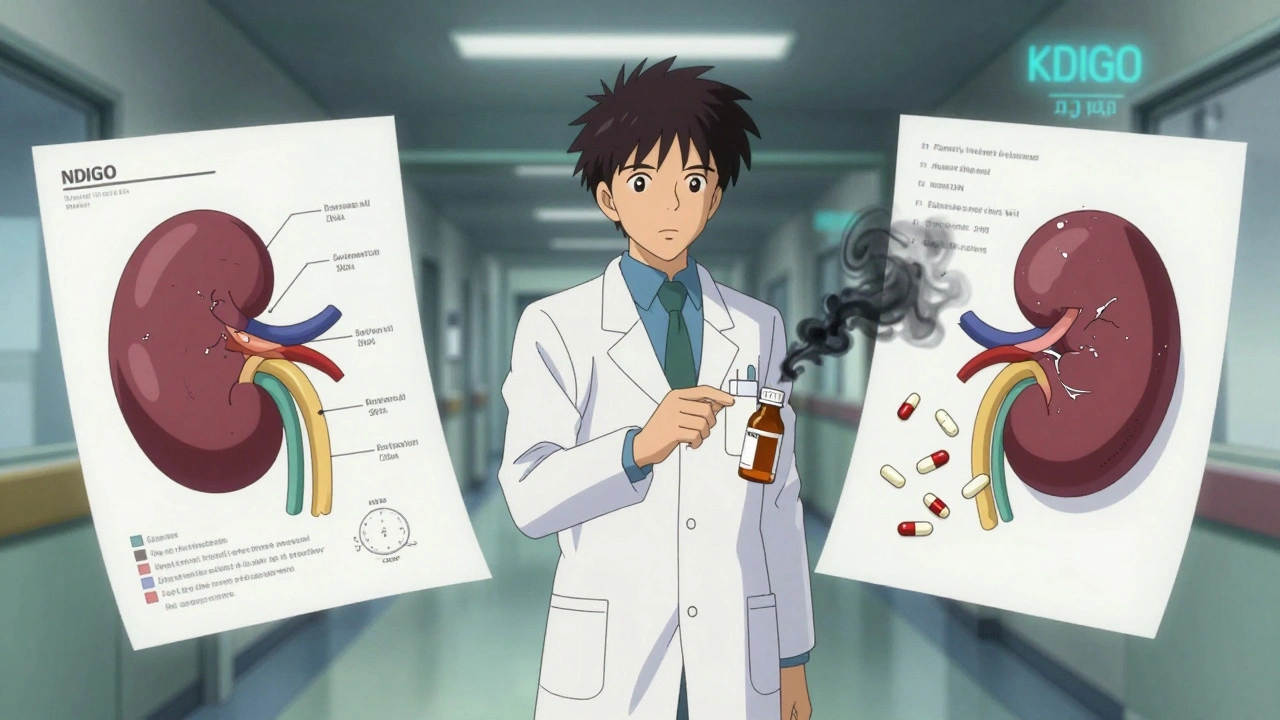
If your kidneys are already working at 40% capacity due to CKD, adding stress from contrast dye or a NSAID can drop function to 15% in hours. This isn’t theoretical. Studies show that 12% to 50% of CKD patients who get iodinated contrast for a CT scan develop contrast-induced AKI. For those with diabetes and CKD, the risk jumps to 20-50%. And it’s not just contrast. About 1.5% to 5% of CKD patients on NSAIDs like ibuprofen or naproxen will have an acute kidney injury within weeks. These numbers aren’t just statistics-they’re real people in hospitals, often because no one asked if they were taking Advil for their back pain.What makes this worse is that AKI on CKD often goes unnoticed. Doctors check creatinine levels, but if your baseline is already high from CKD, a 0.3 mg/dL rise might not seem alarming. Yet that small jump could mean your kidneys lost 50% of their remaining reserve. The KDIGO guidelines say AKI is defined by a 0.3 mg/dL increase in creatinine over 48 hours, or urine output under 0.5 mL/kg/h for more than six hours. For someone with CKD, that’s a red flag.
Contrast Dye: When It’s Necessary and When It’s Not
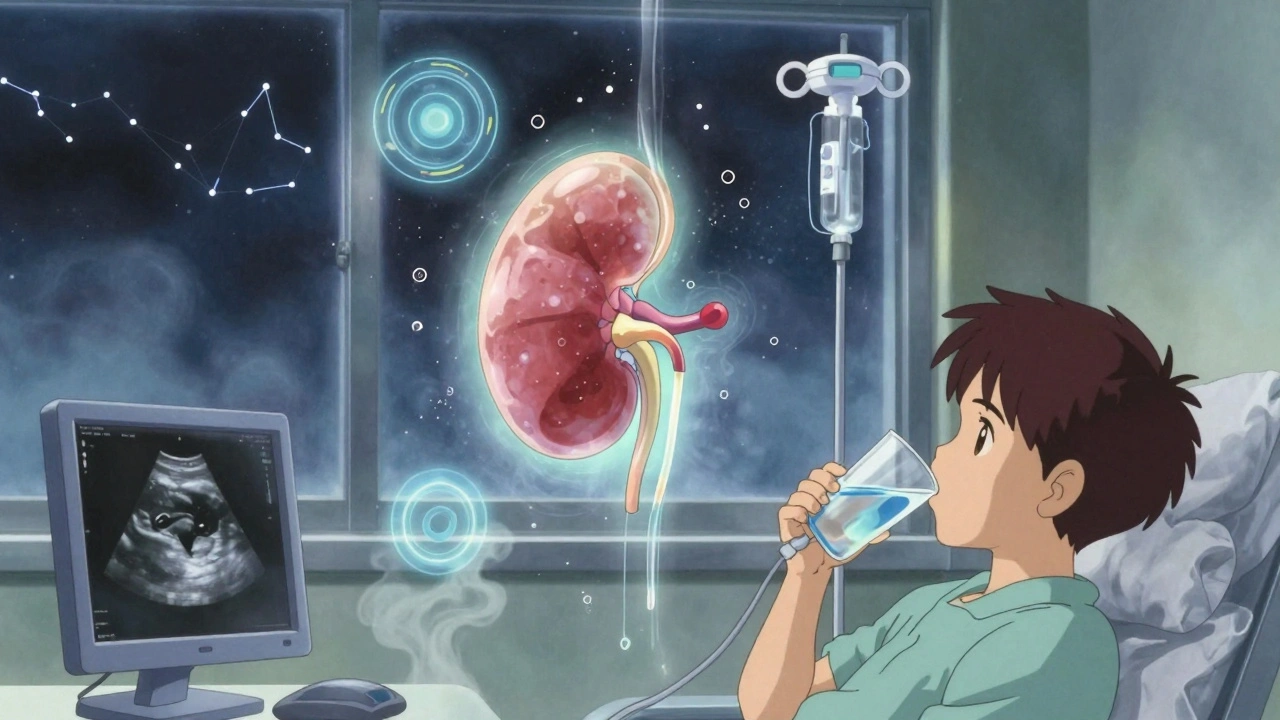
CT scans with contrast are common. They help find tumors, bleeding, infections. But for someone with an eGFR below 60 mL/min/1.73m², that dye can be toxic. The KDIGO guidelines are clear: avoid it if possible. If you need it, use the lowest dose-usually under 100 mL. And never give it without hydration.Hydration isn’t just drinking water. It’s medical-grade hydration: isotonic saline at 1.0 to 1.5 mL/kg/h for 6 to 12 hours before and after the scan. Studies show this cuts the risk of AKI by 30-40%. No fancy solutions. No albumin. No dextrans. Just plain saline. And it works. Even in patients with heart failure, this approach is safe when done carefully.
For patients with eGFR below 30, the recommendation is even stronger: consider alternatives. An MRI without contrast, an ultrasound, or a non-contrast CT might give you the same answer without the risk. If contrast is unavoidable, some centers use hemodialysis right after the procedure. But don’t assume it’s a safety net-it’s not. Dialysis doesn’t fully prevent AKI, and it adds stress to an already fragile system.
The Medications You Need to Stop (Yes, Even the Over-the-Counter Ones)
NSAIDs are the silent killers in CKD. Ibuprofen, naproxen, celecoxib-they all block prostaglandins that help keep blood flow to your kidneys. In a healthy person, this doesn’t matter much. In someone with CKD, it’s like turning off a valve. The Veterans Health Administration found NSAID use in CKD patients increases AKI risk by 2.5 times. That’s not a small risk. That’s a red light.And it’s not just NSAIDs. Aminoglycosides (like gentamicin) cause kidney damage in 10-25% of patients on a full course. Vancomycin? Nephrotoxic in 5-40% of cases, especially when trough levels go above 15 mcg/mL. Amphotericin B? Up to 80% of patients on it develop kidney injury. These aren’t rare side effects. They’re expected outcomes in vulnerable people.
Even blood pressure meds like ACE inhibitors and ARBs need attention. They’re great for slowing CKD progression-but during an AKI episode, they can reduce kidney blood flow even more. If you’re hospitalized with infection or dehydration, your doctor may temporarily hold them. Don’t panic. It’s not stopping treatment-it’s preventing collapse. Your creatinine might rise 15-25% when you stop them, but that’s often reversible. Letting your kidneys fail because you kept taking them? That’s not safe.
What You Can Do Right Now
You don’t need to wait for a doctor to tell you what to do. Here’s your action list:- Stop taking NSAIDs. Use acetaminophen (Tylenol) instead for pain, unless your doctor says otherwise.
- Tell every provider you see that you have CKD. Write it on your phone, carry a card, say it out loud.
- Ask before any imaging: “Can we do this without contrast?” If they say no, ask: “What’s the lowest dose possible?”
- Drink water daily-especially before and after any procedure. Don’t wait until you’re thirsty.
- Review all your meds with a pharmacist. They catch things doctors miss. Pharmacist-led reviews reduce AKI by 22% in hospitalized CKD patients.
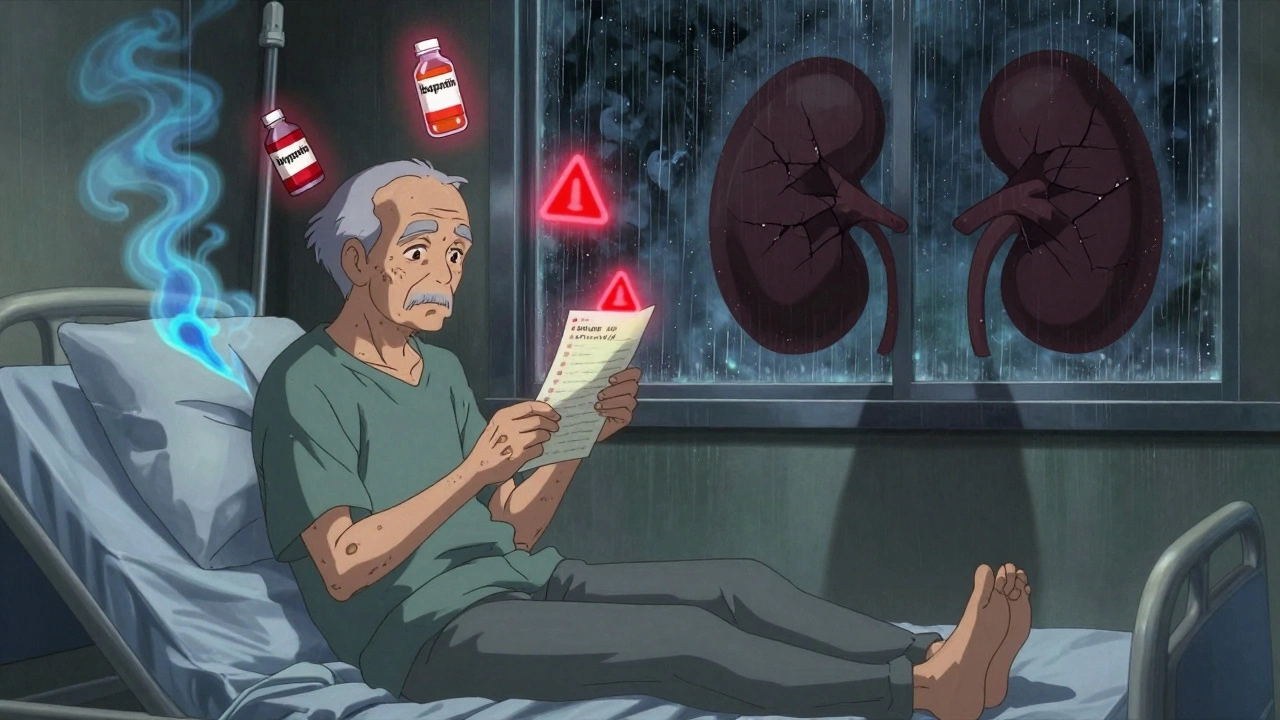
One patient I worked with-72, diabetic, eGFR 38-had a CT scan with contrast and ended up in the ICU. He’d been taking ibuprofen for arthritis. He didn’t think it mattered. He was wrong. After his hospital stay, he started carrying a list of his meds and his eGFR. He now asks every nurse: “Do I need to stop anything before this?” He’s been AKI-free for 18 months.
Monitoring and Follow-Up
After an AKI episode, your kidneys don’t bounce back the same. About 30% of AKI cases in CKD patients lead to permanent loss of function. 10-15% will need dialysis within five years. That’s why follow-up isn’t optional.Check your creatinine every 24-48 hours during hospital stays. At home, monitor eGFR and urine albumin-to-creatinine ratio (uACR) every 3-6 months. If your kidney function hasn’t returned to baseline after 7 days, you might have Acute Kidney Disease (AKD)-a new term that means your kidneys are still healing, not just recovering. That changes how you manage your care.
Some centers now use new biomarkers like TIMP-2 and IGFBP7 to predict AKI within 12 hours. These aren’t routine yet, but they’re coming. In the meantime, stick with the basics: track your numbers, know your limits, speak up.
What Doesn’t Work
There’s a lot of noise out there. N-acetylcysteine (NAC)? Some studies say it helps with contrast injury, others say it doesn’t. The evidence is mixed. Don’t rely on it. Dopamine? Don’t use it-it doesn’t help and can cause side effects. Diuretics? They don’t protect your kidneys. They just make you pee more. Fenoldopam? No benefit. Sodium bicarbonate? New data shows it’s no better than saline.And here’s the biggest myth: “I’m on dialysis, so contrast is fine.” Not true. Dialysis patients still get contrast-induced AKI. The damage happens before the dialysis starts. Hydration and avoidance still matter.
The Role of Your Care Team
This isn’t just your job. It’s your team’s job too. Nephrologists are consulted in 65-75% of serious AKI on CKD cases-and those patients have 20% lower mortality. Electronic alerts in hospital systems reduce bad prescribing by 35%, but 40% of doctors still override them. Why? Because they’re tired of false alarms. But when an alert says “NSAID contraindicated in CKD,” don’t override it. Listen.Pharmacists are your secret weapon. They see your full med list. They know which drugs are risky. They can flag interactions before you even walk into the hospital. Ask for a med review every time you get a new prescription.
Final Thoughts
Protecting your kidneys with CKD isn’t about grand gestures. It’s about consistency. Saying no to ibuprofen. Drinking water before a scan. Asking questions. Telling every provider you see that your kidneys are fragile. It’s not fear. It’s awareness.Every time you avoid a nephrotoxic drug or choose an alternative imaging test, you’re not just preventing an AKI. You’re buying time. Time to live without dialysis. Time to be with your family. Time to avoid the hospital. That’s worth every small step you take today.
Michael Robinson
December 9, 2025 AT 07:59It’s not about fear. It’s about knowing your body is already carrying a heavy load. One small push, and it breaks. That’s all.
Sabrina Thurn
December 11, 2025 AT 01:34The KDIGO guidelines are clear, but real-world practice is a mess. I’ve seen nephrologists override hydration protocols because the patient ‘didn’t seem dehydrated.’ Meanwhile, the creatinine climbs, and no one connects the dots. This isn’t just about meds-it’s about systemic neglect. Pharmacist-led reviews are the only consistent safeguard we’ve got. They catch the ibuprofen, the vancomycin, the missed fluid balance. We need more of them, not fewer.
Sarah Gray
December 12, 2025 AT 22:45Let’s be honest-most patients don’t understand eGFR, and most providers don’t bother explaining it. You say ‘avoid NSAIDs’ like it’s common knowledge, but I’ve had patients on daily Advil for 15 years because their primary care doctor never said ‘stop.’ It’s not ignorance-it’s institutional failure. If this were a drug warning on a bottle, it’d be a class-action lawsuit. But it’s just… a footnote in a chart.
And yes, I’ve seen the ‘I’m on dialysis so contrast is fine’ myth too. That’s like saying ‘my car has no engine, so I can drive it into a wall.’ The damage happens before the dialysis machine even turns on.
Angela R. Cartes
December 13, 2025 AT 17:51Acetaminophen is safer? Sure, if you’re not a liver patient. But nobody talks about that. You’re just swapping one organ for another. This whole ‘avoid this, avoid that’ advice is just fearmongering dressed up as medicine. What about the 30% of CKD patients who die from heart failure because they were too scared to take a painkiller? You’re not protecting kidneys-you’re creating a culture of paralysis.
Andrea Beilstein
December 15, 2025 AT 04:51There’s a deeper truth here. We treat kidneys like a backup system, not the core organ they are. We don’t say ‘avoid alcohol if you have a failing heart.’ We don’t say ‘don’t run a marathon if you have COPD.’ But we let people take ibuprofen like it’s candy because ‘it’s just a kidney.’ It’s not. It’s the filter. It’s the regulator. It’s the silent partner in every system. And we treat it like an afterthought.
Maybe the problem isn’t the meds. Maybe it’s the way we see the body.
Lisa Whitesel
December 15, 2025 AT 21:19Stop pretending hydration is a cure. It’s a Band-Aid. The real problem is that we keep giving nephrotoxic drugs to people who shouldn’t get them. No amount of saline fixes bad prescribing. Stop glorifying water and fix the system.
Anna Roh
December 16, 2025 AT 00:14My mom had CKD. She took ibuprofen for 10 years. No one ever told her to stop. She didn’t even know what eGFR meant. Then she got a CT with contrast and ended up in the hospital. They said it was ‘unavoidable.’ It wasn’t. It was negligence. I’m not mad at the doctors. I’m mad at the system that lets this keep happening.
Larry Lieberman
December 16, 2025 AT 03:41Just read this and cried a little. 😭 I’ve been on dialysis for 3 years. I stopped NSAIDs the day I got my diagnosis. Still took a CT with contrast last year because the radiologist said ‘it’s fine.’ Turned out it wasn’t. My creatinine spiked. They said ‘it’s normal for you.’ It wasn’t. It was a warning. I’m now carrying a laminated card that says ‘CKD Stage 4. NO CONTRAST. NO NSAIDS. HYDRATE.’ If you have CKD? Do this. Please.
Tejas Bubane
December 16, 2025 AT 07:23Everyone talks about contrast and NSAIDs like they’re the only villains. What about antibiotics? What about herbal supplements? What about the guy who takes turmeric pills because ‘it’s natural’ and then gets AKI? Nobody warns about that. This is selective outrage. Pick one thing and stick to it or stop pretending you know everything.
Ajit Kumar Singh
December 16, 2025 AT 18:31India we have so many people with CKD and no access to nephrologists. We have clinics where they give ibuprofen like candy. No one checks creatinine. No one asks about meds. We need education not just for patients but for the village pharmacists. My uncle took painkillers for back pain for 5 years. Now he’s on dialysis. This is not a US problem. This is a global failure.
om guru
December 18, 2025 AT 16:28Respectfully, the most critical intervention is not avoiding contrast or NSAIDs. It is consistent monitoring. A simple monthly creatinine test, a urine dipstick, and a conversation with a primary care physician can prevent 80% of these events. The tools are available. The will is not. We must institutionalize vigilance, not rely on patient advocacy alone.
iswarya bala
December 19, 2025 AT 04:49i had no idea about this till i read this. my dad has ckd and he takes tylenol now. i told him to carry a card too. he laughed but then he made one. he’s okay now. thank you for sharing.
Simran Chettiar
December 20, 2025 AT 18:53It is imperative to recognize that the medical paradigm, as it currently stands, is fundamentally flawed in its approach to chronic disease management, particularly in the context of renal physiology, wherein the reductionist model of symptom suppression through pharmacological intervention disregards the systemic interconnectivity of homeostatic mechanisms, and thus perpetuates a cycle of iatrogenic harm that is both predictable and preventable, yet systematically ignored due to institutional inertia, economic incentives, and the epistemological limitations of evidence-based medicine as it is currently operationalized within primary care frameworks.
Kathy Haverly
December 21, 2025 AT 10:05So let me get this straight. You want us to stop all painkillers, drink saline like it’s water, and beg doctors not to use contrast? And then you pat yourself on the back like you’re some kind of kidney guardian? What about the people who need that CT scan to find the cancer? What about the ones who can’t afford to miss work for hydration protocols? This isn’t medicine. It’s guilt-tripping with a side of medical jargon.
Sarah Gray
December 21, 2025 AT 17:59You’re right. This isn’t perfect. But the alternative is letting people die because we were too lazy to say ‘stop taking Advil.’ I’ve seen it. I’ve written the notes. I’ve watched the creatinine rise. You don’t get to call this guilt-tripping when it’s literally saving lives. If you think hydration and avoiding NSAIDs is too much, then you’re the problem.